Artwork
Facsimilie signatures
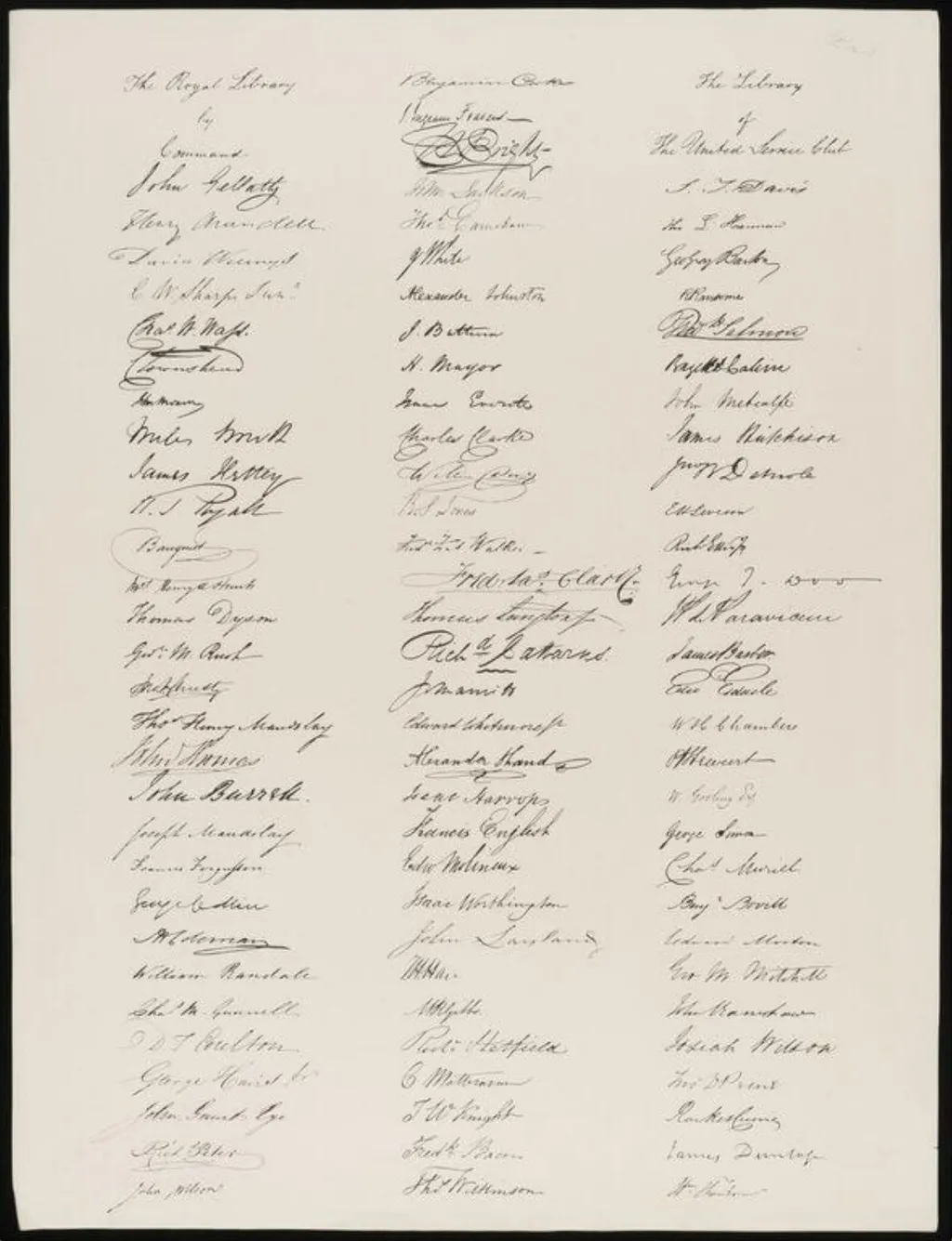
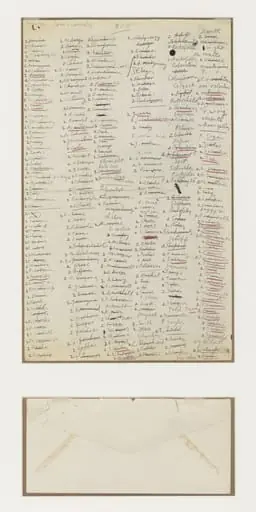
Facsimilie signatures is a print by Unknown. It dates from 1850 and is held in the collection of the Victoria and Albert Museum. This 1850 print presents a compilation of handwritten signatures arranged in three vertical columns.
About this work
Overview
Rendered in black and white, the page features a variety of penmanship styles—some legible and forceful, others faint or hurried.
This 1850 print presents a compilation of handwritten signatures arranged in three vertical columns. Rendered in black and white, the page features a variety of penmanship styles—some legible and forceful, others faint or hurried. The layout is utilitarian, lacking decorative elements, suggesting a documentary rather than artistic intent. The paper shows signs of age but no significant damage, indicating careful handling over time.
Subject & Meaning
The signatures appear to represent individuals associated with specific institutions, as indicated by headings such as 'The Royal Library' and 'The United Service Club.' Rather than serving as a personal memento, the print likely functioned as a formal record of membership, endorsement, or participation. The diversity of handwriting implies a broad cross-section of contributors, possibly gathered for a collective purpose or institutional initiative.
Technique & Style
The print reproduces original signatures through a mechanical process, preserving their individual quirks—varying pressure, slant, and ink density. The absence of uniformity in size and clarity reflects the fidelity of the reproduction to the source material. No attempt has been made to standardize the handwritings, emphasizing authenticity over aesthetic harmony. The composition is dense, maximizing space without regard for visual balance.
History & Provenance
The print is held in the collection of the Victoria and Albert Museum, where it is cataloged as a historical artifact rather than a work of fine art. Its origin is tied to institutional practices of the mid-nineteenth century, when collecting and preserving autographs was common among organizations seeking to document their membership or public support. Its survival suggests it was retained for its evidentiary value.
Context
In the 1850s, autograph collection was a widespread cultural practice, particularly among civic and professional groups. Institutions often compiled signatures to affirm legitimacy, commemorate events, or build archives of notable associates. This print reflects that trend, capturing a moment when personal handwriting carried social weight and served as a tangible link between individuals and collective identity.
Legacy
Today, the print survives as a quiet testament to the social rituals of its time. It offers no grand narrative but provides insight into how institutions documented participation before digital records. Its value lies in its unembellished record of names and hands, preserving the ordinary acts of signing that once held institutional significance.
Artist & collection

 Domestic Scene
 Giacomo and Cardinal Marco, investing Andrea, Abbot of San Zeno, with his Benefice
 The Nymph of Fontainebleau
 Portrait of a Woman
 Madonna and Child with Saints in the Enclosed Garden
 Venus and Minerva
 Family Group of Four on Sofa
 Wall painting from Room H of the Villa of P. Fannius Synistor at Boscoreale