Artwork
Garuda and Saubhari
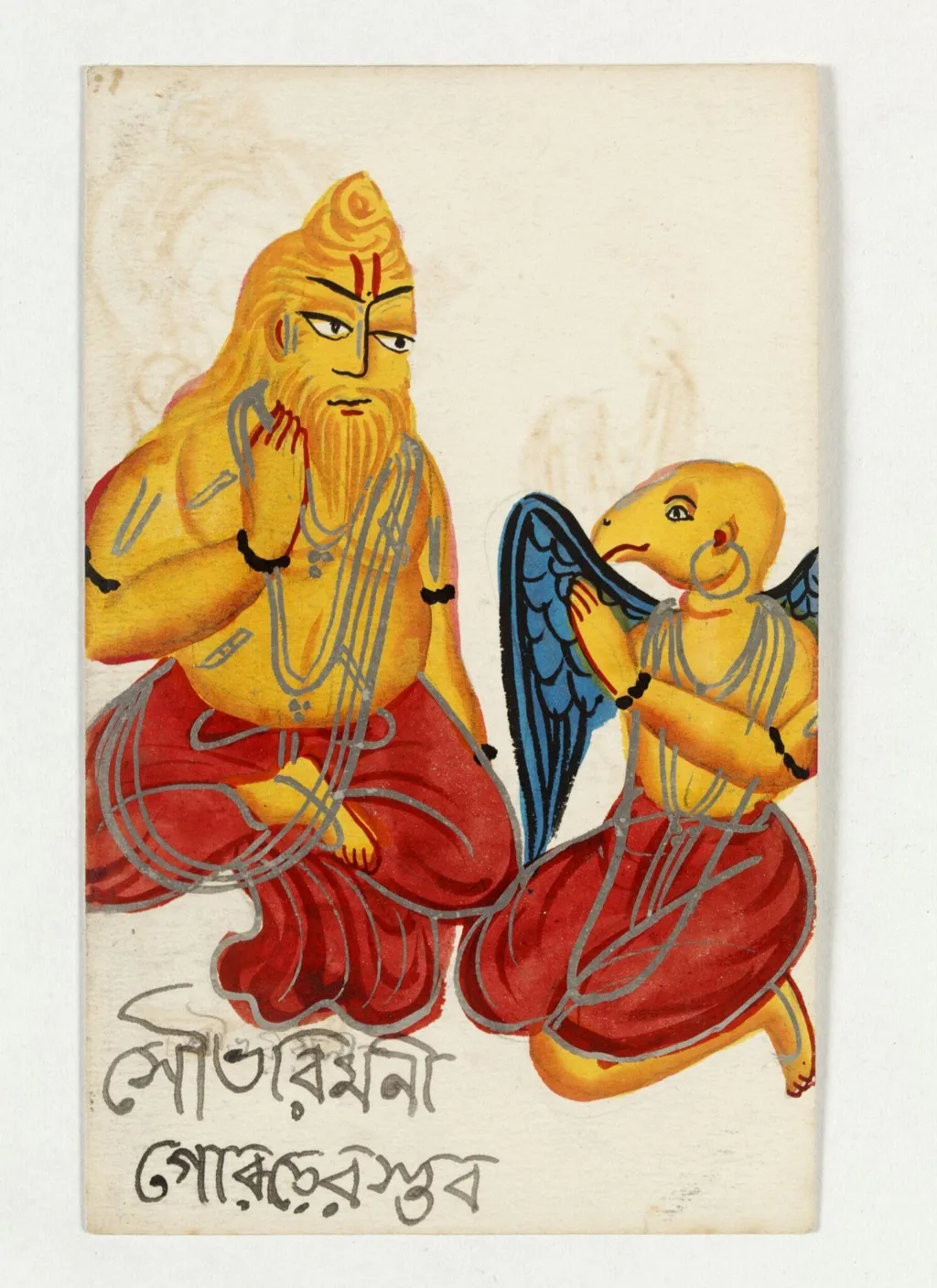
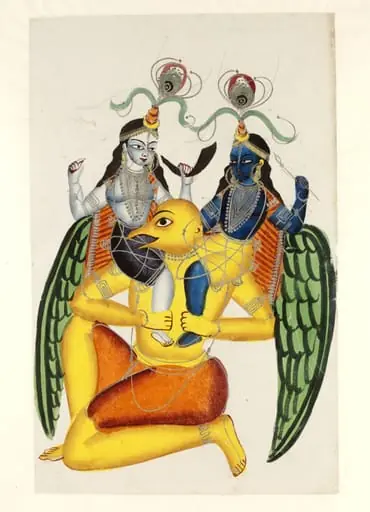
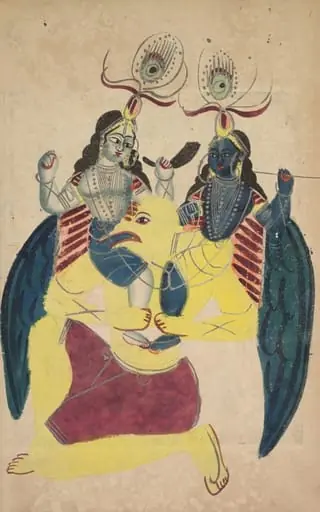
Garuda and Saubhari is a paint painting by the Impressionist artist Unknown. It dates from 1890 and is held in the collection of the Victoria and Albert Museum.
About this work
Overview
Originating in Calcutta, it belongs to the Kalighat tradition, a genre of popular religious art developed by Bengali artists in the 19th century.
This watercolour and tin-alloy painting on paper, dated around 1890, portrays the mythological encounter between Garuda and the sage Saubhari. Originating in Calcutta, it belongs to the Kalighat tradition, a genre of popular religious art developed by Bengali artists in the 19th century. The work combines devotional subject matter with a distinctive visual language marked by flat planes of colour and strong outlines, reflecting its origins in a commercial artistic milieu.
Subject & Meaning
The scene illustrates a moment from the Ramayana in which Garuda, the divine bird-man and vehicle of Vishnu, pays homage to the sage Saubhari. Saubhari, depicted with a beard and beads, represents ascetic wisdom, while Garuda, shown with wings and a flute, embodies devotion and service. Their interaction underscores themes of spiritual hierarchy and reverence, common in Hindu narrative art, where divine beings acknowledge the sanctity of human sages.
Technique & Style
Executed in watercolour with tin-alloy accents, the painting employs bold black outlines and unmodulated hues, typical of Kalighat aesthetics. Forms are simplified, with no attempt at shading or perspective. The figures are rendered in flat, bright yellow, contrasting with the red waistcloth and beads. The brushwork is swift and confident, suggesting production for mass consumption, likely as devotional souvenirs sold near the Kalighat temple in Calcutta.
History & Provenance
Created around 1890, the painting emerges from a period when Kalighat artists adapted traditional iconography to meet the demands of urban patrons and colonial-era visitors. These works were often produced in workshops near the Kalighat temple, blending religious themes with contemporary social commentary. While specific ownership history is unrecorded, its style aligns with other known Kalighat pieces from the late 19th century collected by British and Indian buyers.
Context
Kalighat paintings arose in response to shifting cultural dynamics in 19th-century Bengal. As British colonial rule reshaped urban life, artists translated mythological narratives into accessible, affordable formats. These works served both devotional and satirical functions, addressing religious devotion while subtly reflecting societal changes. The depiction of Garuda and Saubhari fits within this dual role, affirming tradition even as its medium evolved for new audiences.
Legacy
The Kalighat style influenced later Indian modernist movements and remains a touchstone for studies of vernacular art under colonialism. Though production declined by the early 20th century, surviving works like this one preserve a unique fusion of religious storytelling and commercial artistry. Today, they are valued not only for their aesthetic qualities but also as cultural documents of a society negotiating identity, faith, and change.
Artist & collection

 Domestic Scene
 Giacomo and Cardinal Marco, investing Andrea, Abbot of San Zeno, with his Benefice
 The Nymph of Fontainebleau
 Portrait of a Woman
 Madonna and Child with Saints in the Enclosed Garden
 Venus and Minerva
 Family Group of Four on Sofa
 Wall painting from Room H of the Villa of P. Fannius Synistor at Boscoreale