Artwork
Grenze Zwischen Bild und Blatt [Border Between Picture and Sheet]
![Grenze Zwischen Bild und Blatt [Border Between Picture and Sheet], by Unknown, 1972](https://artifactworldgallery.com/img/unknown--grenze-zwischen-bild-und-blatt-border-between-picture-and-sh--0e5eeee4f2b98458-w1024.webp)
Grenze Zwischen Bild und Blatt [Border Between Picture and Sheet] is a drawing by Unknown. It dates from 1972 and is held in the collection of the Victoria and Albert Museum.
About this work
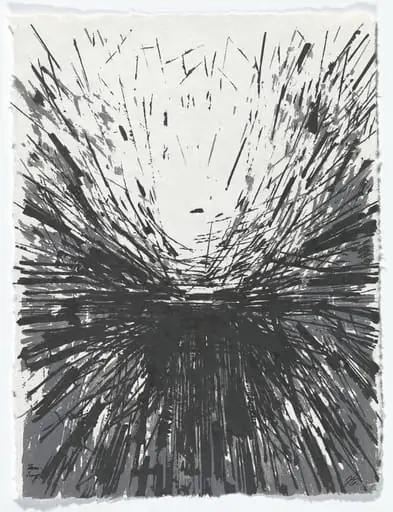
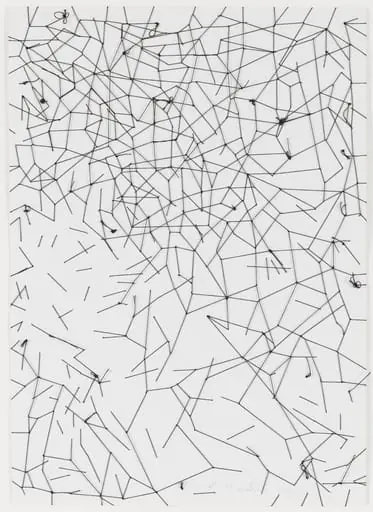
This drawing looks like a tangle of straight black lines on white paper. It’s not messy—each line follows strict rules from a computer.
Plotters were new in 1972. This artist wrote code that drew the lines instead of using a brush. The result is precise but still feels alive.
Next time you see a plotter, look at the Victoria and Albert Museum for this one.
Overview
Grenze Zwischen Bild und Blatt (Border Between Picture and Sheet) is a plotter drawing created by an unknown artist in 1972, utilizing a computer and mechanical pen plotter to generate its composition.
Subject & Meaning
The artwork features a complex arrangement of straight black lines on a white background, adhering to strict computational rules yet conveying a sense of dynamism. The title suggests an exploration of the boundary between the visual image (Bild) and the physical medium (Blatt).
Technique & Style
Executed using a pen plotter driven by a custom computer program, the drawing showcases the early integration of digital technology in art. The precise, rule-based lines reflect the algorithmic process, resulting in a piece that is both mechanically exact and visually engaging.
History & Provenance
Created in 1972, when plotter technology was novel, the work is now part of the Victoria and Albert Museum's collection. The artist's identity remains unknown.
Context
Produced at the dawn of computer-assisted art, Grenze Zwischen Bild und Blatt represents an early experiment in leveraging technology to explore geometric abstraction and the interplay between digital instruction and physical output.
Legacy
As an early example of computer-generated art, it influences subsequent generations of digital and algorithmic artists, demonstrating the potential for mechanical precision to create visually compelling works.
Artist & collection

 Domestic Scene
 Giacomo and Cardinal Marco, investing Andrea, Abbot of San Zeno, with his Benefice
 The Nymph of Fontainebleau
 Portrait of a Woman
 Madonna and Child with Saints in the Enclosed Garden
 Venus and Minerva
 Family Group of Four on Sofa
 Wall painting from Room H of the Villa of P. Fannius Synistor at Boscoreale