Artwork
H Beard Print Collection
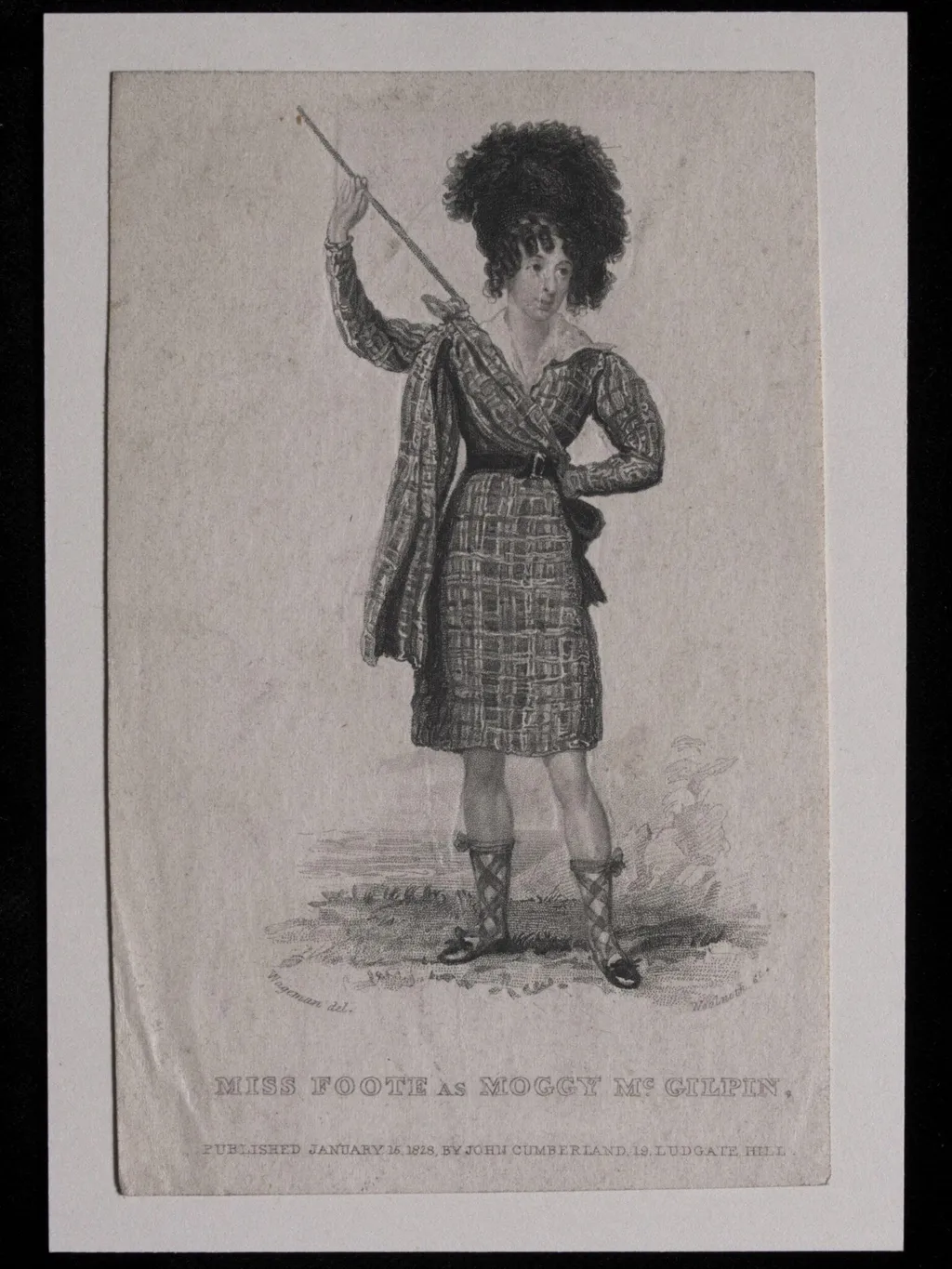
H Beard Print Collection is a print by the Romanticist artist Unknown. It dates from 16 and is held in the collection of the Victoria and Albert Museum.
About this work
This print shows a woman in a frilly dress standing with one hand on her hip.
This print shows a woman in a frilly dress standing with one hand on her hip. She’s dressed as Moggy McGilpin, a funny stage character from old plays. The print was sold in London in 1828 by John Cumberland.
It’s a rare look at how regular people dressed up for theater back then. Miss Foote wasn’t famous—just someone posing in costume. The face is simple, but the clothes tell the story.
Want to see more stage costumes from this era? Try the Victoria and Albert Museum.
Overview
This print, part of the Harry Beard Collection, portrays an unidentified woman dressed as Moggy McGilpin, a comic stage figure from early 19th-century British theater. Published in London on January 16, 1828, by John Cumberland, it captures a moment of popular theatrical costume culture rather than a celebrated performer. The image reflects the accessibility of stage personas to amateur performers and the public’s fascination with character roles outside formal productions.
Subject & Meaning
The figure represents Moggy McGilpin, a stock comedic character known for exaggerated manners and working-class attire in 18th- and early 19th-century farces. The woman’s pose—hand on hip, dress full and frilled—emulates the character’s theatricality, not her personal identity. Her anonymity underscores how such costumes were often worn by non-professionals for entertainment, blurring lines between performance and everyday mimicry in Georgian Britain.
Technique & Style
The print is a hand-colored engraving, typical of popular theatrical ephemera of the period. Lines are crisp but simplified, emphasizing costume details over facial expression. The dress’s ruffles and lace are rendered with careful texture, while the face remains deliberately unindividualized, suggesting the costume itself was the focus. This stylistic choice aligns with commercial prints designed to highlight attire rather than likeness.
History & Provenance
Produced by John Cumberland, a known publisher of theatrical prints in Regency London, the work entered the Harry Beard Collection, a significant archive of British stage memorabilia. Its survival is uncommon, as such prints were often discarded after brief use. The print’s date and publisher confirm its origin in a thriving market for affordable, image-based theater souvenirs aimed at middle-class audiences.
Context
In the 1820s, theatrical characters like Moggy McGilpin were widely recognized through broadsheets, pantomimes, and street performances. Public interest in costume extended beyond the stage, with amateurs dressing up for private gatherings and public events. This print captures that cultural moment, when theatrical identity was a shared, participatory phenomenon rather than the domain of professional actors alone.
Legacy
The print survives as a rare artifact of non-professional engagement with theater costume. It offers insight into how ordinary people interacted with popular culture before photography. Today, it contributes to scholarly understanding of early Victorian visual culture and is referenced in studies of costume history, particularly within institutions like the Victoria and Albert Museum.
Artist & collection

 Domestic Scene
 Giacomo and Cardinal Marco, investing Andrea, Abbot of San Zeno, with his Benefice
 The Nymph of Fontainebleau
 Portrait of a Woman
 Madonna and Child with Saints in the Enclosed Garden
 Venus and Minerva
 Family Group of Four on Sofa
 Wall painting from Room H of the Villa of P. Fannius Synistor at Boscoreale