Artwork
H Beard Print Collection
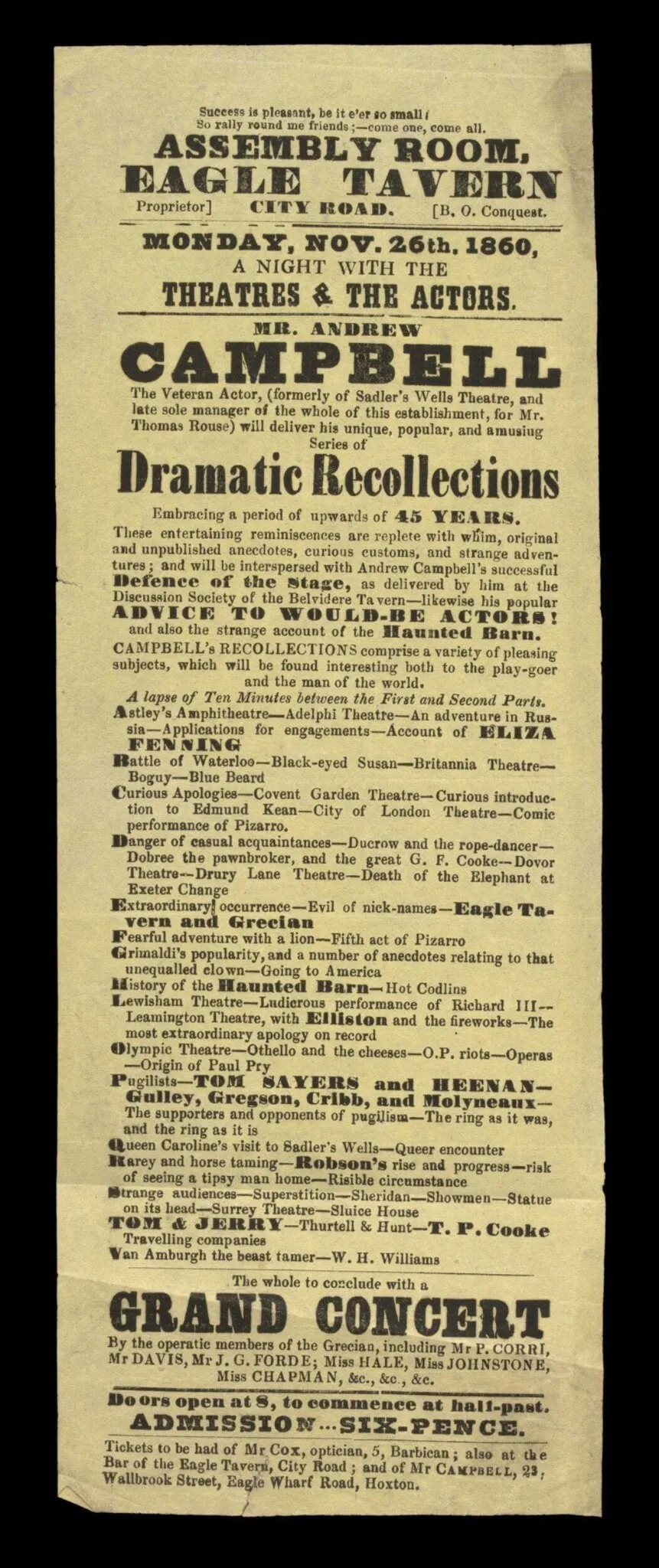
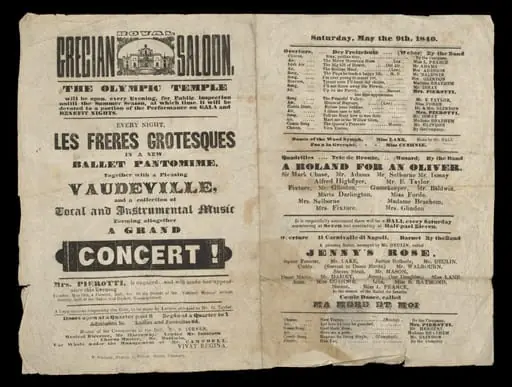
H Beard Print Collection is a print by the Impressionist artist Unknown. It dates from 26 and is held in the collection of the Victoria and Albert Museum. This printed programme dates from 1860 and advertised a series of performances at the Eagle Tavern’s Assembly Room on City Road, London.
About this work
This print shows a program for performances at a London tavern in 1860.
This print shows a program for performances at a London tavern in 1860. Two actors, Mr. Andrew Campbell and friends, put on "Dramatic Recollections." The sheet lists songs and jokes in tiny, neat print.
It’s a piece of everyday life turned into a keepsake. People back then saved these for memories. Cheap prints like this were like today’s flyers or ticket stubs.
See one next at the Victoria and Albert Museum.
Overview
This printed programme dates from 1860 and advertised a series of performances at the Eagle Tavern’s Assembly Room on City Road, London. It promoted Mr. Andrew Campbell’s 'Dramatic Recollections,' a popular act blending spoken monologues, songs, and comic sketches. Designed as a disposable handout, it was likely distributed to audience members and preserved as a personal memento of the evening’s entertainment.
Subject & Meaning
The programme documents a form of working-class leisure in mid-Victorian London, where taverns hosted intimate theatrical performances. Campbell’s 'Dramatic Recollections' combined nostalgia, humor, and musical interludes, appealing to audiences seeking accessible, emotionally resonant entertainment. The printed list of acts reflects the structure of variety performance, offering a snapshot of popular taste and the cultural role of public houses beyond drinking.
Technique & Style
The print is produced in a simple, dense typographic style typical of cheap ephemera of the period. Text is arranged in tight columns with minimal decoration, prioritizing legibility over ornament. No illustrations are present, and the layout suggests mass production via letterpress. The small, uniform typeface indicates a low-cost printing method, consistent with its function as a utilitarian, short-lived promotional item.
History & Provenance
The programme originates from the Eagle Tavern, a known venue for informal theatricals in the City Road district. Its survival suggests it was kept by an attendee as a keepsake, a common practice among middle- and working-class audiences. It is now part of the H. Beard Print Collection, which preserves such ephemera as records of everyday cultural life, later acquired by the Victoria and Albert Museum for its historical value.
Context
In 1860, London’s taverns functioned as informal theatres, offering affordable entertainment to those excluded from elite venues. Campbell’s performances were part of a broader trend of 'recitation' acts that blended storytelling with song, popularized by traveling performers. Printed programmes like this were ubiquitous but rarely archived, making surviving examples rare windows into the social rhythms of urban life during the Industrial Revolution.
Legacy
Though intended as transient material, this programme endures as evidence of a vibrant, overlooked strand of Victorian popular culture. Its preservation in institutional collections highlights how everyday objects can illuminate social history. It contributes to broader understandings of how ordinary people engaged with performance, memory, and public space in an era before recorded media.
Artist & collection

 Domestic Scene
 Giacomo and Cardinal Marco, investing Andrea, Abbot of San Zeno, with his Benefice
 The Nymph of Fontainebleau
 Portrait of a Woman
 Madonna and Child with Saints in the Enclosed Garden
 Venus and Minerva
 Family Group of Four on Sofa
 Wall painting from Room H of the Villa of P. Fannius Synistor at Boscoreale