Artwork
Hamlet
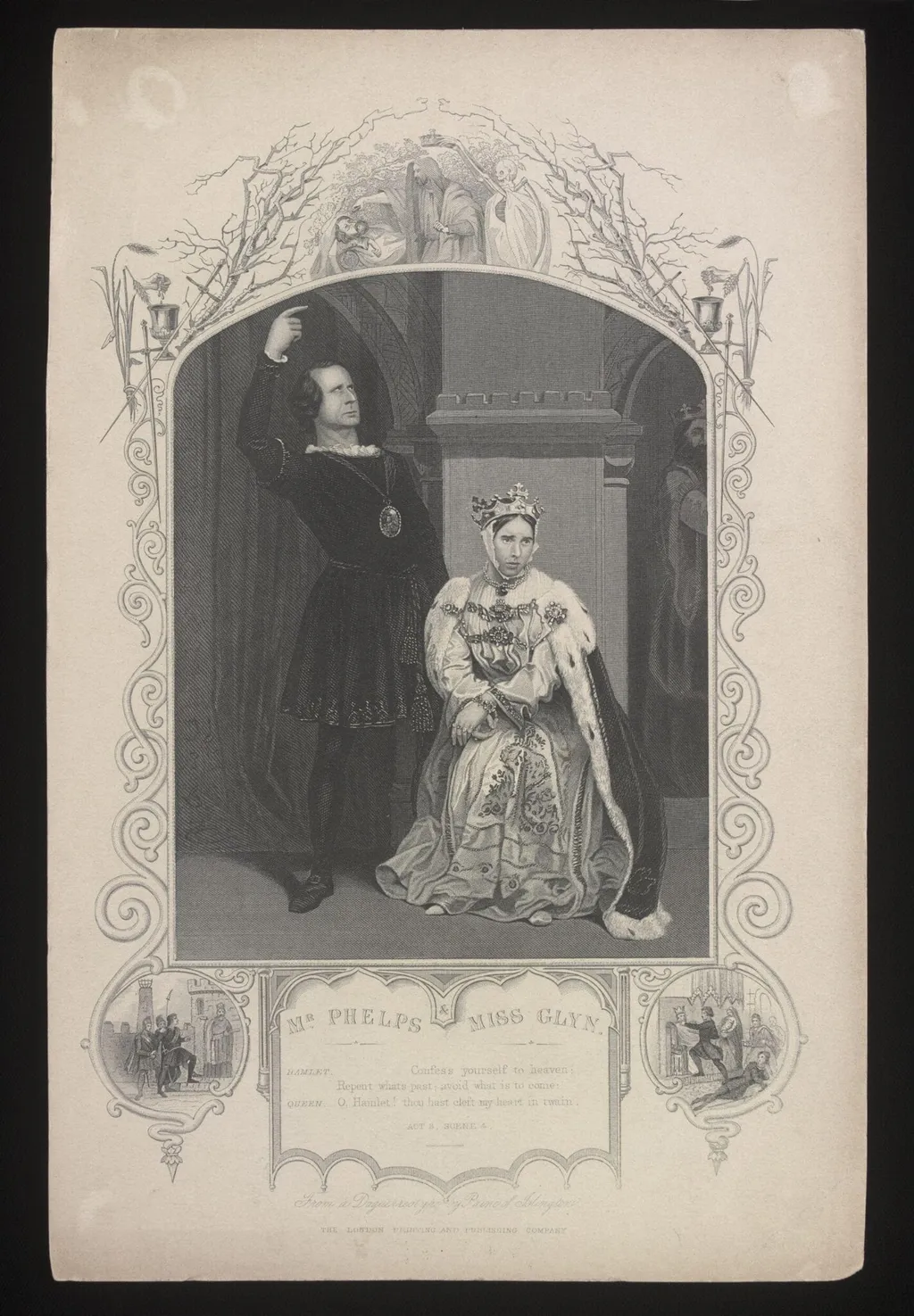
Hamlet is a print by the Impressionist artist Unknown. It dates from 1850 and is held in the collection of the Victoria and Albert Museum.
About this work
Overview
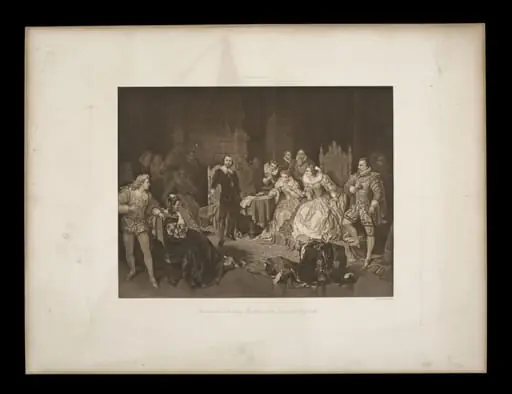
This 1850 engraving depicts a moment from Act 3, Scene 4 of Shakespeare’s Hamlet, produced in London as part of the Harry Beard Collection.
This 1850 engraving depicts a moment from Act 3, Scene 4 of Shakespeare’s Hamlet, produced in London as part of the Harry Beard Collection. It reproduces a composition originally painted by James Northcote, a British artist known for his literary subjects. The print captures Hamlet’s confrontation with his mother, Gertrude, in her private chamber, rendered in fine linear detail typical of mid-nineteenth-century reproductive engraving.
Subject & Meaning
The scene portrays Hamlet confronting Gertrude over her hasty marriage to Claudius, while the ghost of his father appears behind a tapestry. Though the specter is rendered as an indistinct, shadowy form without facial features, Hamlet’s gesture and posture convey visceral recognition. Gertrude, seated and passive, remains unaware of the apparition, heightening the psychological tension between visible reality and inner torment.
Technique & Style
Executed as a line engraving, the work employs precise, controlled strokes to define figures and drapery, characteristic of reproductive prints of the period. The ghost is suggested through minimal, ghostly contours, contrasting with the sharper delineation of Hamlet and Gertrude. The composition follows Northcote’s painted original, prioritizing narrative clarity over atmospheric depth, typical of illustrated Shakespearean scenes intended for domestic audiences.
History & Provenance
The print derives from a painting by James Northcote, completed in the early 1800s and later reproduced for wider circulation. It entered the Harry Beard Collection, a significant assemblage of Shakespearean visual materials assembled in the Victorian era. Such prints were commonly distributed as affordable art, reflecting the era’s fascination with literary illustration and the democratization of cultural imagery.
Context
In mid-nineteenth-century Britain, Shakespearean scenes were popular subjects in visual art, often used to reinforce moral and emotional narratives in an increasingly literate public. Engravings like this one bridged elite painting and popular culture, appearing in books, albums, and private collections. Northcote’s interpretations were widely circulated, contributing to standardized visual representations of Shakespeare’s characters during a time of national literary canonization.
Legacy
The print survives as part of a broader tradition of Shakespearean illustration, preserved today in institutions such as the Victoria and Albert Museum. While Northcote’s original paintings are less widely known, his compositional choices influenced how generations visualized key moments from the plays. This engraving exemplifies the role of reproductive prints in shaping public perception of literary drama in the pre-photographic age.
Artist & collection

 Domestic Scene
 Giacomo and Cardinal Marco, investing Andrea, Abbot of San Zeno, with his Benefice
 The Nymph of Fontainebleau
 Portrait of a Woman
 Madonna and Child with Saints in the Enclosed Garden
 Venus and Minerva
 Family Group of Four on Sofa
 Wall painting from Room H of the Villa of P. Fannius Synistor at Boscoreale