Artwork
Manuscript of the Perfection of Wisdom in Eight Thousand Lines (Ashtasahasrika Prajnaparamita-sutra)
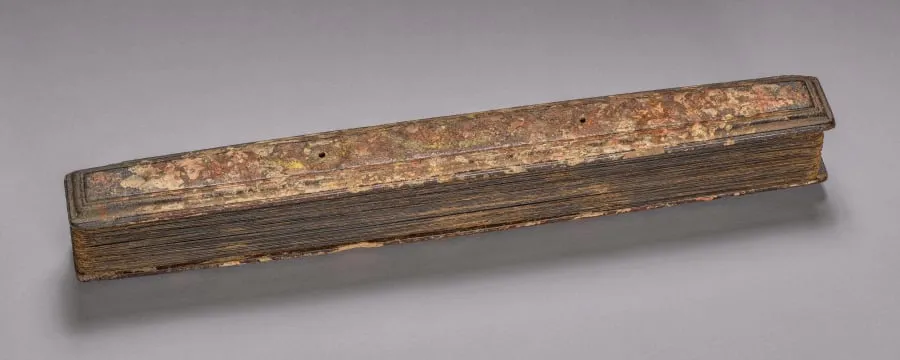
Manuscript of the Perfection of Wisdom in Eight Thousand Lines (Ashtasahasrika Prajnaparamita-sutra) is an unspecified painting by Unknown. It dates from 14 and is held in the collection of the Cleveland Museum of Art.
About this work
Overview
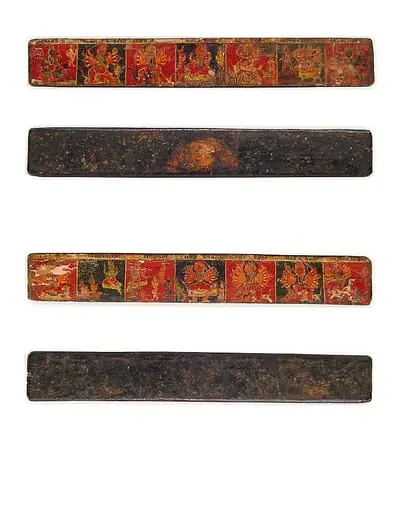
The manuscript, a long, narrow scroll, contains carefully rendered Sanskrit verses of the Ashtasahasrika Prajnaparamita‑sutra, interspersed with vivid miniature paintings of Buddhist deities rendered in red, blue and gold. It functioned as a devotional object, traditionally displayed alongside sacred images and still bearing ritual residues on its cover.
Subject & Meaning
The text presents the Mahayana doctrine of the perfection of wisdom, while the accompanying iconography depicts bodhisattvas and goddesses that embody the sutra’s philosophical ideals. The visual program reinforces the sutra’s teachings by providing a symbolic, devotional counterpart to the written word.
Technique & Style
Sanskrit calligraphy is executed in uniform, orderly rows, reflecting the disciplined script of Indian monastic scribes. The miniature paintings, added later in Nepal, employ bright mineral pigments and gold leaf, characteristic of Kathmandu’s thangka tradition, merging Indian textual precision with Nepali ornamental flair.
History & Provenance
A Nepali monk named Aryashrimittra journeyed to an Indian monastic university, where he commissioned the initial copying of the sutra. Upon returning to Nepal, local artists completed the decorative program. The manuscript’s colophon records this itinerary, evidencing the cross‑border movement of monks and texts that transmitted Buddhism into the Himalayan region.
Context
During the medieval period, itinerant monks served as primary conduits for Buddhist doctrine between the Indian subcontinent and the Himalayas. This manuscript exemplifies that exchange, embodying both Indian scholarly practice and Nepali artistic sensibility, and was venerated as a sacred object within monastic and lay settings.
Artist & collection

 Domestic Scene
 Giacomo and Cardinal Marco, investing Andrea, Abbot of San Zeno, with his Benefice
 The Nymph of Fontainebleau
 Portrait of a Woman
 Madonna and Child with Saints in the Enclosed Garden
 Venus and Minerva
 Family Group of Four on Sofa
 Wall painting from Room H of the Villa of P. Fannius Synistor at Boscoreale
 Rafter with geometrical, plant, animal and heraldic motifs
 Bottom cover, from a Manuscript of the Perfection of Wisdom in Eight Thousand Lines (Ashtasahasrika Prajnaparamita-sutra)
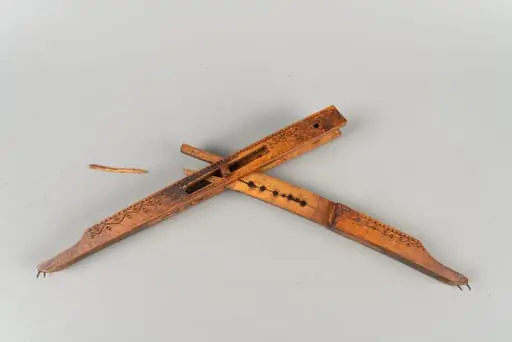 Obiect compozit din lemn de formă alungită, format din două stinghii articulate printr-o încastrare alungită paralelă care îi permite frângerea prin intermediul unui cui/pene din lemn, în vederea formării unei pârghii cu ajutorul căreia se răsucește țesătura pe sulul dinainte al războiului de țesut, pentru menținerea tensionată a acesteia. Obiectul prezintă la ambele capete câte două gheare metalice care facilitează fixarea pârghiei pe sulul de lemn al războiului de țesut. Are suprafața decorată cu motive geometrice: linii în formă de zigzag, șiruri de triunghiuri mici, și cu două motive sub formă de rozetă, realizate prin incizare, încrestare și colorare cu pigment negru. Pe fețele laterale piesa poartă incizat anul confecționăii acesteia, "1877", și inscripțiile: "BC MC" și "…..". Cromatica: culoarea naturală a lemnului, negru.
 Untitled
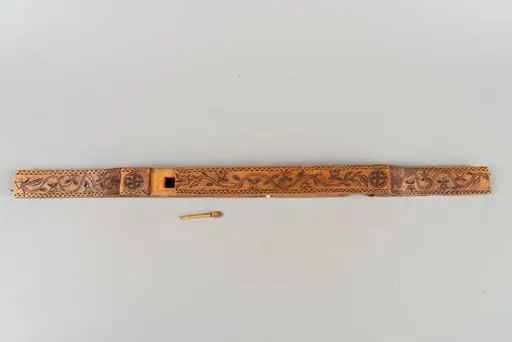 Obiect compozit din lemn de formă alungită, format din două stinghii articulate printr-o încastrare alungită paralelă care îi permite frângerea prin intermediul unui cui/pene din lemn, în vederea formării unei pârghii cu ajutorul căreia se răsucește țesătura pe sulul dinainte al războiului de țesut, pentru menținerea tensionată a acesteia. Obiectul prezintă la ambele capete câte două gheare metalice care facilitează fixarea pârghiei pe sulul de lemn al războiului de țesut. Suprafața piesei este decorată cu motive geometrice mărunte, formând șiruri de linii în zigzag realizate prin încrestare și cu motive vegetale și florale realizate prin incizare și colorare cu culoare neagră formată din cenușă amestecată cu grăsime (untură). Pe una dintre fețele laterale se găsește marcat prin incizare anul confecționării piesei, 1885. Cromatica: culoarea naturală a lemnului, negru.
 Sfânta Mare Cuvioasă Parascheva de la Iași are crucea albă-orange în mâna stângă, binecuvântând, și o ramură de finic verde, nuanța verde smarald în mâna dreaptă. Este îmbrăcată în veșmânt roșu vermillon-orange cu interiorul căptușit cu verde-smarald, cu marginea-bordură galbenă și franjuri verzi. Sacosul este alb-crem cu danteluță, guleraș și dungi albastre-orange. Sfânta Cuvioasă are părul negru lung, lăsat pe umeri, coroană roșie cu verde-brad și aureolă brun-bronzie. Fondul icoanei este cerul albastru bleu-ciel în registrul superior-mijloc și un câmp galben-chihlimbar, ancadrator întregii compoziții. Întreaga compoziție iconografică este încadrată de un chenar decorativ fitomorf, format dintr-o ghirlandă de 9 ruje mari orange-cărămizii cu frunze verzi. Inscripția din româno-chirilică se traduce Paraschiva. Cromatica este armonioasă: roșu vermillon-orange, albastru cobalt-ceruleum, verde smarald, mușchi de pădure, bej-crem, bronziu, galben-chihlimbar, negru, ocru, alb zinc. Icoana este din Nordul Transilvaniei, Nicula.
 Icoana este segmentată în patru ferestre, icoană cruce, reprezentându-i pe Sfântul Mare Mucenic Gheorghe purtător de biruință, de două ori, pe diagonală, pe Sfântul Mare Ierarh Nicolae făcător de minuni și vindecător de boli, pe Sfânta Mare Cuvioasă Parascheva, de la Iași. Au veșminte roșii vermillon, epitrahilul Sfântului Nicolae este verde smarald, fondul Sfintei Parascheva este orange, fondul Sfântului Gheorghe din dreapta registrul inferior este verde. Întreaga tematică iconografică este încadrată de un chenar decorativ geometrizant, dantelat, din foiță aurie. Registrul superior are fondul albastru ultramarin, iar registrul inferior fondul este rozaliu pal. Interiorul crucii este un rotund verde-absint. Icoana excelează prin combinațiile cromatice luminoase și foarte vii. Inedită este și prezența dublă, în ipostasuri diferite, pe diagonală, a Sfântului Mare Mucenic Gheorghe. Icoana este de Țara Oltului. Are rama colorată în cafeniu și roșu, în interior. Inscripția din româno-chirilică se traduce SF Gheorghe Sf Nicolae Sf Parascheva Sf Gheorghe.
 Text, Folio 60 (recto), from a Manuscript of the Perfection of Wisdom in Eight Thousand Lines (Ashtasahasrika Prajnaparamita-sutra)
 Este o icoană de iconostas din Biserica din Cărpiniș, Roșia Montană, județul Alba. Maica Domnului este Eleusa - Înduioșătoare, tandră și iubitoare, ținând în brațe Pruncul Iisus Hristos care are în mâna stângă o carte închisă și un hrisov înfășurat și Binecuvântează cu mâna dreaptă, arătând înspre Maica Domnului, arâtâdu-ne-O. Maica Domnului arată calea cu mâna dreaptă, deci este Hodighitria și Eleusa, lipindu-și capul de capul Pruncului Mântuitor, aureolele întâlnindu-se tainic. Maica Domnului este înveșmântată în mantie cu maforion roșu vermillon-stacojiu cu drapaje acajou și interiorul căptușit cu ocru-bej și sacos crem-auriu. Pruncul Iisus Hristos este înveșmântat în crem-luminos; veșmânt bogat ornamentat cu elemente punctiflorale acajou și cute orange-portocalii. Fondul icoanei este orange-luminos, decorat cu câteva elemente astrale - steluțe albe. Icoana are un chenar decorativ lat brun-acajou. Inscripția din româno-chirilică se traduce MP IC XC Maica Domnului Iisus Hristos. Pomenește Doamne pe ctitorii Stan Bucur și Pamfil Bucur, mai la anu 1718, Cărpiniș, Ivan zugrav. Cromatica este armonioasă, senină, vie: roșu vermillon-stacojiu, orange luminos, brun, bej, bronziu, stacojiu, brun-acajou, alb, negru. Icoana este deosebită, fiind valoroasă atât prin desenul rafinat, cât și prin cromatica exemplară. Icoana este pictată de Popa Ivan Zugravul din Rășinari. Icoana este datată 1718, prima jumătate a secolului al XVIII-lea.