Artwork
Mrs Liston as Madge in Love in a Village
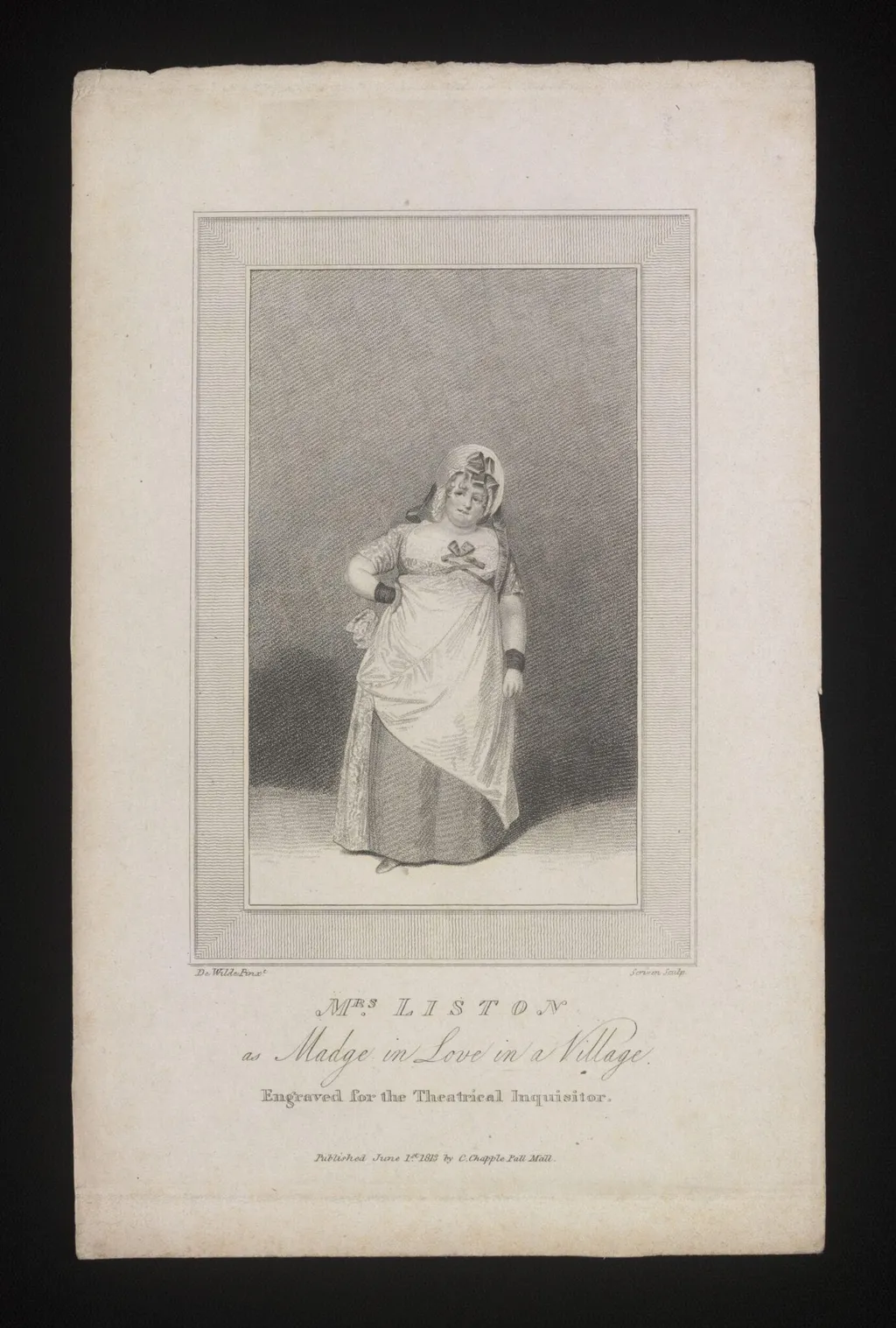
Mrs Liston as Madge in Love in a Village is a print by the Romanticist artist Unknown. It dates from 1 and is held in the collection of the Victoria and Albert Museum.
About this work
You see a black-and-white print of a woman on stage. She wears a simple dress and holds a fan. Her face shows playful energy.
This print comes from a 1811 play called *Love in a Village*. Mrs Liston played the comic servant Madge. Prints like this let fans remember their favorite actors.
Look up the Victoria and Albert Museum to see more theater prints.
Overview
This 1811 black‑and‑white print captures the actress Mrs Liston in the role of Madge, the comic servant from the popular stage work *Love in a Village*. Produced by the London firm Vernon, Hood & Sharp and dated 1 September 1811, the image was intended as a souvenir for theatre‑goers, preserving a moment of performance for those unable to attend.
Subject & Meaning
The composition shows the performer in a modest costume, a plain dress complemented by a handheld fan, her face animated with a mischievous grin. The portrayal emphasizes the light‑hearted, farcical nature of Madge’s character, inviting viewers to recall the humor and charm she contributed to the production.
Technique & Style
Executed as a line engraving, the print relies on stark contrasts of ink to suggest texture and movement. Fine hatching delineates the folds of the dress and the delicate fan, while broader strokes define the figure’s posture, creating a clear, immediate visual narrative typical of early‑nineteenth‑century theatrical ephemera.
History & Provenance
The print entered the Harry Beard Collection, a notable assemblage of theatrical prints, before being catalogued by the Victoria and Albert Museum. Its provenance traces back to the original publisher, Vernon, Hood & Sharp, a firm known for producing a range of popular prints for the London public during the Regency era.
Context
*Love in a Village* was a widely performed English ballad opera in the early 1800s, and the role of Madge offered a comedic foil to the romantic plot. Prints of actors in costume were a common means of disseminating theatrical culture, allowing admirers to own a visual record of a favorite performance.
Artist & collection

 Domestic Scene
 Giacomo and Cardinal Marco, investing Andrea, Abbot of San Zeno, with his Benefice
 The Nymph of Fontainebleau
 Portrait of a Woman
 Madonna and Child with Saints in the Enclosed Garden
 Venus and Minerva
 Family Group of Four on Sofa
 Wall painting from Room H of the Villa of P. Fannius Synistor at Boscoreale