Artwork
Our tent-life at Baalbec
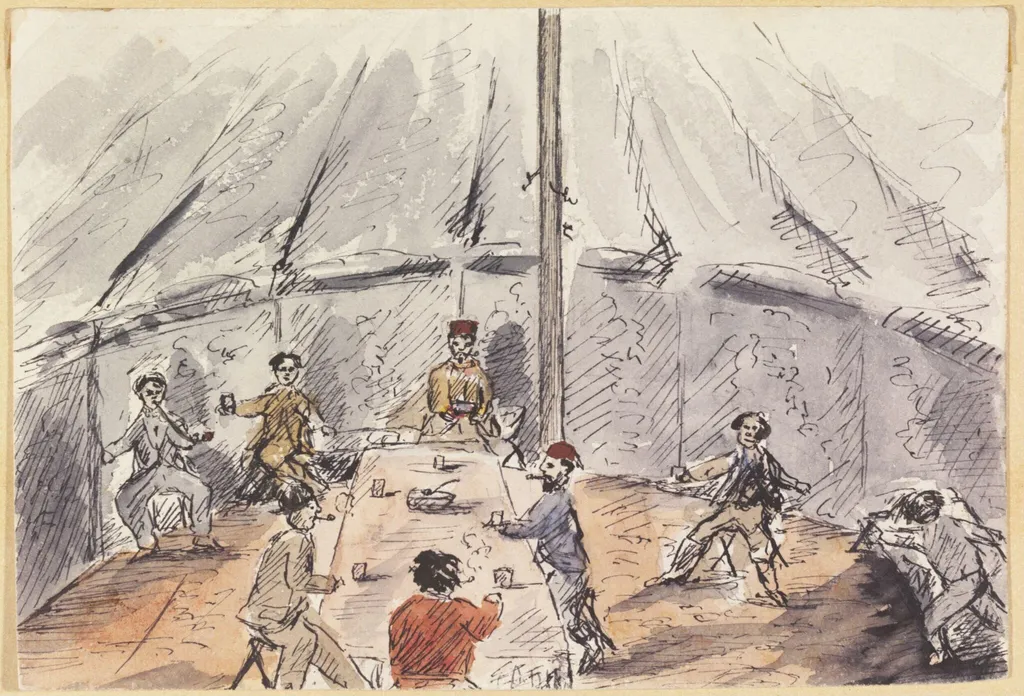
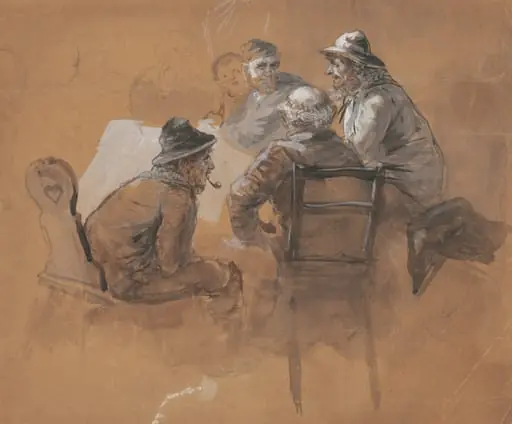
Our tent-life at Baalbec is a watercolor work on paper by the Impressionist artist Unknown. It dates from 1850 and is held in the collection of the Victoria and Albert Museum. Created in 1850, this watercolour depicts a moment of daily life inside a tent at Baalbec.
About this work
Overview
The work is unsigned and attributed to an anonymous artist, though its stylistic traits align closely with another known sketch, SD.
Created in 1850, this watercolour depicts a moment of daily life inside a tent at Baalbec. The work is unsigned and attributed to an anonymous artist, though its stylistic traits align closely with another known sketch, SD.1346, hinting at a single hand. The piece was once tentatively linked to Mark Twain, but no evidence supports this claim. Its informal, spontaneous quality suggests it was made during travel, capturing an unposed scene with immediacy.
Subject & Meaning
Inside a modest tent, a small group of individuals engage in quiet, everyday activities—conversing, moving, resting. The composition avoids narrative drama, instead focusing on the rhythm of ordinary life. The bright yellow jacket of one figure draws attention without dominating, while the subdued tones of others ground the scene in realism. The setting reflects transient existence, perhaps of travelers or archaeologists, emphasizing the intimacy of temporary shelter in a foreign landscape.
Technique & Style
The artist employed loose, fluid brushwork and minimal detail, favoring suggestion over precision. Watercolour washes create soft shadows and uneven textures, particularly on the tent’s fabric walls and rough ground. Lines remain visible and unrefined, conveying a sense of rapid observation. The lack of polished finish enhances the immediacy of the moment, echoing the spontaneity of on-site sketching rather than studio composition.
History & Provenance
The painting’s origin remains undocumented beyond its date and location. The reverse side bears preliminary studies of camels and horses, indicating it was likely part of a travel journal or field notebook. While once associated with Mark Twain, scholarly consensus rejects this attribution due to absence of corroborating evidence. Its current context suggests it entered a collection as a fragment of 19th-century Orientalist travel documentation.
Context
In the mid-19th century, European and American travelers frequently visited Baalbec, drawn by its ancient ruins. Sketches like this served as personal records rather than public art, often made by amateurs or professionals documenting their journeys. The scene reflects a broader trend of informal visual diary-keeping among visitors to the Levant, capturing fleeting encounters with local life amid archaeological exploration.
Legacy
Though unsigned and uncelebrated in its time, the work contributes to a quiet archive of 19th-century travel sketches. Its unpolished aesthetic anticipates later movements like Impressionism in its emphasis on transient light and candid moments. It survives not as a celebrated artwork but as a tangible record of how observers engaged with distant places—through direct, unmediated observation.
Artist & collection

 Domestic Scene
 Giacomo and Cardinal Marco, investing Andrea, Abbot of San Zeno, with his Benefice
 The Nymph of Fontainebleau
 Portrait of a Woman
 Madonna and Child with Saints in the Enclosed Garden
 Venus and Minerva
 Family Group of Four on Sofa
 Wall painting from Room H of the Villa of P. Fannius Synistor at Boscoreale
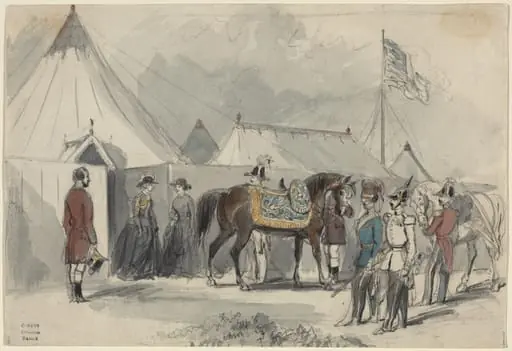 The Queen
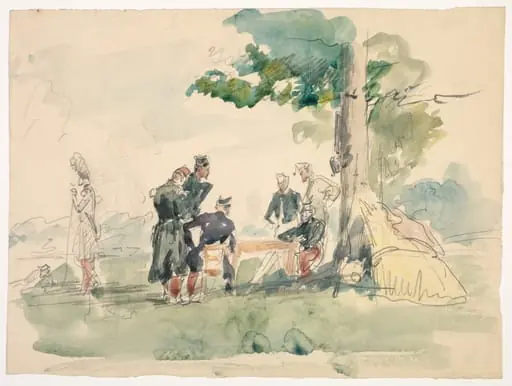 Militaires sous un arbre (Soldiers under a Tree)
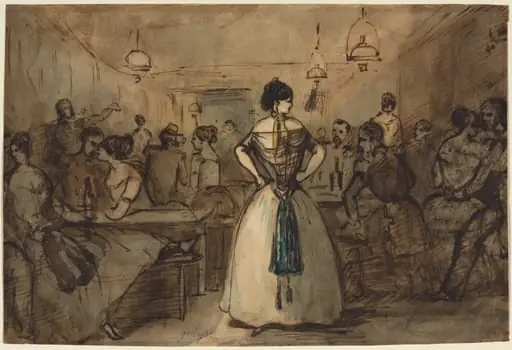 Officers and Courtesans in an Interior
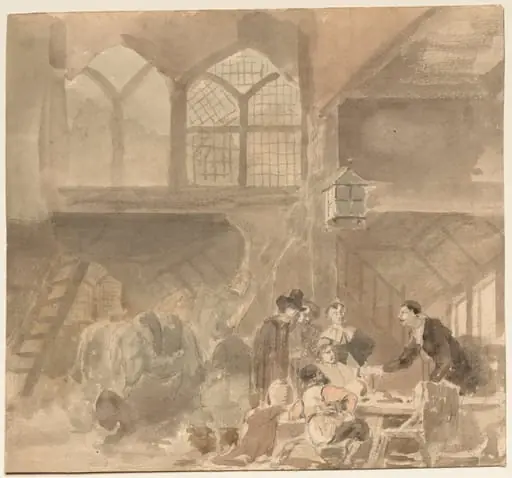 Interior of an Inn
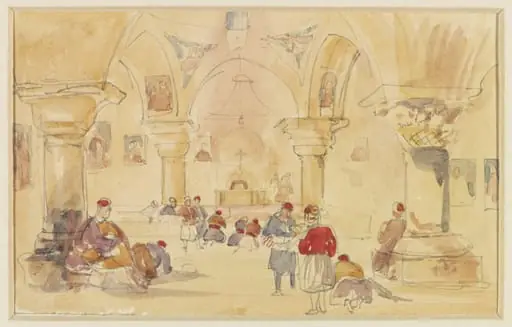 Chapel of St. Helena, Crypt of the Holy Sepulchre, Jerusalem
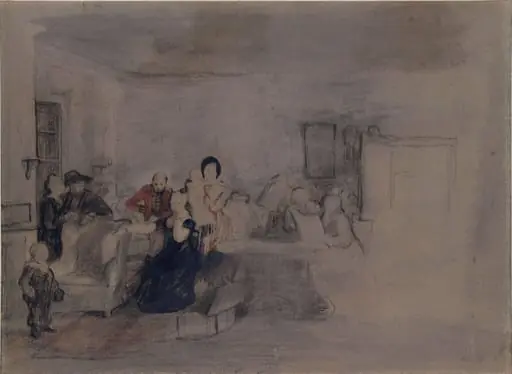 A Sketch for "The Reading of the Will"
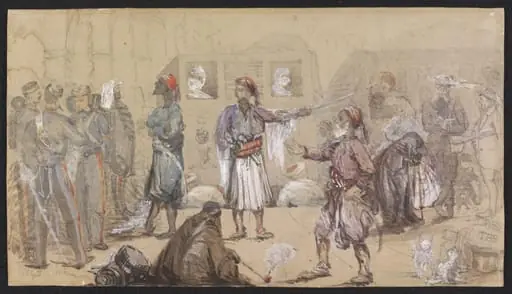 Railway Station, Alexandria
 Catching a Tune
 At the Café (Au café)
 Untitled
 Sketches of Figures
 Fishermen