Artwork
Parvati and Ganesh
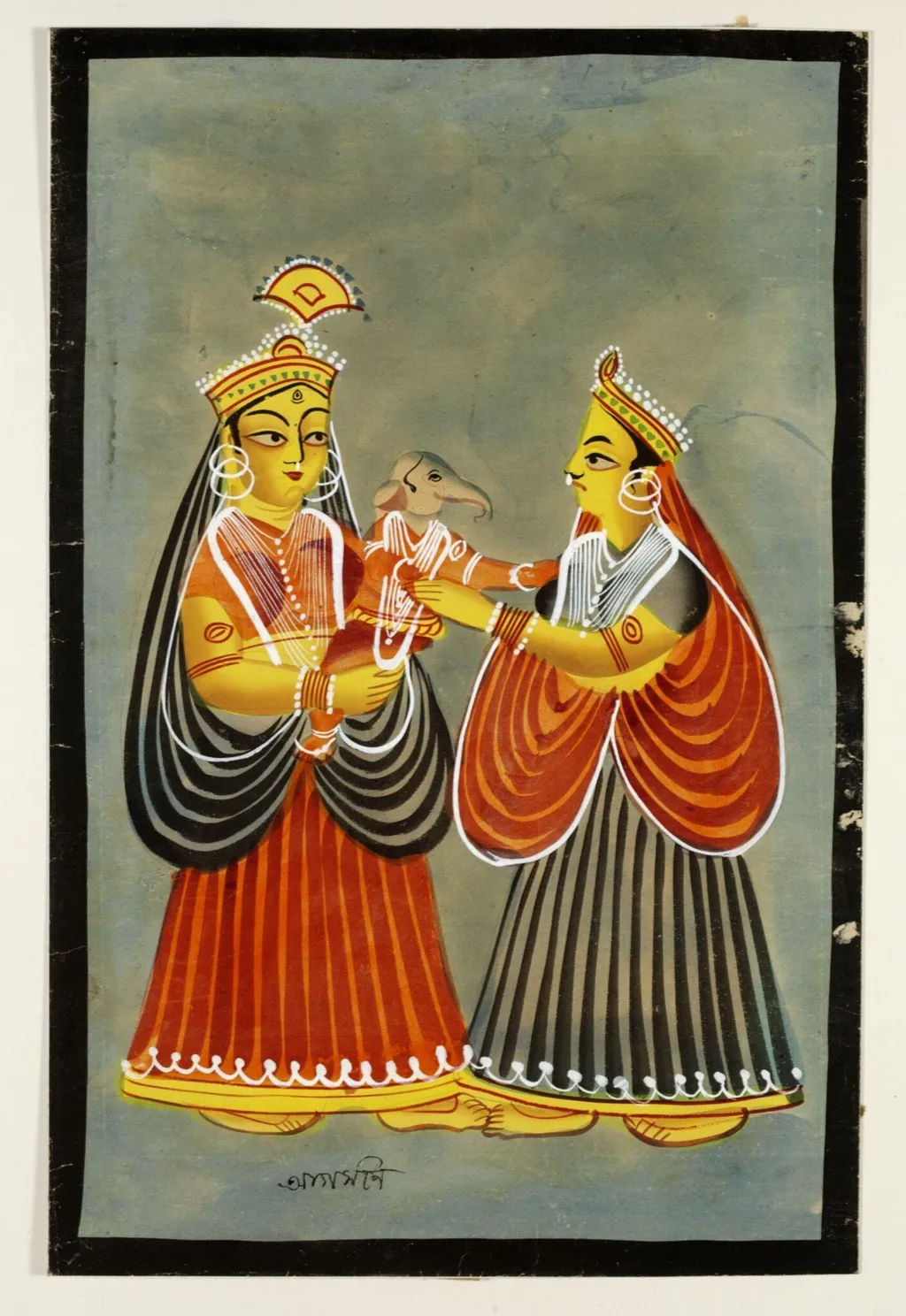
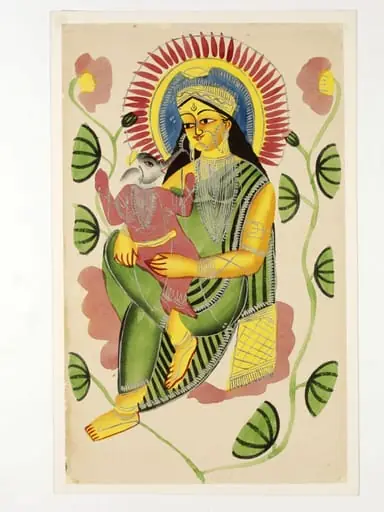
Parvati and Ganesh is a paint painting by the Impressionist artist Unknown. It dates from 1885 and is held in the collection of the Victoria and Albert Museum. This 1885 opaque watercolour on paper originates from the Kalighat school of painting in Calcutta.
About this work
Overview
It portrays a scene from Hindu mythology involving the goddess Parvati and her son Ganesh, rendered in the distinctive folk style of the region.
This 1885 opaque watercolour on paper originates from the Kalighat school of painting in Calcutta. It portrays a scene from Hindu mythology involving the goddess Parvati and her son Ganesh, rendered in the distinctive folk style of the region. Characterized by bold outlines and vivid, unmodulated hues, the work reflects the rapid, expressive brushwork typical of Kalighat artists who catered to pilgrims and urban audiences.
Subject & Meaning
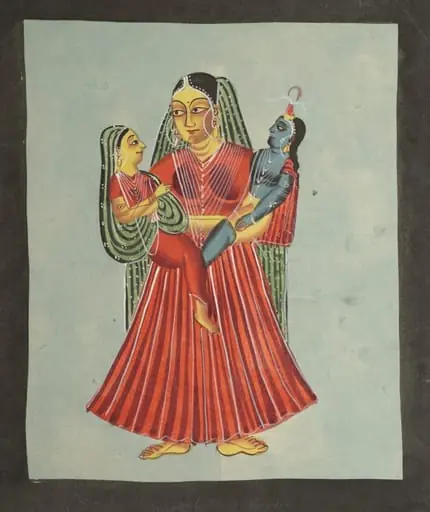
The painting illustrates Parvati leading her son Ganesh, depicted with an elephant’s head, to her father’s home. This narrative, drawn from Puranic lore, signifies familial devotion and the divine child’s return to his maternal lineage. The absence of a setting focuses attention on the figures, emphasizing their symbolic roles rather than a literal location, aligning with the tradition’s tendency to distill myth into essential forms.
Technique & Style
Executed in opaque watercolour on paper, the work employs flat areas of intense colour—red, black, orange—outlined with confident, sweeping lines. Figures are simplified, with minimal anatomical detail and no perspective, typical of Kalighat’s folk aesthetic. Jewelry and garments are rendered with rhythmic patterns, enhancing visual rhythm without narrative clutter, reflecting an economy of form suited to mass production and devotional use.
History & Provenance
The painting was acquired from Miss M. Steele, whose collection was inherited from her mother, suggesting a private Western ownership lineage. Its presence in such a collection indicates early 20th-century interest in Indian vernacular art among colonial-era collectors. While its exact origin within Kalighat’s workshop system is undocumented, its style firmly places it within the late 19th-century production of Calcutta’s temple-adjacent artists.
Context
Produced during British colonial rule, Kalighat paintings responded to shifting urban life and religious practice. While rooted in myth, these works often subtly mirrored contemporary social dynamics—gender roles, class, and cultural identity. This image of maternal authority and divine kinship may have resonated with both local devotees and colonial observers, serving as both devotional object and cultural artifact.
Legacy
As part of the Kalighat tradition, this painting contributes to a body of work that bridged religious iconography and urban popular culture. Its survival in private collections highlights its transition from devotional commodity to museum object. Though no longer produced in its original context, such works remain vital references for understanding the adaptability of Indian folk art under colonial influence.
Artist & collection

 Domestic Scene
 Giacomo and Cardinal Marco, investing Andrea, Abbot of San Zeno, with his Benefice
 The Nymph of Fontainebleau
 Portrait of a Woman
 Madonna and Child with Saints in the Enclosed Garden
 Venus and Minerva
 Family Group of Four on Sofa
 Wall painting from Room H of the Villa of P. Fannius Synistor at Boscoreale