Artwork
Rama and Sita
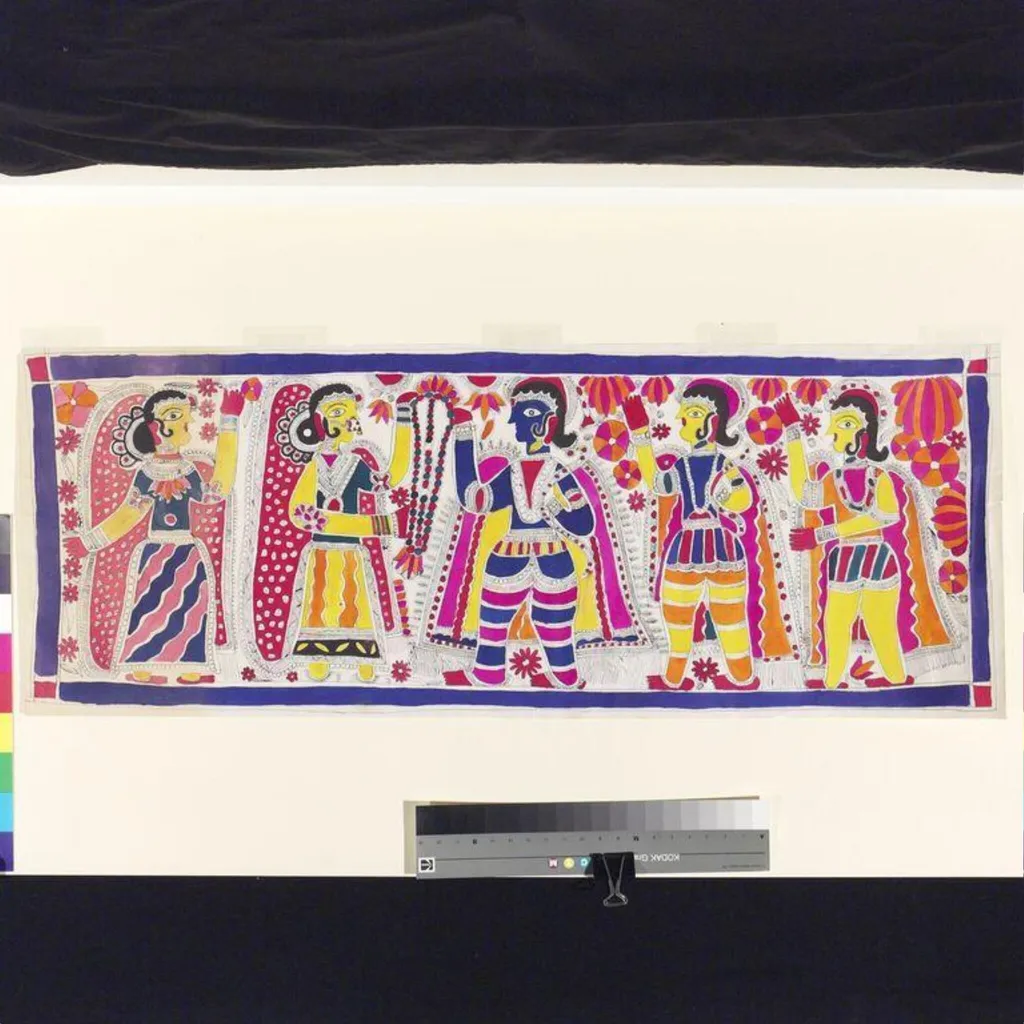
Rama and Sita is a paint painting by Unknown. It dates from 1973 and is held in the collection of the Victoria and Albert Museum.
About this work
Overview
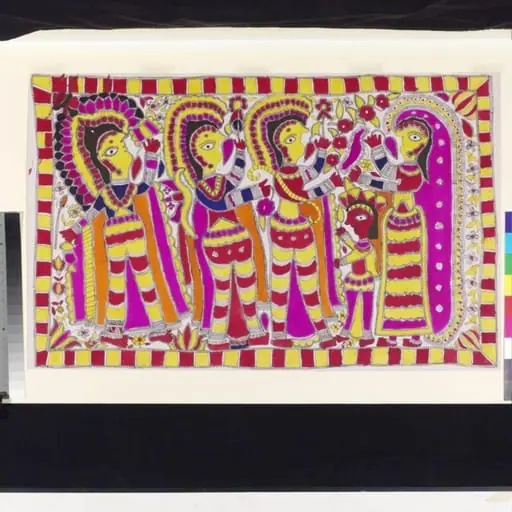
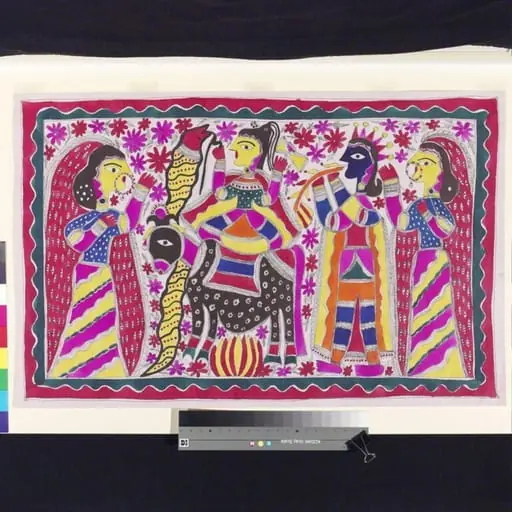
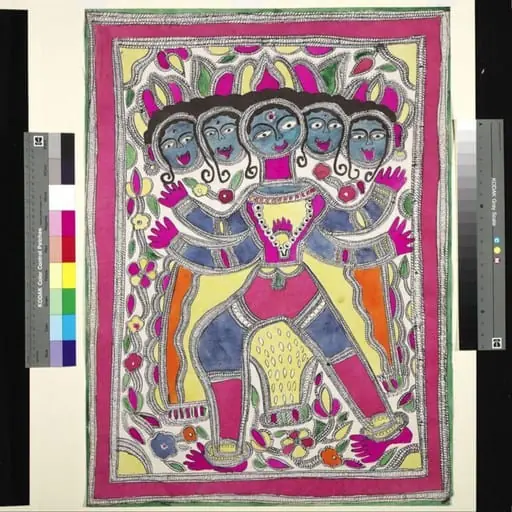
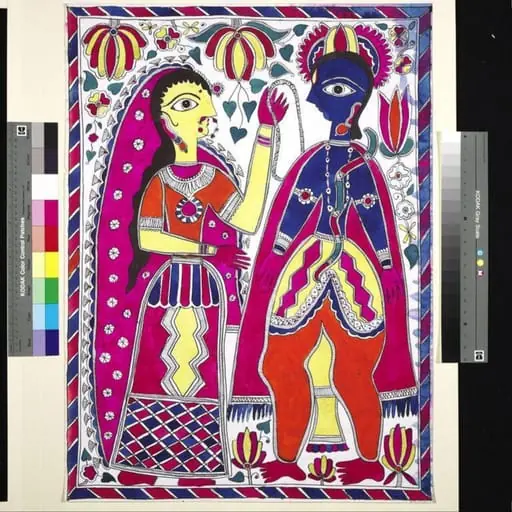
Created in 1973, this ink and paint work on paper illustrates the Hindu wedding of Rama and Sita using the Madhubani visual language of Bihar. Five figures are arranged side by side, rendered in vivid, flat colors with bold outlines, against a patterned backdrop of stars, flowers and sunbursts in reds, oranges and pinks.
Subject & Meaning
The central scene shows Sita presenting a floral garland to Rama, while an attendant stands beside her. Rama is flanked by his brother Lakshmana and another male figure, all dressed in traditional garments. The composition reflects the ritual’s significance and draws from the Ramayana narrative, a common theme in Madhubani depictions of fertility and divine unions.
Technique & Style
Executed in the Madhubani tradition, the piece employs dense decorative motifs, stylized facial features with large eyes, and a flat, ornamental treatment of clothing. Historically a wall art practiced by women, the style was transferred to paper in the mid‑20th century, allowing the intricate line work and bright pigments to be reproduced for broader audiences.
History & Provenance
Madhubani art emerged from rural Bihar, where women painted religious and domestic scenes on walls. By the 1960s, the practice expanded to commercial paper formats, supporting rural artisans. This 1973 work exemplifies that transition, preserving the cultural practice while entering the market for collectible artworks.
Context
The painting belongs to a period when Indian folk traditions were gaining recognition beyond their local settings, partly due to government and NGO initiatives that promoted regional crafts. Its subject, drawn from the epic Ramayana, aligns with the style’s longstanding focus on mythological narratives and communal celebrations.
Artist & collection

 Domestic Scene
 Giacomo and Cardinal Marco, investing Andrea, Abbot of San Zeno, with his Benefice
 The Nymph of Fontainebleau
 Portrait of a Woman
 Madonna and Child with Saints in the Enclosed Garden
 Venus and Minerva
 Family Group of Four on Sofa
 Wall painting from Room H of the Villa of P. Fannius Synistor at Boscoreale