Artwork
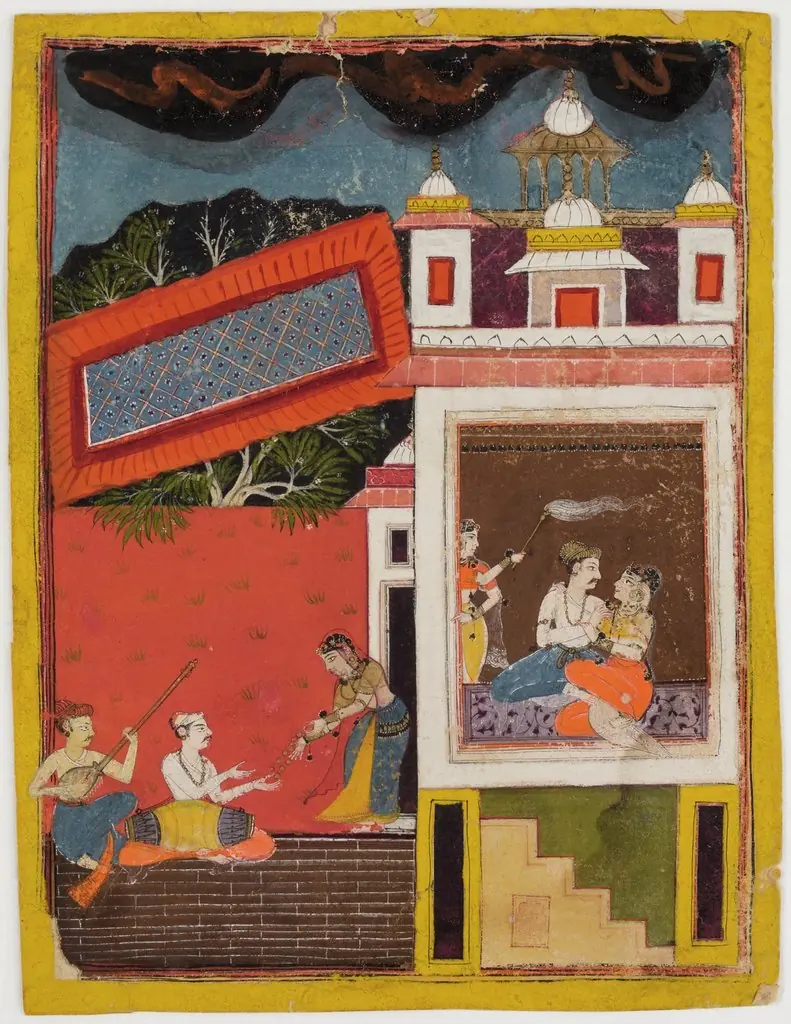
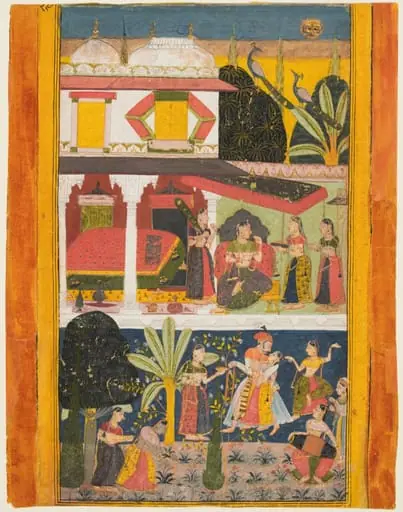
Rati, the Goddess of Erotic Love, Takes Aim at Krishna, from a Rasikapriya
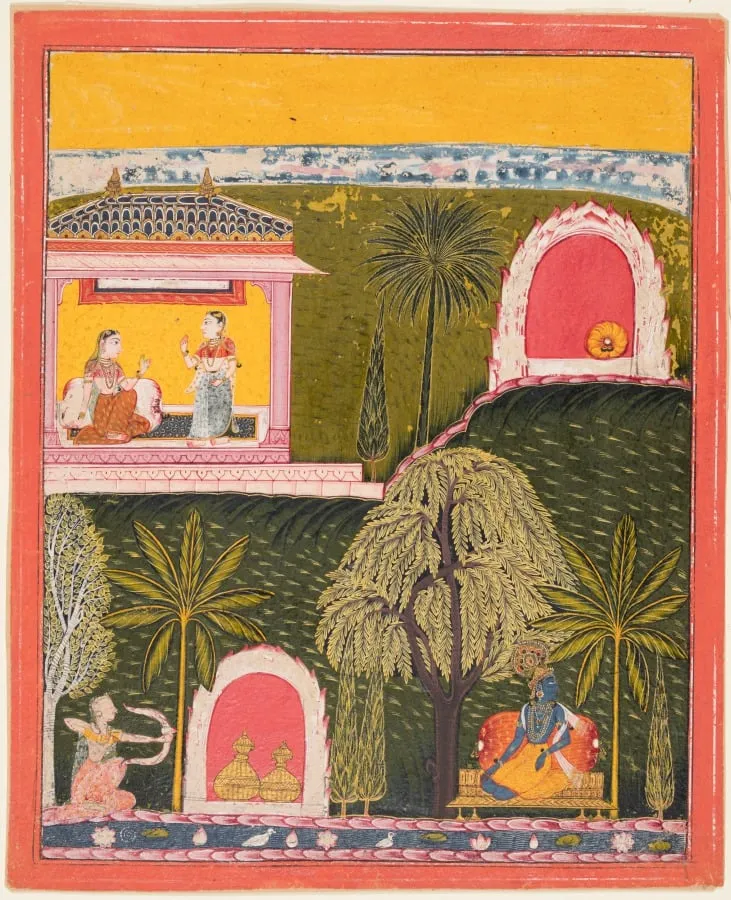
Rati, the Goddess of Erotic Love, Takes Aim at Krishna, from a Rasikapriya is an unspecified painting by the Baroque artist Unknown. It dates from 1660 and is held in the collection of the Cleveland Museum of Art.
About this work
Overview
The work depicts a domestic interior illuminated by abundant light, where a heroine, known in classical Indian literature as the nayika, is engaged in conversation with her close companion, the sakhi. Their dialogue centers on sending a message to the deity Krishna, who is shown seated in a garden setting near a lotus pond at the lower right of the composition.
Subject & Meaning
Central to the narrative is Rati, the goddess of erotic love, who appears in the lower left, poised to launch a flower‑shaped arrow toward Krishna. The arrow symbolizes the transmission of love, intended to bind Krishna’s affection to the heroine. An empty pavilion in the upper right suggests a forthcoming romantic encounter that has yet to unfold.
Technique & Style
Rendered in the delicate brushwork characteristic of Indian miniature painting, the scene balances vivid coloration with fine linear detail. The bright interior is contrasted with the serene garden exterior, while the figures are delineated with precise outlines and ornamental costumes that convey status and emotion.
History & Provenance
The composition is derived from the Rasikapriya, a 16th‑century treatise on poetics and aesthetics that outlines idealized scenes of love. The painting’s provenance traces through private collections before entering a public museum, where it is catalogued as an example of courtly narrative art.
Context
The tableau reflects the broader tradition of Nayika‑Sakhi iconography, wherein a heroine’s longing and her confidante’s counsel are visualized alongside divine participants. Such scenes were popular in courtly circles, serving both as moral exemplars of devotion and as decorative illustrations of literary texts.
Legacy
As a visual interpretation of a classical literary source, the painting continues to inform scholars of the interplay between text and image in pre‑modern Indian art, illustrating how mythological motifs were adapted for didactic and aesthetic purposes.
Artist & collection

 Domestic Scene
 Giacomo and Cardinal Marco, investing Andrea, Abbot of San Zeno, with his Benefice
 The Nymph of Fontainebleau
 Portrait of a Woman
 Madonna and Child with Saints in the Enclosed Garden
 Venus and Minerva
 Family Group of Four on Sofa
 Wall painting from Room H of the Villa of P. Fannius Synistor at Boscoreale