Artwork
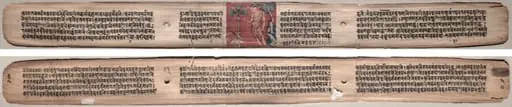
Text, folio 73 (verso) from a Gandavyuha-sutra (Scripture of the Supreme Array)

Text, folio 73 (verso) from a Gandavyuha-sutra (Scripture of the Supreme Array) is an unspecified painting by Unknown. It dates from 1104 and is held in the collection of the Cleveland Museum of Art. The object is a narrow wooden folio, the verso of folio 73, taken from a Gandavyuha‑sutra manuscript.
About this work
Overview
The object is a narrow wooden folio, the verso of folio 73, taken from a Gandavyuha‑sutra manuscript. Its surface is densely covered with tiny, dark characters that occupy almost the entire panel, forming orderly rows of text. The wood shows signs of age, with worn edges, occasional chips and faded areas where the material has deteriorated.
Subject & Meaning
The script records a portion of the Gandavyuha‑sutra, a Buddhist scripture recounting the pilgrim journey of the bodhisattva Sudhana. The text serves a devotional and instructional purpose, conveying teachings on the path to enlightenment within the Mahayana tradition.
Technique & Style
The writing employs the traditional Nepalese script style used for religious manuscripts, characterized by compact, uniform characters that maximize space. The letters are incised or painted in dark pigment on the wooden support, a method common in Himalayan manuscript production where paper was scarce.
History & Provenance
The folio originates from a larger codex likely produced in the Kathmandu Valley, a historic centre of Buddhist textual transmission. Its precise date is not specified, but the material and script align with medieval Nepalese manuscript practices, suggesting creation between the 12th and 15th centuries.
Context
In Nepal, Buddhist texts were often inscribed on wood or cloth as part of monastic libraries. The Gandavyuha‑sutra was a central work for tantric and scholastic study, and such manuscripts were used in ritual recitation and teaching within monastic curricula.
Legacy
Surviving wooden folios like this provide rare insight into the material culture of Nepalese Buddhism, illustrating how sacred literature was adapted to local resources. They inform contemporary scholarship on the diffusion of Mahayana texts across the Himalayas.
Artist & collection

 Domestic Scene
 Giacomo and Cardinal Marco, investing Andrea, Abbot of San Zeno, with his Benefice
 The Nymph of Fontainebleau
 Portrait of a Woman
 Madonna and Child with Saints in the Enclosed Garden
 Venus and Minerva
 Family Group of Four on Sofa
 Wall painting from Room H of the Villa of P. Fannius Synistor at Boscoreale
 Text, folio 94 (verso) from a Gandavyuha-sutra (Scripture of the Supreme Array)
 Text, folio 22 (verso) from a Gandavyuha-sutra (Scripture of the Supreme Array)
 Text, folio 37 (verso) from a Gandavyuha-sutra (Scripture of the Supreme Array)
 Text, folio 115 (verso) from a Gandavyuha-sutra (Manuscript of the Supreme Array)
 Text, folio 37 (verso) from a Gandavyuha-sutra (Scripture of the Supreme Array)
 Folio 73 from a Gandavyuha-sutra (Scripture of the Supreme Array): Sudhana and an antelope (recto); text (verso)