Artwork
The Music Teacher and His Wife
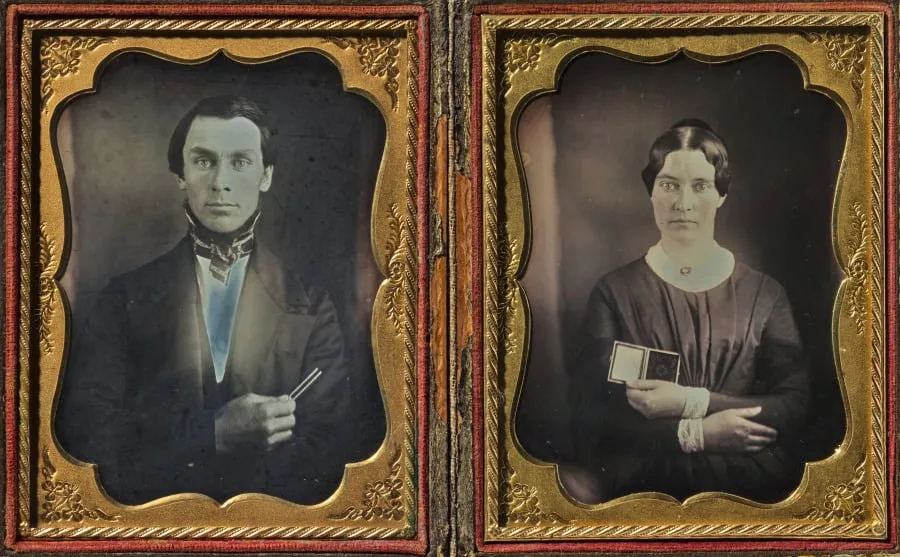
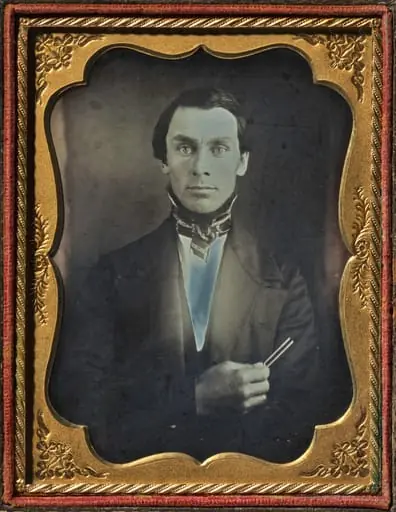
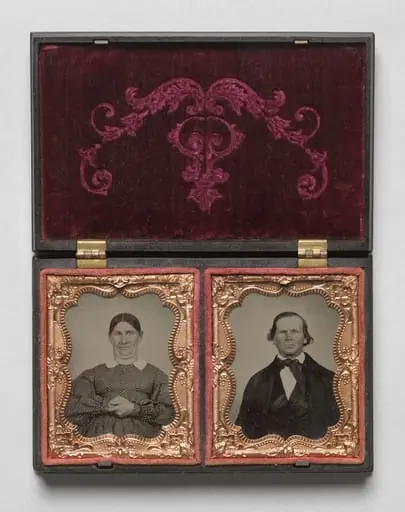
The Music Teacher and His Wife is a photography by the Impressionist artist Unknown. It dates from 1854 and is held in the collection of the Cleveland Museum of Art. This photograph captures a music teacher and his wife in a studio setting, likely taken in the mid-19th century.
About this work
Overview
The image reflects the deliberate construction of personal image through photographic portraiture during a time when such images were rare and meaningful.
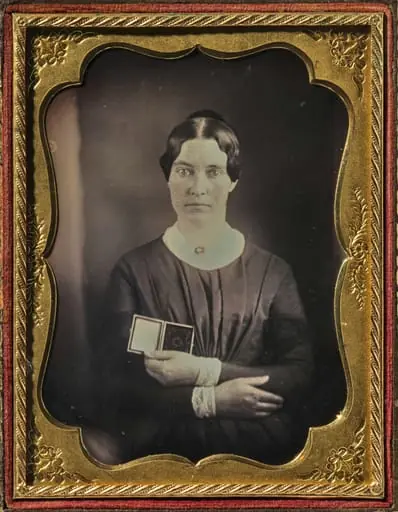
This photograph captures a music teacher and his wife in a studio setting, likely taken in the mid-19th century. Both subjects are posed formally, dressed in their best attire, and surrounded by carefully selected objects that signal their social standing and professional identity. The image reflects the deliberate construction of personal image through photographic portraiture during a time when such images were rare and meaningful.
Subject & Meaning
The man holds a tuning fork, a clear reference to his profession as a music teacher, while his wife’s refined dress and composed posture emphasize domestic respectability. Together, their presentation conveys a shared aspiration toward cultural refinement and economic stability. The objects and attire were chosen not merely for appearance but to communicate values—education, order, and upward mobility—to viewers beyond the immediate family.
Technique & Style
The photograph employs controlled lighting to model the figures with subtle contrast, enhancing volume and texture without the use of paint. While hand coloring was common in the era, this image appears uncolored, relying instead on the natural tonal range of the medium. The composition is balanced and static, typical of studio portraiture, where the background and pose serve to frame the subjects as dignified and composed.
History & Provenance
Photographs like this were often commissioned for significant life events, such as marriage or professional achievement. Given the rarity of photographic access at the time, this image likely served as a lasting record of the couple’s status. Its survival suggests it was preserved within the family, possibly passed down as a treasured heirloom rather than displayed publicly.
Context
In the mid-1800s, photography was still a novel and costly medium, making each sitting a deliberate act. Studios offered controlled environments where clients could curate their image using clothing, props, and posture. This portrait aligns with broader trends in middle-class self-representation, where visual identity became a tool for asserting social belonging in an era of rapid change.
Legacy
This image exemplifies how early photography functioned as a medium of personal and social documentation. It preserves not only the appearance of its subjects but also the cultural values they wished to project. As such, it contributes to the historical record of how ordinary individuals engaged with new technologies to assert identity in a world increasingly defined by visual representation.
Artist & collection

 Domestic Scene
 Giacomo and Cardinal Marco, investing Andrea, Abbot of San Zeno, with his Benefice
 The Nymph of Fontainebleau
 Portrait of a Woman
 Madonna and Child with Saints in the Enclosed Garden
 Venus and Minerva
 Family Group of Four on Sofa
 Wall painting from Room H of the Villa of P. Fannius Synistor at Boscoreale