Artwork
The siege of Arbela in the era of Hulagu Khan, page from a Chingiz-nama (Book of Chingiz Khan) of the Jami al-tavarikh (Compendium of Chronicles) of Rashid al-Din (Persian,1247–1318)
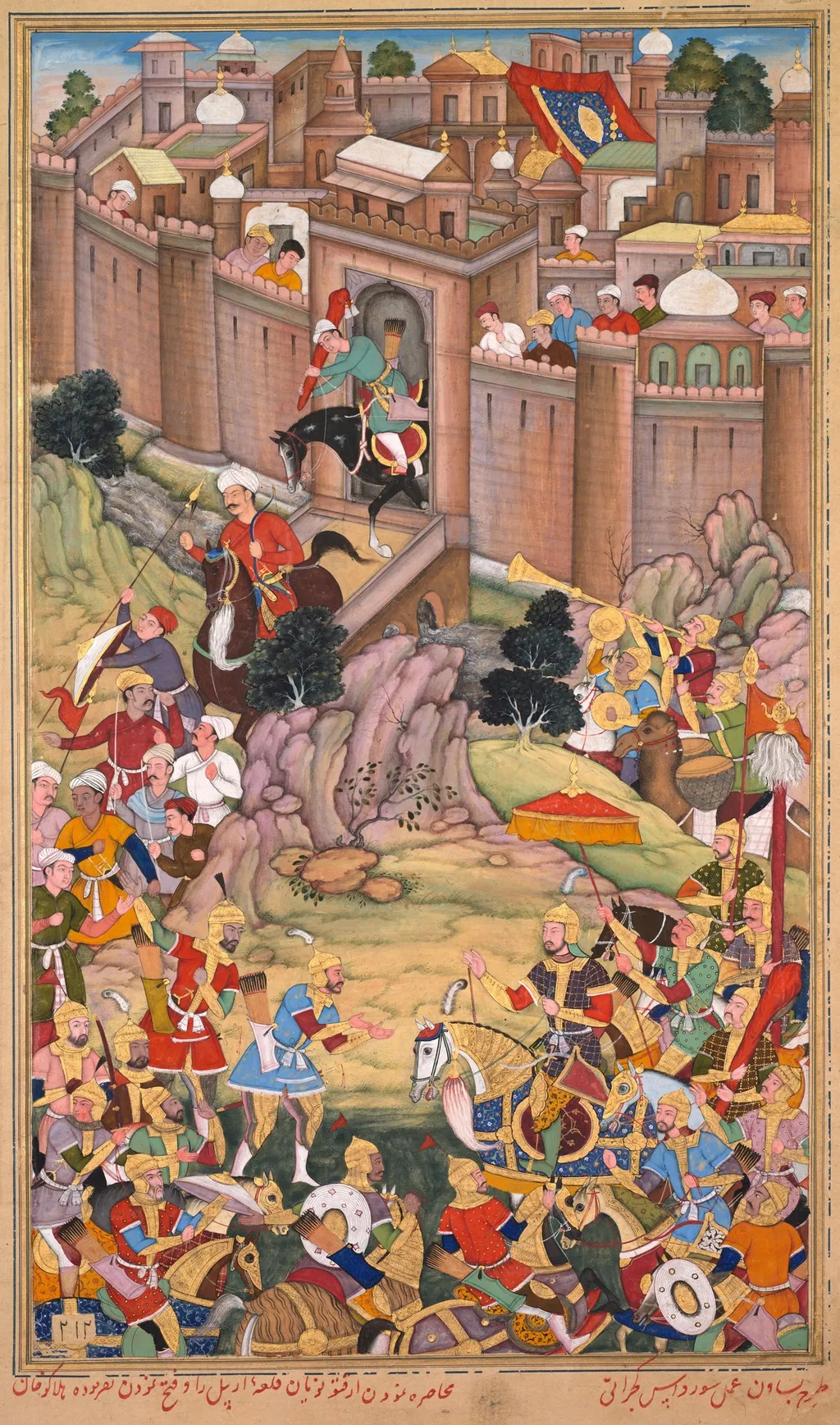
The siege of Arbela in the era of Hulagu Khan, page from a Chingiz-nama (Book of Chingiz Khan) of the Jami al-tavarikh (Compendium of Chronicles) of Rashid al-Din (Persian,1247–1318) is an unspecified painting. It dates from 1598 and is held in the collection of the Cleveland Museum of Art.
About this work
Overview
The miniature illustrates the siege of Arbela during the campaigns of Hulagu Khan, as recorded in the Chingiz-nama section of Rashid al‑Din’s Jami al‑tavarikh. Executed in the Persian manuscript tradition of the late thirteenth century, the work combines narrative detail with a vivid palette to convey the intensity of the battle.
Subject & Meaning
The scene captures a crowded battlefield surrounding a fortified city, with mounted warriors and infantry engaged in close combat. Figures scale the high walls while others clash below, reflecting the chronicler’s emphasis on the ferocity of the Mongol advance and the resistance of the besieged populace.
Technique & Style
Rendered in miniature format, the painting employs bright reds, blues and golds typical of Ilkhanid court art. Fine brushwork delineates individual faces, armor and weaponry, while linear architectural elements define the fortress’s towers and ramparts, creating a dense yet organized composition.
History & Provenance
The work originates from a copy of Rashid al‑Din’s Jami al‑tavarikh, a universal history compiled between 1300 and 1310. The manuscript later entered European collections and is now held by the Cleveland Museum of Art, where it is displayed as part of the museum’s Persian miniatures holdings.
Context
Produced under the Ilkhanate, the miniature reflects the period’s interest in documenting Mongol conquests for both political legitimation and artistic patronage. The depiction of Hulagu’s campaign aligns with contemporary Persian efforts to record the transformative impact of Mongol rule on the region.
Artist & collection
