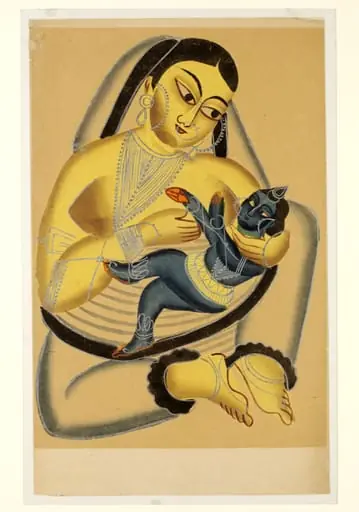
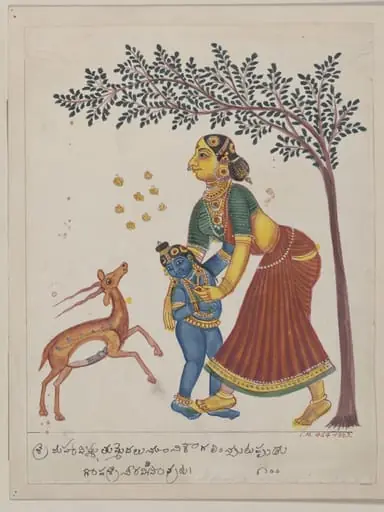
Artwork
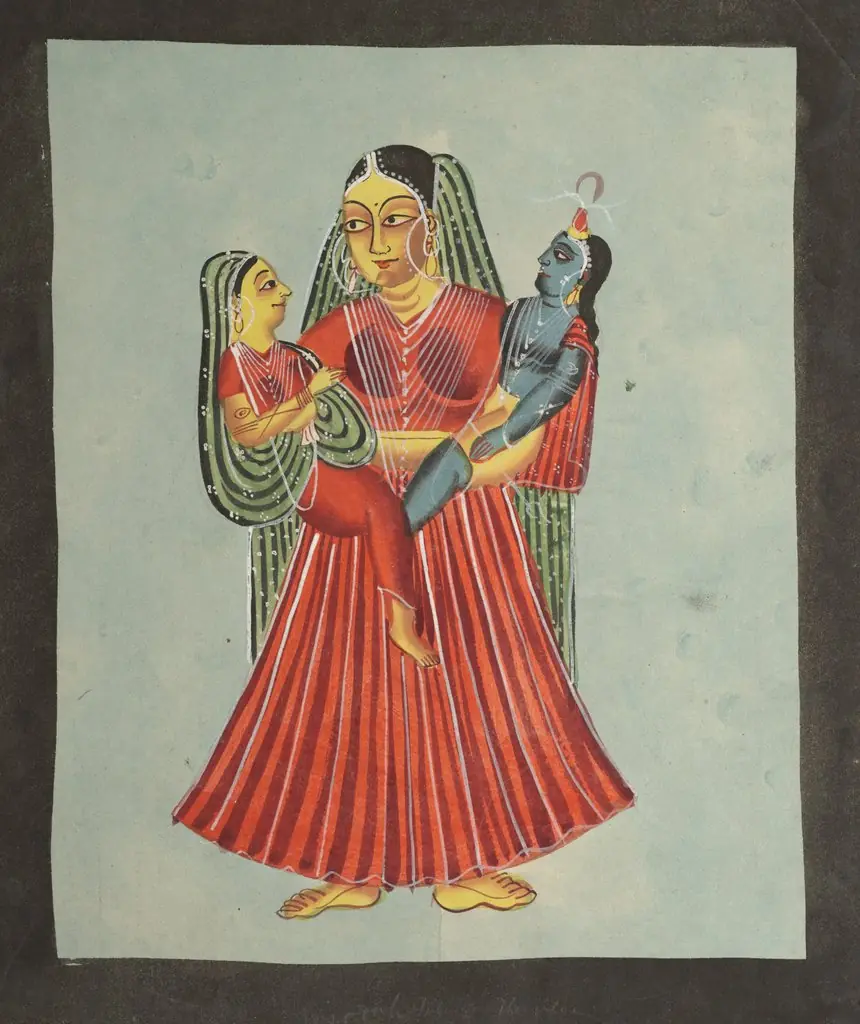
Yasoda suckling Krishna.
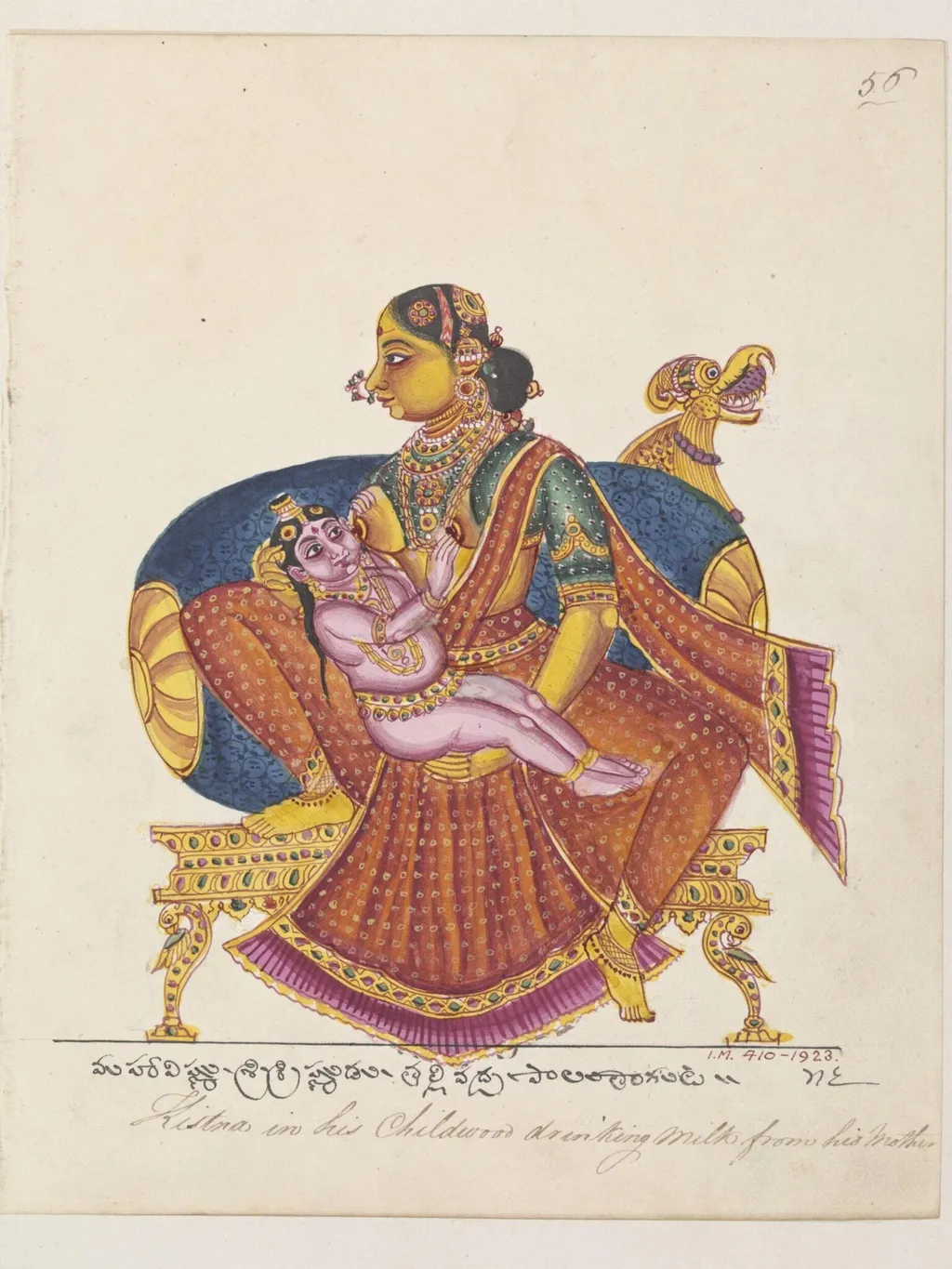
Yasoda suckling Krishna. is a paint painting by the Patna School of Painting artist Unknown. It dates from 1820 and is held in the collection of the Victoria and Albert Museum. This painting is one of a hundred illustrated depictions of Hindu deities originating from South India.
About this work
Overview
Rendered in watercolor or gouache on paper, the work belongs to a devotional tradition rather than the European Romantic movement.
This painting is one of a hundred illustrated depictions of Hindu deities originating from South India. It portrays a tender moment between Yasoda, the foster mother of Krishna, and the infant god. Rendered in watercolor or gouache on paper, the work belongs to a devotional tradition rather than the European Romantic movement. Its intimate scale and detailed ornamentation reflect regional artistic practices tied to religious storytelling.
Subject & Meaning
The scene illustrates Yasoda nursing Krishna, a moment drawn from Bhagavata Purana narratives that emphasize divine love expressed through maternal care. The infant’s gaze upward and Yasoda’s downward look convey mutual affection, reinforcing the idea of the divine as approachable and humanized. The act of nursing symbolizes Krishna’s earthly upbringing and the sacred bond between caregiver and child, central to Vaishnavite devotion.
Technique & Style
The composition uses flat, saturated colors and fine linear detail typical of South Indian miniature painting. Yasoda’s attire—orange skirt, green upper garment, and red sash—is rendered with precision, while gold accents highlight Krishna’s necklace and her jewelry. The background is uniformly pale, focusing attention on the figures. Facial expressions are subtle, and spatial depth is minimized, adhering to conventions of devotional illustration rather than naturalistic perspective.
History & Provenance
The painting is part of a larger illustrated series commissioned likely for a temple or royal patronage in the Deccan or Tamil region during the 18th or early 19th century. Such albums were used for ritual contemplation or as teaching aids in religious instruction. Its survival suggests it was carefully preserved, possibly within a devotional household or temple collection, though its specific provenance before modern institutional acquisition remains undocumented.
Context
This work emerges from a vibrant tradition of South Indian manuscript and album painting that illustrated Hindu epics and Puranas. Unlike European Romanticism, which prioritized individual emotion and nature, this tradition fused spiritual narrative with ornamental aesthetics, serving devotional and didactic purposes. The emphasis on familial bonds between gods and humans reflects broader theological themes in Bhakti movements, where personal devotion was central to spiritual experience.
Legacy
The painting contributes to a sustained visual language of Krishna’s childhood in South Indian art, influencing later devotional imagery in both religious and popular media. While not widely known outside specialized collections, it exemplifies how regional styles preserved theological narratives through intimate, finely crafted scenes. Its continued presence in museum holdings underscores its value as a cultural artifact of Hindu devotional practice.
Artist & collection

 Domestic Scene
 Giacomo and Cardinal Marco, investing Andrea, Abbot of San Zeno, with his Benefice
 The Nymph of Fontainebleau
 Portrait of a Woman
 Madonna and Child with Saints in the Enclosed Garden
 Venus and Minerva
 Family Group of Four on Sofa
 Wall painting from Room H of the Villa of P. Fannius Synistor at Boscoreale