Artwork
Odysseus and Nausicaa
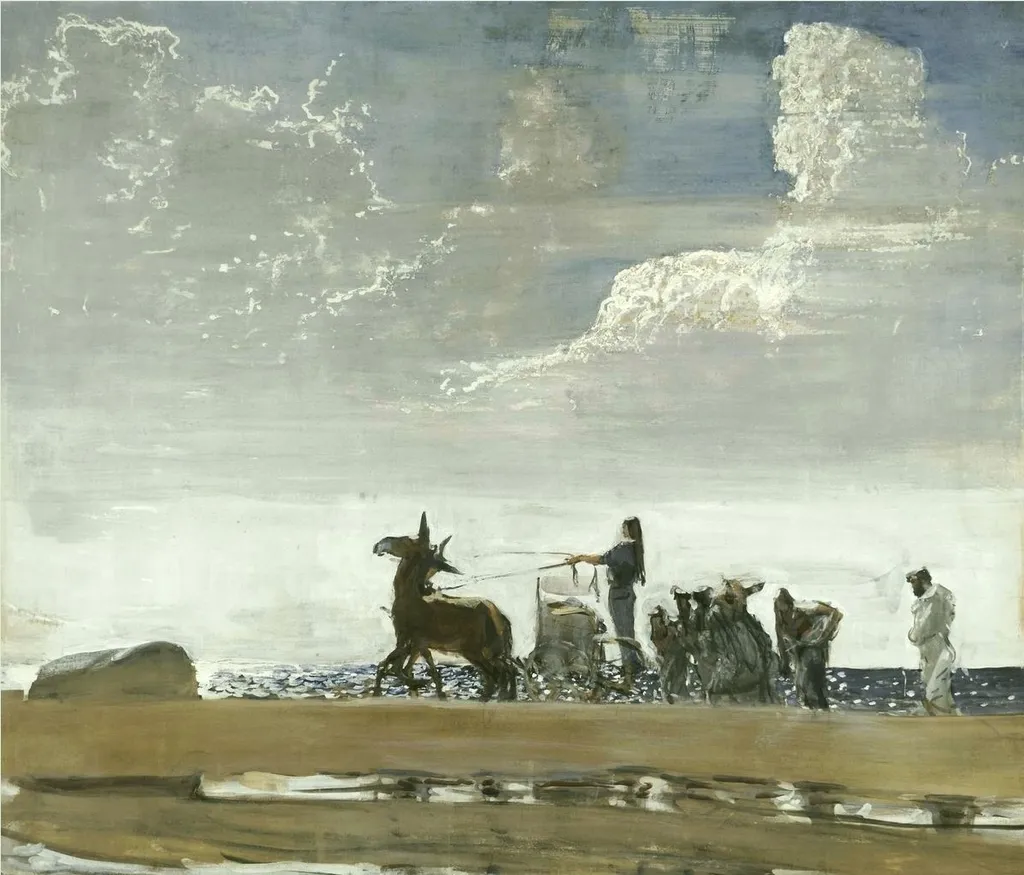
Odysseus and Nausicaa is a gouache painting by the Post-Impressionist artist Valentin Serov. It dates from 1910 and is held in the collection of the Tretyakov Gallery.
About this work
Overview
Valentin Alexandrovich Serov painted *Odysseus and Nausicaa* in 1910 with gouache, a water‑based medium that allows opaque color. The work belongs to the post‑impressionist vein of his later output and is part of the Tretyakov Gallery’s collection in Moscow.
Subject & Meaning
The composition illustrates the Homeric episode in which the shipwrecked hero Odysseus meets the Phaeacian princess Nausicaa. Nausca, shown centrally, holds the reins of a mule‑drawn chariot, while a figure in white—identified as Odysseus—looks toward her, suggesting the moment of recognition and hospitality.
Technique & Style
Serov employs gouache’s matte opacity to render a sky heavy with clouds and a landscape that recedes behind a large rock. The contrast between the woman’s dark garments and the man’s white attire emphasizes their separate roles, while the crowded chariot conveys kinetic energy within a relatively flat pictorial space.
History & Provenance
Created during the Belle Époque, the painting reflects Serov’s activity in St. Petersburg and Moscow at the height of his career as a portraitist. After its completion it entered the Tretyakov Gallery, where it remains on view as part of the museum’s Russian art holdings.
Context
Serov’s interest in classical subjects aligns with a broader turn among Russian artists of the early twentieth century toward mythological and literary themes, often rendered with a modern, post‑impressionist sensibility that softened academic conventions.
Artist & collection
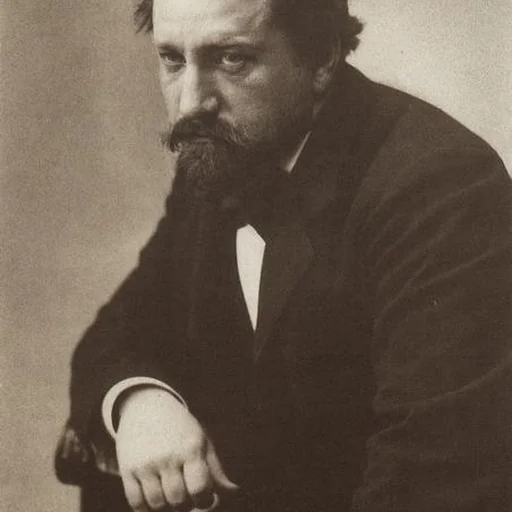
Artist
Valentin Alexandrovich Serov (Russian: Валентин Александрович Серов; 19 January 1865 – 5 December 1911) was a Russian painter and draughtsman during the Belle Époque, active in St.
