Artwork
Notre Dame de Paris
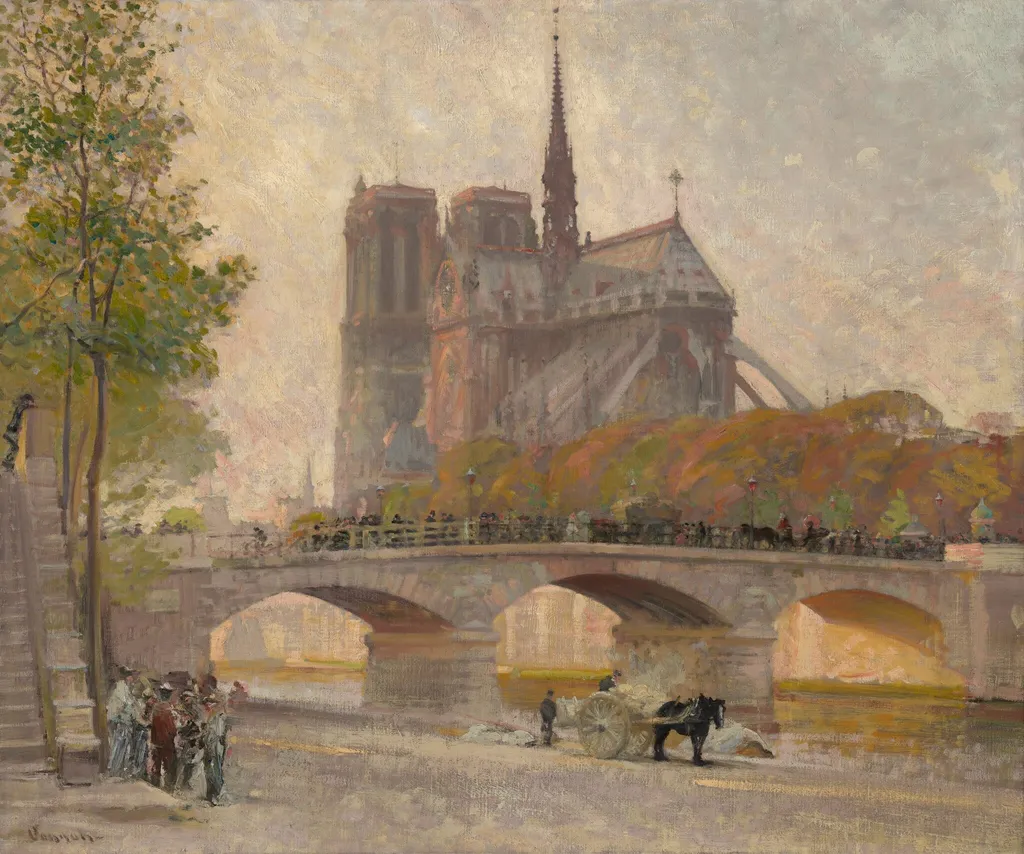
Notre Dame de Paris is an oil painting by the Impressionist artist Robert William Vonnoh. It dates from 1890 and is held in the collection of the National Gallery of Art.
About this work
Overview
Robert William Vonnoh’s oil on canvas, dated around 1890, depicts a Parisian riverscape dominated by the silhouette of Notre‑Dame cathedral. A multi‑arched bridge spans the water, populated with pedestrians, trees, and a horse‑drawn carriage, while figures linger on the riverbank. The composition balances architectural grandeur with everyday activity.
Subject & Meaning
The work juxtaposes the enduring presence of the cathedral’s twin towers and spire against the transient flow of city life. By placing ordinary commuters and a carriage in the foreground, Vonfrey highlights the coexistence of historic monument and modern urban rhythm, suggesting a quiet continuity within a bustling environment.
Technique & Style
Executed in a muted palette of grays and browns, the painting employs loose, expressive brushwork that conveys movement without sacrificing compositional clarity. The handling of light and atmosphere aligns with late‑19th‑century Impressionist tendencies, emphasizing overall mood over precise detail.
History & Provenance
Created circa 1890, the canvas reflects Vonnoh’s interest in European subjects during his later career. While specific ownership records are scarce, the painting has been referenced in catalogues of American artists who worked abroad, situating it within the broader exchange of transatlantic artistic ideas of the period.
Own this work as a print
Artist & collection

