Artwork
Easter Monday-Hélène Daurmont
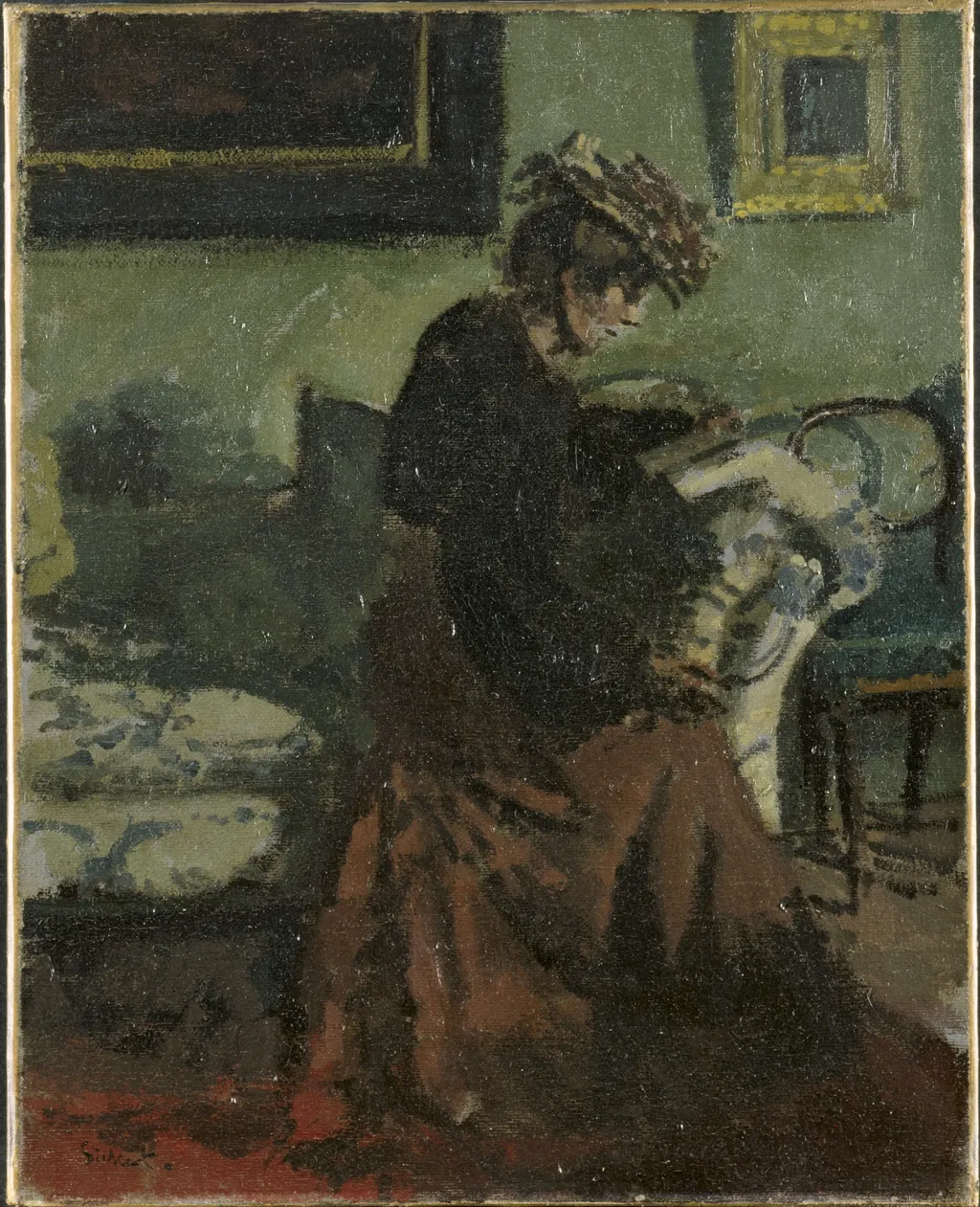
Easter Monday-Hélène Daurmont is an oil painting by the Post-Impressionist artist Walter Sickert. It dates from 1906 and is held in the collection of the Cleveland Museum of Art.
About this work
Overview
Walter Sickert’s 1906 oil work titled *Easter Monday—Hélène Daurmont* presents a dimly lit interior where a solitary woman occupies a chair. The composition is dominated by subdued tones and a narrow band of daylight entering from a right‑hand window, casting half‑shadow on the sitter’s face while the surrounding space recedes into darkness.
Subject & Meaning
The painting captures an everyday moment, focusing on a lone female figure in a quiet domestic setting. By isolating the woman amid muted surroundings, Sickert emphasizes the anonymity of ordinary life, inviting contemplation of the private, unremarkable episodes that populate urban experience.
Technique & Style
Executed with brisk, gestural brushwork, the canvas conveys a sense of immediacy; details of the figure’s features and furnishings are suggested rather than fully rendered. The loose handling of paint, combined with a limited palette of deep hues, creates a textured surface that hints at the artist’s interest in rapid observation and the visual language of early twentieth‑century Post‑Impressionism.
History & Provenance
Created during Sickert’s involvement with the Camden Town Group, the work reflects his engagement with London’s street and interior scenes. *Easter Monday—Hélène Daurmont* entered the collection of the Cleveland Museum of Art, where it remains part of the institution’s holdings of early modern British painting.
Artist & collection

Artist
Walter Richard Sickert (31 May 1860 – 22 January 1942) was a German-born British painter and printmaker who was a member of the Camden Town Group of Post-Impressionist artists in early 20th-century London.