Artwork
Mercury and Io
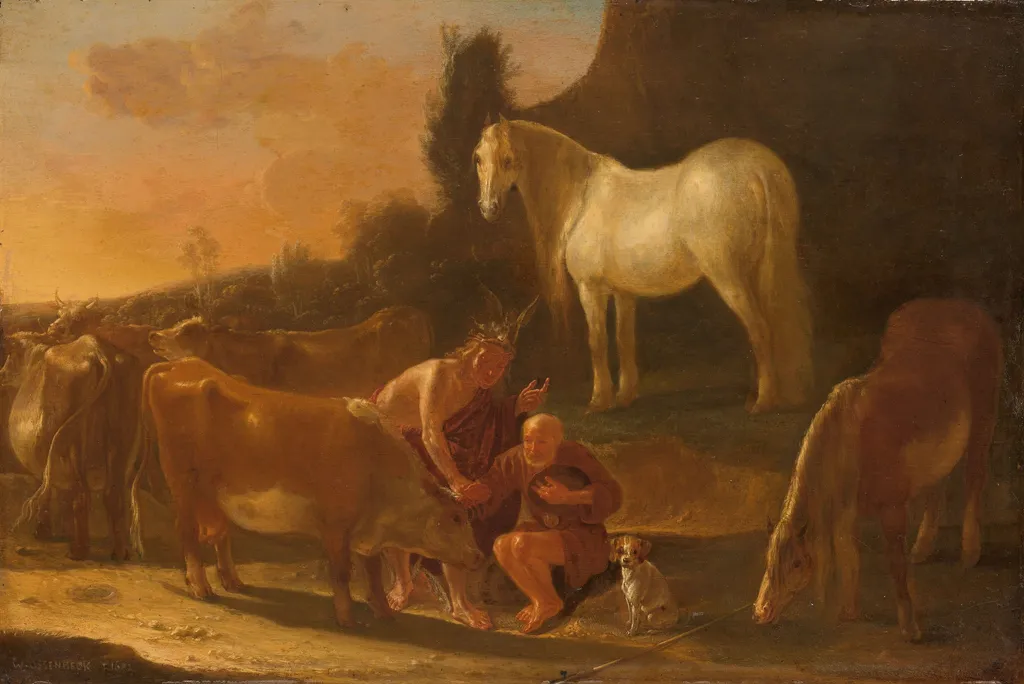
Mercury and Io is an oil painting by the Flemish Baroque painting artist Willem Ossenbeeck. It dates from 1632 and is held in the collection of the Rijksmuseum.
About this work
Overview
The scene is rendered with a calm, balanced atmosphere that emphasizes the narrative moment within a pastoral setting.
Willem Ossenbeeck’s oil on canvas, dated 1632, portrays a mythological encounter between Mercury and Io. The composition centers on a seated male figure holding a bowl and a standing female figure adorned with a leafy crown and winged back, surrounded by cows, horses, and a small dog. The scene is rendered with a calm, balanced atmosphere that emphasizes the narrative moment within a pastoral setting.
Subject & Meaning
The work references the classical tale in which Zeus, disguised as Mercury, pursues the nymph Io. The female figure’s crown of leaves and wings identify her as a divine or semi‑divine being, while the presence of cattle alludes to Io’s transformation into a cow. The interaction between the figures suggests a moment of gentle contact rather than dramatic chase, highlighting themes of transformation and concealed identity.
Technique & Style
Ossenbeeck employs pronounced chiaroscuro, using strong contrasts of light and shadow to model the figures and animals. The illumination falls on the central pair, creating depth and directing the viewer’s eye, while the surrounding fauna recede into darker tones. The brushwork is smooth in the flesh tones and more textured in the animal pelts, reflecting the artist’s skill in rendering both human and animal forms within a unified visual language.
History & Provenance
Created in the early seventeenth century, the painting entered the collection of the Rijksmuseum in Amsterdam, where it remains on display. Documentation traces its ownership through several Dutch private collections before its acquisition by the museum, confirming its attribution to Ossenbeeck and its status as a representative example of his mythological oeuvre.
Context
During the Dutch Golden Age, artists often revisited classical subjects, integrating them with contemporary domestic settings. Ossenbeeck’s treatment of Mercury and Io reflects this trend, merging mythic narrative with a familiar, bucolic landscape. The inclusion of everyday animals and a modest interior space aligns the work with the period’s interest in realism and moral allegory, situating the painting within broader artistic currents of the 1630s.
Own this work as a print
Artist & collection
Artist
Dutch painter Willem Ossenbeeck worked in oils around the early 1600s. Two of his scenes on view here are Mercury and Io, a mythological tale turned into a quiet indoor drama, and Landscape with Shepherd, Shepherdess…
