Artwork
Herd near a fountain
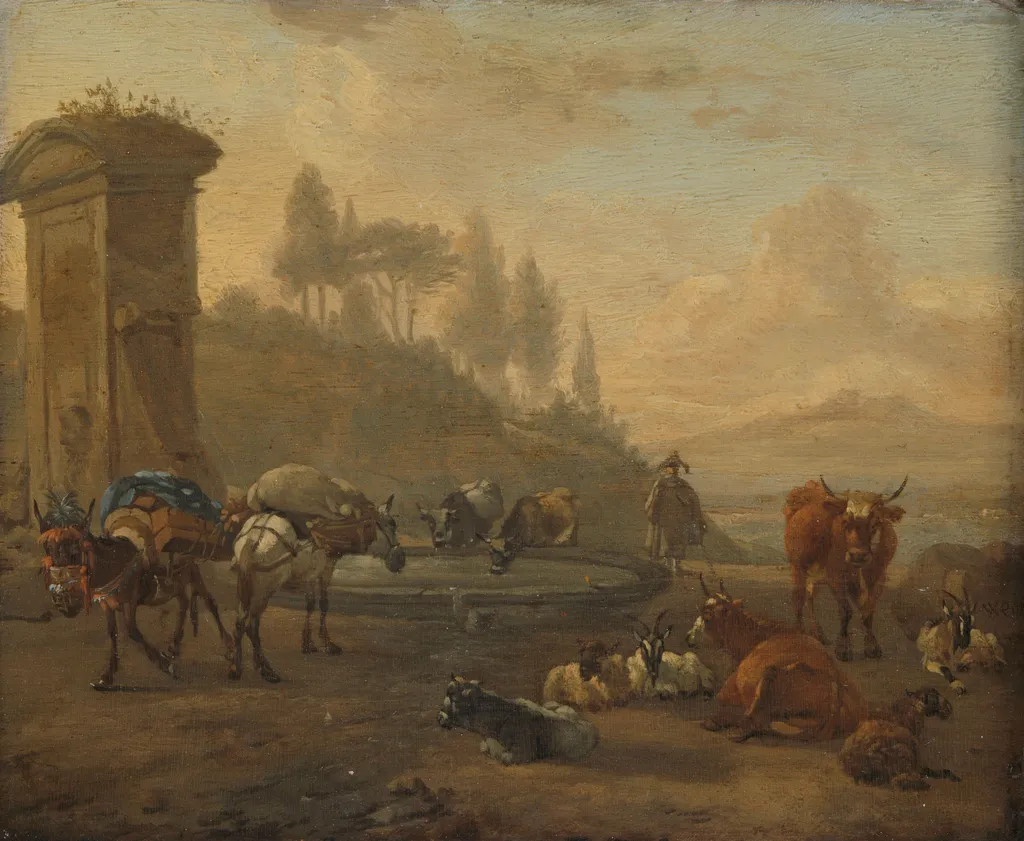
Herd near a fountain is an oil painting by the Dutch Golden Age artist Willem Romeyn. It dates from 1650 and is held in the collection of the Rijksmuseum.
About this work
Overview
Willem Romeyn’s oil painting Herd near a Fountain, dated around 1650, presents a tranquil rural scene. Executed in the Dutch landscape tradition, the work is part of the Rijksmuseum’s collection. The composition centers on a modest stone fountain surrounded by livestock and a few figures, set against a hazy horizon.
Subject & Meaning
The canvas depicts a modest street where donkeys and cows, their loads draped in blue cloth, line the left side. A solitary man stands beside the fountain while sheep and goats rest nearby. The inclusion of a solitary tree and a distant pillar suggests a quiet, everyday moment in an agricultural community.
Technique & Style
Romeyn employs a warm, muted palette to model light and shadow, creating a soft chiaroscuro that gives depth to the figures and architecture. The brushwork is delicate, rendering the fur of the animals and the texture of stone with subtle gradations, while the atmospheric background recedes into a gentle, hazy blur.
History & Provenance
Created in the mid‑17th century, the painting entered the Rijksmuseum’s holdings as part of its Dutch Golden Age collection. Its attribution to Romeyn, a known specialist in pastoral scenes, has been affirmed through stylistic analysis and archival records linking the work to the museum’s early acquisitions.
Context
During the Dutch Golden Age, genre landscapes often highlighted the harmony between humans, animals, and the countryside. Romeyn’s work reflects this cultural emphasis, portraying a serene, orderly environment that underscores the period’s appreciation for rural labor and the quiet dignity of everyday life.
Own this work as a print
Artist & collection
Artist
Willem Romeyn (1624–1697) was a Dutch Golden Age landscape artist, born in Haarlem.
