Artwork
Front View of Buitenzorg Palace after the Earthquake of 10 October 1834
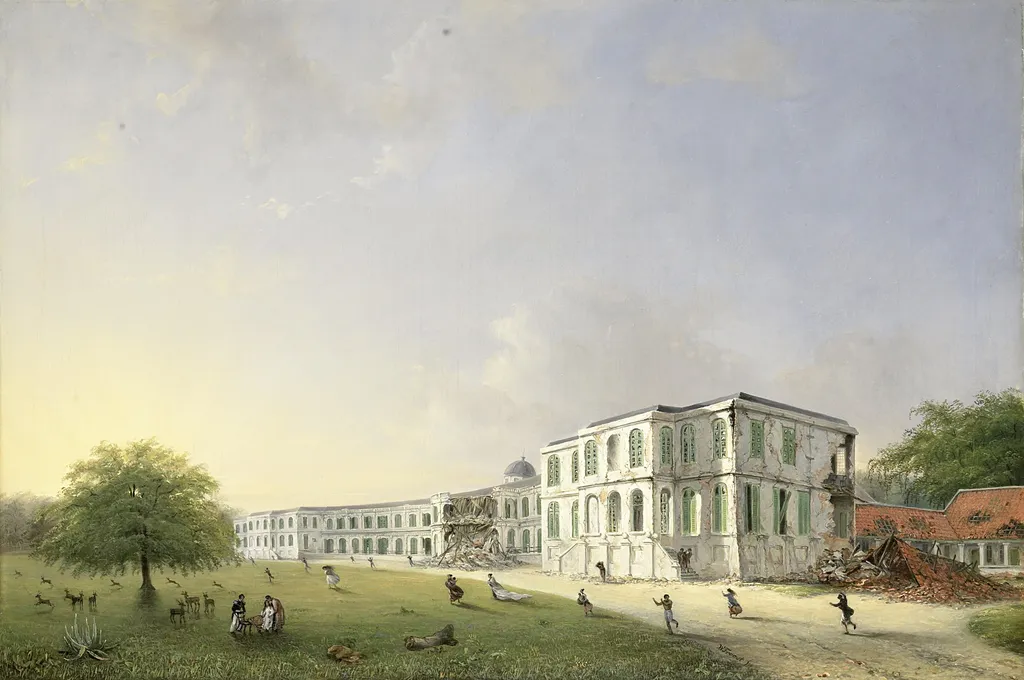
Front View of Buitenzorg Palace after the Earthquake of 10 October 1834 is an oil painting by Willem Troost. It dates from 1834 and is held in the collection of the Rijksmuseum.
About this work
Overview
Willem Troost’s 1834 oil painting records the condition of Bogor Palace—then known as Buitenzorg—shortly after the earthquake of 10 October 1834. The work presents a broad view of the palace’s façade amid a devastated courtyard, emphasizing both structural damage and the surrounding landscape.
Subject & Meaning
The canvas captures the palace’s cracked walls, shattered windows and a collapsed corner, while figures move among the debris, some transporting possessions, others pausing in contemplation. Trees line the left side and distant livestock add a sense of continuity beyond the disaster, suggesting resilience amid upheaval.
Technique & Style
Executed in oil on canvas, Troost employs a muted palette and soft lighting to convey the hazy atmosphere after the quake. Loose brushwork defines the ruined masonry, whereas finer detail renders the human activity, creating a contrast between the chaotic ruin and moments of quiet observation.
History & Provenance
Created the same year as the seismic event, the painting entered the collection of the Rijksmuseum, where it remains on display. Its acquisition reflects the museum’s interest in documenting Dutch colonial architecture and historical events in the East Indies.
Context
The work belongs to a period when Dutch artists documented colonial territories, often emphasizing the impact of natural disasters on European structures abroad. The 1834 earthquake was a significant event in Java, and Troost’s depiction provides a visual record of its immediate aftermath.
Own this work as a print
Artist & collection
