Museum
King Ferdinand I National Military Museum
King Ferdinand I National Military Museum is a museum.
About King Ferdinand I National Military Museum
Overview & Identity
The King Ferdinand I National Military Museum (Romanian: Muzeul Militar Național "Regele Ferdinand I") is a prominent historical institution located in Bucharest, Romania. Established on December 18, 1923, by Royal Decree no. 6064 signed by King Ferdinand I, the museum was created to preserve and showcase Romania's military heritage. It is situated at 125-127 Mircea Vulcănescu Street, near the Gara de Nord (North Railway Station), and serves as a key resource for understanding the nation's military history from ancient times to the modern era. The institution was officially renamed to honor its founder in 2006.
History & Founding
The museum's origins trace back to the 1906 National Exhibition in Carol Park, where an Artillery Museum pavilion sparked the idea for a permanent institution. Although a military section was authorized in 1914, World War I disrupted its progress. Following the war, a temporary exhibition opened in 1919 under the patronage of King Ferdinand I and Queen Marie, displaying war trophies. This success led to the official establishment of the National Military Museum in 1923. The institution faced significant challenges, including a devastating fire in 1938, damage from the 1940 earthquake, and demolition of its buildings in 1943 by German authorities. It underwent multiple relocations, including stints on Șerban-Vodă Street and Nicolae Bălcescu Boulevard, before settling in its current location in 1986.
Building & Architecture
The museum currently occupies the former barracks of the 4th Ilfov Regiment, a building constructed in 1898 on Mircea Vulcănescu Street. The complex was reorganized and modernized before reopening to the public on October 23, 1988. The facility covers an area of 22,150 square meters and is divided into four buildings with a total of nine floors. The architecture accommodates extensive indoor exhibition halls as well as a large outdoor area dedicated to heavy military hardware. This location, formerly a military barracks, provides a historically appropriate setting for the collection, situated close to the city's main railway station.
Collection Highlights & Notable Holdings
The museum's collection spans from prehistoric times to the present, featuring archaeological artifacts, medieval weaponry, and modern military technology. Notable indoor exhibits include uniforms, cold weapons, firearms, and a comprehensive narrative of Romanian history from Antiquity through the 1989 Revolution. The outdoor courtyard houses a significant array of heavy equipment, including Vickers/Reșița anti-aircraft guns, Negrei Model 1916 heavy mortars, and various tanks such as the Renault FT, Renault R35, Panzer IV, and the TACAM R-2 tank destroyer. The aviation hangar displays helicopters and aircraft, including a replica of the IAR-80 fighter and a Fleet 10G training aircraft, alongside rocket launchers and a train-mounted launcher.
Significance & Legacy
The King Ferdinand I National Military Museum is considered one of Romania's most significant cultural institutions, often regarded as a primary alternative for understanding national history, especially when other major museums are undergoing restoration. It serves as a vital educational tool for patriotic instruction and public engagement with military history. The museum administers regional branches in Bacău, Cluj-Napoca, and Constanța, extending its reach beyond the capital. Its collection preserves crucial artifacts from the War of Independence, World War I, and World War II, including the country's shift in allegiance during the latter conflict, making it an essential site for historical research and remembrance.
What to see at King Ferdinand I National Military Museum
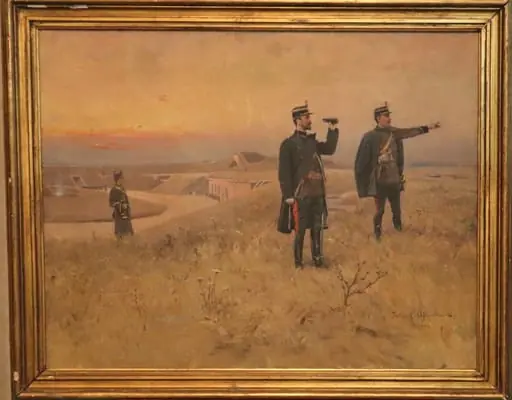
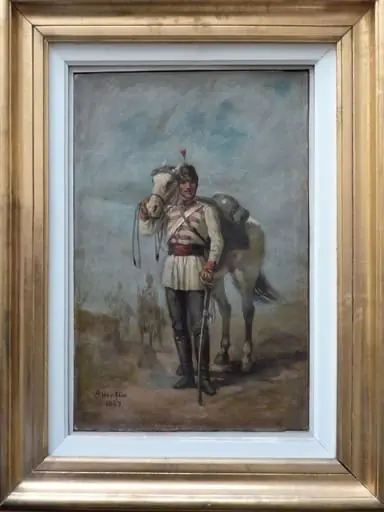
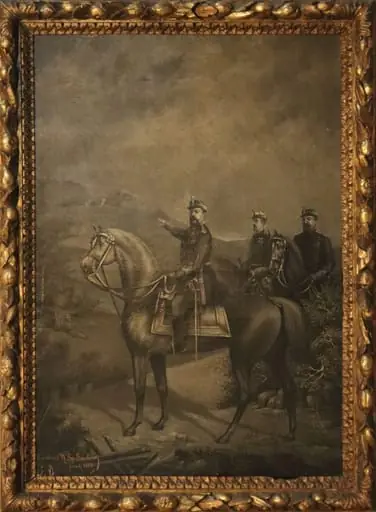
Start with Doi ofițeri din Regimentului 1 Artilerie Cetate by Tadeusz Ajdukiewicz.