Artist
Andries Cornelis Lens
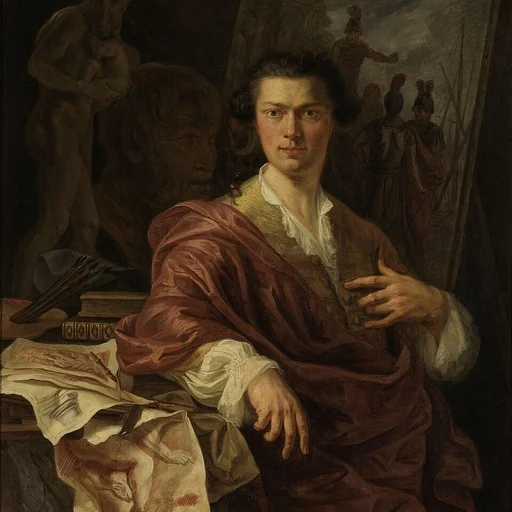
1739–1822
Andries Cornelis Lens was a Rococo painting artist. 11 works are cataloged here, principally at Royal Museum of Fine Arts Antwerp. Andries Cornelis Lens was born in Antwerp.
Overview
Andries Cornelis Lens or André Corneille Lens (Antwerp, 31 March 1739 – Brussels, 30 March 1822) was a Flemish painter, illustrator, art theoretician and art educator. He is known for his history paintings of biblical and mythological subjects and portraits. Wishing to contribute to the revival of painting in Flanders, he took his inspiration from the classical traditions of the 16th century and drew inspiration from Raphael. He was thus a promoter of Neoclassicism in Flemish art. He was a teacher and director of the Academy of Fine Arts of Antwerp. Lens was court painter to the governor-general of the Austrian Netherlands and settled in Brussels where he married. Lens was also a writer and historian who published an illustrated book which discussed the costumes, ornaments and furnishings of the various people in Antiquity and another book setting out his art theories.
Life
Andries Cornelis Lens was the son of Corneille Lens and Magdalena Slaets. His father was originally from Tilff near Liège, a Walloon city then in the Prince-Bishopric of Liège. His father was a flower painter and gilder who had moved to Antwerp at a young age. Here he had joined the local Guild of Saint Luke. Corneille Lens became the dean of the Guild but often had conflicts with the Guild. Andries Cornelis Lens started his artistic training with the painter Carel Ykens the Younger. After Ykens died in 1753 he continued his studies with Balthasar Beschey. At the same time Lens studied at the Antwerp Academy where he was a precocious student who obtained several first prizes for life drawing, winning the second prize at the age of 15 and the first prize at the age of 17. One of his teachers at the Academy was the engraver Peter Martenasie. Martenasie thought drawing after the Antique and required his students to draw after Greek statues. Lens painted a portrait of Martenasie. Martenasie was influential on Lens' development towards a classicist style.
Lens became a director and teacher at the Antwerp Academy in 1763. To prove his qualifications for this position he gave the Academy in the year of his appointment a composition Hercules protects painting from Ignorance and Envy (Royal Museum of Fine Arts Antwerp). The governor-general of the Southern Netherlands Prince Charles Alexander of Lorraine took a liking to the young artist and appointed Lens as his court painter in September 1764. He also gave Lens a stipend which allowed him to go study in Italy. The artist left on 21 October 1764 for Italy where he studied for almost four years and copied many of the old Italian masters and in particular, Raphael. His brother Jacob (also known as 'Jacques-Joseph') who was seven years his junior accompanied him on his trip to Italy. They spent time in Florence, Rome and Naples. He travelled back to Antwerp via Paris where he was exposed to new currents in art. Upon his return to Antwerp Lens became a promoter of these new ideas.
Lens tried to introduce reforms at the Antwerp Academy aimed at emphasizing the study after models from the Antique. His proposals met with resistance from his fellow directors. Like his father, Lens came into conflict with the Guild of Saint Luke. He regarded the Guild as an obstacle to the development of the artist and pleaded for the liberation of the artist from the guild system which made it a condition to practice art in any city in Flanders that the artist be a member of the local guild. When his young brother Jacob was denied a first prize in a local drawing competition, he took the matter very personally. He sent an anonymous letter to Prince Charles Alexander of Lorraine at the court of Brussels pleading for the removal of the Guild's authority over Antwerp's artists and placing that authority in the hands of the Academy, which would determine the fitness of an artist to practise. As a court painter himself, Lens was in fact not subject to the Guild restrictions. He argued that the mixing of the painters with the craftsmen in the Guild was an unnecessary burden on the painters. The Prince sent the anonymous letter on to the Antwerp city government, which in turn sought the advice of the Academy. The Guild opposed any reform to the current system. Lens visited the Prince to plead his case in person. He prevailed in the end and the empress Maria Theresa issued on 20 March 1773 an order th
Work
Andries Cornelis Lens was a painter whose main subject matter were scenes from the bible and Antique mythology. He was an early representative of Neoclassicism in Flemish painting. His version of Neoclassicism is very personal and influenced by Flemish painting traditions. While his work was not appreciated by his contemporary Flemish artists, he was successful in his time and had various important patrons. However, he did not establish his own school and his reputation did not survive for long.
Collections represented


Museum


Museum
Artists in a similar vein