Artist
Yayoi Kusama
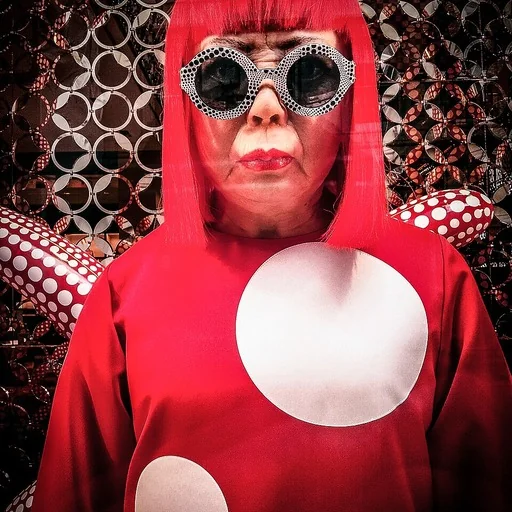
Japanese, b. 1929
Yayoi Kusama is a Japanese Abstract Expressionism artist. 9 works are cataloged here, principally at Museum of Modern Art. Yayoi Kusama was born in Matsumoto.
Overview
Yayoi Kusama (草間 彌生, Kusama Yayoi; born 22 March 1929) is a Japanese contemporary artist who works primarily in sculpture and installation. She is also active in painting, performance, video art, fashion, poetry, fiction, and other arts. Her work is based in conceptual art and shows some attributes of feminism, minimalism, surrealism, art brut, pop art, and abstract expressionism, and is infused with autobiographical, psychological, and sexual content. She has been acknowledged as one of the most important living artists to come out of Japan, the world's top-selling female artist, and the world's most successful living artist. Her work influenced that of her contemporaries, including Andy Warhol and Claes Oldenburg. Kusama was raised in Matsumoto, and trained at the Kyoto City University of Arts for a year in a traditional Japanese painting style called nihonga. She was inspired by American abstract impressionism. She moved to New York City in 1958 and was a part of the New York avant-garde scene throughout the 1960s, especially in the pop-art movement. Embracing the rise of the hippie counterculture of the late 1960s, she came to public attention when she organized a series of happenings in which naked participants were painted with brightly colored polka dots. She experienced a period in the 1970s during which her work was largely overlooked, but a revival of interest in the 1980s brought her art back into public view. Kusama has continued to create art in various museums around the world, from the 1950s onwards. Kusama has been open about her mental health and has resided since the 1970s in a mental health facility. She says that art has become her way to express her mental problems. "I fight pain, anxiety, and fear every day, and the only method I have found that relieved my illness is to keep creating art", she told an interviewer in 2012. "I followed the thread of art and somehow discovered a path that would allow me to live."
Early life: 1929–1949
Yayoi Kusama was born on 22 March 1929 in Matsumoto, Nagano. Born into a family of merchants who owned a plant nursery and seed farm, Kusama began drawing pictures of pumpkins in elementary school and created artwork she saw from hallucinations, works of which would later define her career. Her mother was not supportive of her creative endeavors; Kusama would rush to finish her art because her mother would take it away to discourage her. Her mother was physically abusive, and she remembers her father as "the type who would play around, who would womanize a lot". She said her mother would often send her to spy on her father's extramarital affairs, which instilled within her a lifelong contempt for sexuality, particularly the male's lower body and the phallus: "I don't like sex. I had an obsession with sex. When I was a child, my father had lovers and I experienced seeing him. My mother sent me to spy on him. I didn't want to have sex with anyone for years ... The sexual obsession and fear of sex sit side by side in me." Her traumatic childhood, including her fantastic visions, can be said to be the origin of her artistic style. The pumpkins which are monumental in her art came from a visit to a big seed-harvesting ground with her grandfather when she was 10 years old. She said that she was "enchanted by their charming and winsome form" as well as their "generous unpretentiousness" even though they generally may not inspire too much respect. When Kusama was ten years old, she began to experience vivid hallucinations which she has described as "flashes of light, auras, or dense fields of dots". These hallucinations included flowers that spoke to Kusama, and patterns in fabric that she stared at coming to life, multiplying, and engulfing or expunging her, a process which she has carried into her artistic career and which she calls "self-obliteration". Kusama's art became her escape from her family and her own mind when she began to have hallucinations. She was reportedly fascinated by the smooth white stones covering the bed of the river near her family home, which she cites as another of the seminal influences behind her lasting fixation on dots. When Kusama was 13, she was sent to work in a military factory where she was tasked with sewing and fabricating parachutes for the Japanese army, then embroiled in World War II. Discussing her time in the factory, she says that she spent her adolescence "in closed darkness" although she could always hear the air-raid alerts going off and see American B-29s flying overhead in broad daylight. Her childhood was greatly influenced by the events of the war, and she claims that it was during this period that she began to value notions of personal and creative freedom. She attended Arigasaki High School. She went on to study Nihonga painting at the Kyoto Municipal School of Arts and Crafts in 1948. Frustrated with this distinctly Japanese style, she became interested in the European and American avant-garde, staging several solo exhibitions of her paintings in Matsumoto and Tokyo in the 1950s.
Early success in Japan: 1950–1956
By 1950, she was depicting abstract natural forms in watercolor, gouache, and oil paint, primarily on paper. She began covering surfaces—walls, floors, canvases, and later, household objects, and naked assistants—with the polka dots that became a trademark of her work. Her first show took place in Japan in 1952. The vast fields of polka dots, or "infinity nets", as she called them, were taken directly from her hallucinations. The earliest recorded work in which she incorporated these dots was a drawing in 1939 at age 10, in which the image of a Japanese woman in a kimono, presumed to be the artist's mother, is covered and obliterated by spots. Her first series of large-scale, sometimes more than 30 ft-long canvas paintings, Infinity Nets, were entirely covered in a sequence of nets and dots that alluded to hallucinatory visions. The Metropolitan Museum of Art's published wall text and object labels for Surrealism Beyond Borders state that Kusama was not officially associated with Surrealism, but discuss early gouaches such as A Circus Rider's Dream (1955) in relation to the movement. The same text notes that she was in contact with the poet-critic Shūzō Takiguchi, described there as a major proponent of Surrealism in Japan. On her 1954 painting Flower (D.S.P.S), Kusama has said:
One day I was looking at the red flower patterns of the tablecloth on a table, and when I looked up I saw the same pattern covering the ceiling, the windows, and the walls, and finally all over the room, my body and the universe. I felt as if I had begun to self-obliterate, to revolve in the infinity of endless time and the absoluteness of space, and be reduced to nothingness. As I realised it was actually happening and not just in my imagination, I was frightened. I knew I had to run away lest I should be deprived of my life by the spell of the red flowers. I ran desperately up the stairs. The steps below me began to fall apart and I fell down the stairs spraining my ankle.
New York City: 1957–1972
After living in Tokyo and France, Kusama left Japan at the age of 27 for the United States. She has stated that she began to consider Japanese society "too small, too servile, too feudalistic, and too scornful of women". Before leaving Japan for the United States, she destroyed many of her early works. In 1957, she moved to Seattle, where she had an exhibition of paintings at the Zoe Dusanne Gallery. She stayed there for a year before moving on to New York City, following correspondence with Georgia O'Keeffe in which she professed an interest in joining the limelight of the city, and sought O'Keeffe's advice. She arrived in New York City in 1958 where the majority of her well known collections were born: Infinity Networks and sculptures. Her first exhibition that earned great success was in 1959 at the Brata Gallery and then she went on to pioneering body art performances and "happenings". During her time in the US, she quickly established her reputation as a leader in the avant-garde movement and received praise for her work from the anarchist art critic Herbert Read. In 1961, she moved her studio into the same building as Donald Judd and sculptor Eva Hesse; Hesse became a close friend. In the early 1960s, Kusama began to create so-called soft sculptures by covering items such as ladders, shoes and chairs with white phallic protrusions. Despite the micromanaged intricacy of the drawings, she turned them out fast and in bulk, establishing a rhythm of productivity which she still maintains. She established other habits too, like having herself routinely photographed with new work and regularly appearing in public wearing her signature bob wigs and colorful, avant-garde fashions. In June 1963, one of Kusama's soft sculpture pieces, a couch covered with phallus-like protrusions she had sewn, was exhibited at the Green Gallery. Included in the same exhibition was a papier-mache sculpture by Claes Oldenburg, who had not worked in soft sculpture. Kusama's piece received the most attention from attendees and critics, and by September Oldenburg was exhibiting sewn soft sculpture, some pieces of which were very similar to Kusama's; Oldenburg's wife apologized to Kusama at the exhibit. According to Fordham professor of art Midori Yamamura, Oldenburg likely was inspired by Kusama's work to use sewn pieces himself, pieces which made him an "international star". Kusama became depressed over the incident. A similar incident occurred soon after when Kusama exhibited a boat she had covered in soft sculpture, with photographs of the boat completely covering the walls of the exhibit space, which was very innovative. Andy Warhol remarked on the exhibit, and not long after covered the walls of an exhibit space with photos of a cow, for which he drew significant attention. Kusama became very secretive about her studio work. Helaine Posner, of the Neuberger Museum of Art, said it was likely some combination of sexism and racism that kept Kusama, who was creating work of equal importance to men who were using her ideas and taking the credit for them, from getting the same kinds of backing.
Since 1963, Kusama has continued her series of Mirror/Infinity rooms. In these complex infinity mirror installations, purpose-built rooms lined with mirrored glass contain scores of neon-colored balls, hanging at various heights above the viewer. Standing inside on a small platform, an observer sees light repeatedly reflected off the mirrored surfaces to create the illusi
Return to Japan: 1973–1977
In 1973, Kusama returned to Japan. Her reception from the Japanese art world and press was unsympathetic; one art collector recalled considering her a "scandal queen". She was in ill health, but continued to work, writing shockingly visceral and surrealistic novels, short stories, and poetry. She became so depressed she was unable to work and made another suicide attempt, then in 1977, found a doctor who was using art therapy to treat mental illness in a hospital setting. She checked herself in and eventually took up permanent residence in the hospital. She has been living at the hospital ever since, by choice. Her studio, where she has continued to produce work since the mid-1970s, is a short distance from the hospital in Tokyo. Kusama is often quoted as saying: "If it were not for art, I would have killed myself a long time ago." From this base, she has continued to produce artworks in a variety of media, as well as launching a literary career by publishing several novels, a poetry collection, and an autobiography. Her painting style shifted to high-colored acrylics on canvas, on an amped-up scale.
Revival: 1980s–present
Kusama's move to Japan meant she had to build a new career from scratch. Her organically abstract paintings of one or two colors (the Infinity Nets series), which she began upon arriving in New York, garnered comparisons to the work of Jackson Pollock, Mark Rothko, and Barnett Newman. When she left New York she was practically forgotten as an artist until the late 1980s and 1990s, when a number of retrospectives revived international interest. Yayoi Kusama: A Retrospective was the first critical survey of Yayoi Kusama presented at the Center for International Contemporary Arts (CICA) in New York in 1989, and was organized by Alexandra Munroe. Following the success of the Japanese pavilion at the Venice Biennale in 1993, a dazzling mirrored room filled with small pumpkin sculptures in which she resided in color-coordinated magician's attire, Kusama went on to produce a huge, yellow pumpkin sculpture covered with an optical pattern of black spots. The pumpkin came to represent for her a kind of alter-ego or self-portrait. The 2.5-meter-wide "Pumpkin", made of fiberglass-reinforced plastic, was installed in 1994 on a pier on Naoshima, Kagawa, becoming iconic as her profile grew in the following decades; it was reinstalled in 2022 after being destroyed by a typhoon a year earlier. Kusama's later installation I'm Here, but Nothing (2000–2008) is a simply furnished room consisting of table and chairs, place settings and bottles, armchairs and rugs; however, its walls are tattooed with hundreds of fluorescent polka dots glowing in the UV light. The result is an endless infinite space where the self and everything in the room is obliterated.
The multi-part floating work Guidepost to the New Space, a series of rounded "humps" in fire-engine red with white polka dots, was displayed in Pandanus Lake. Perhaps one of Kusama's most notorious works, various versions of Narcissus Garden have been presented worldwide venues including Le Consortium, Dijon, 2000; Kunstverein Braunschweig, 2003; as part of the Whitney Biennial at Central Park, New York in 2004; and at the Jardin de Tuileries in Paris, 2010. Kusama continued to work as an artist in her ninth decade. She has harkened back to earlier work by returning to drawing and painting; her work remained innovative and multi-disciplinary, and a 2012 exhibition displayed multiple acrylic-on-canvas works. Also featured was an exploration of infinite space in her Infinity Mirror rooms. These typically involve a cube-shaped room lined in mirrors, with water on the floor and flickering lights; these features suggest a pattern of life and death. In 2015–2016, the first retrospective exhibition in Scandinavia, curated by Marie Laurberg, travelled to four major museums in the region, opening at Louisiana Museum of Modern Art in Denmark and continuing to Henie Onstad Kunstsenter Museum, Norway; Moderna Museet in Sweden, and Helsinki Art Museum in Finland. This major show contained more than 100 objects and large-scale mirror room installations. It presented several early works that had not been shown to the public since they were first created, including a presentation of Kusama's experimental fashion design from the 1960s. In 2017, a 50-year retrospective of her work opened at the Hirshhorn Museum in Washington, DC. The exhibit featured six Infinity Mirror rooms, and was scheduled to travel to five museums in the US and Canada. On 25 February 2017, Kusama's All the Eternal Love I Have for the Pumpkins exhibit,
Kusama's mental health
Yayoi Kusama experienced a lot of trauma in her early life that affected and exacerbated her mental health struggles. Her mother forced her to be witness to her father cheating on her mother. Her mother was also disapproving of her artistry; she even took away Kusama's art materials in hopes to deter her. Kusama suffered from Obsessive Compulsive Disorder, or OCD, as well as hallucinations and mania. She had sexual traumas as well and parts of her life were unsafe in a physical sense, as she lived in Japan around the time of World War II. Like many artists, Kusama views her art as an outlet to cope with her struggles, rather than an escape and views it a necessary part of her work. Her artwork with pumpkins and nets illustrates her fixations with "self-obliteration." This and her other works relating to the concept of infinity, place one tiny polka dot or one light around an infinite amount to make one seem small and insignificant. She finds her work to be a confrontation and a transformation of her fears of her traumas, such as her abuse, sexuality, compulsions, and hallucinations into something comforting with the use of softer materials, less vibrant colors, and the continuous or endless feelings expressed in her infinity works.
Meaning and origins of her work
Curator Mika Yoshitake has stated that Kusama's works on display are meant to immerse the whole person into her accumulations, obsessions, and repetitions. Kusama's use of infinite and repetitive patterns started as a way to cope with intrusive thoughts related to her mental health, and these ideas later shaped her immersive artistic environments. Claire Voon has described one of Kusama's mirror exhibits as being able to "transport you to quiet cosmos, to a lonely labyrinth of pulsing light, or to what could be the enveloping innards of a leviathan with the measles". Creating these feelings amongst audiences was intentional. These experiences seem to be unique to her work because Kusama wanted others to sympathise with her in her troubled life. Bedatri D. Choudhury has described how Kusama not feeling in control throughout her life made her, either consciously or subconsciously, want to control how others perceive time and space when entering her exhibits. Art had become a coping mechanism for Kusama. In 1962, Kusama created her work Accumulation of Stamps, 63. The medium used are pasted labels and ink on paper with dimensions of 23 3/4 x 29" (60.3 x 73.6 cm). The art was donated by Phillip Johnson to the Department of Drawings and Prints at the Museum of Modern Art. Kusama experienced hallucinations of flowers, dots, and nets during her childhood. These visions engulfed her surroundings, covering everything from ceilings to windows and walls. She saw the same pattern expand to encompass her body and the entire universe. Kusama's hallucinations, often connected to her mental health, strongly influenced her artistic style and led her to create immersive works that connect personal experience with audience participation. To cope with her condition, Kusama adopted repeated forms in her art, using store-bought labels and stickers. She does not view her art as an end in itself but rather as a means to address her disability that originated in her childhood. The process of repetition, evident in her collages, reflects her artistic approach. Consequently, many of her artworks bear titles that include words like "accumulation" and "infinity". Art critic for The Australian newspaper, Christopher Allen, called Kusama "one of the world's most determinedly vacuous artists".
Performance
In Kusama's Walking Piece (1966), a performance that was documented in a series of eighteen color slides, Kusama walked along the streets of New York City in a traditional Japanese kimono while holding a parasol. The kimono suggested traditional roles for women in Japanese custom. The parasol, however, was made to look inauthentic, as it was actually a black umbrella, painted white on the exterior and decorated with fake flowers. Kusama walked down unoccupied streets in an unknown quest. She then turned and cried without reason, and eventually walked away and vanished from view. This performance, through the association of the kimono, involved the stereotypes that Asian-American women continued to face. However, as an avant-garde artist living in New York, her situation altered the context of the dress, creating a cross-cultural amalgamation. Kusama was able to highlight the stereotype in which her white American audience categorized her, by showing the absurdity of culturally categorizing people in the world's largest melting pot.
Film
In 1968, Kusama and Jud Yalkut's collaborative work Kusama's Self-Obliteration won a prize at the Fourth International Experimental Film Competition in Belgium and the Second Maryland Film Festival and the second prize at the Ann Arbor Film Festival. The 1967 experimental film, which Kusama produced and starred in, depicted Kusama painting polka dots on everything around her, including bodies. In 1991, Kusama starred in the film Tokyo Decadence, written and directed by Ryū Murakami, and in 1993, she collaborated with British musician Peter Gabriel on an installation in Yokohama.
Fashion
In 1968, Kusama established Kusama Fashion Company Ltd, and began selling avant-garde fashion in the "Kusama Corner" at Bloomingdale's. In 2009, Kusama designed a handbag-shaped cell phone entitled Handbag for Space Travel, My Doggie Ring-Ring, a pink dotted phone in accompanying dog-shaped holder, and a red and white dotted phone inside a mirrored, dotted box dubbed Dots Obsession, Full Happiness With Dots, for Japanese mobile communication giant KDDI Corporation's "iida" brand. Each phone was limited to 1,000 pieces. In 2011, Kusama created artwork for six limited-edition lipglosses from Lancôme. That same year, she worked with Marc Jacobs (who visited her studio in Japan in 2006) on a line of Louis Vuitton products, including leather goods, ready-to-wear, accessories, shoes, watches, and jewelry. The products became available in 2012 at a SoHo pop-up shop, which was decorated with Kusama's trademark tentacle-like protrusions and polka-dots. Eventually, six other pop-up shops were opened around the world. When asked about her collaboration with Marc Jacobs, Kusama replied that "his sincere attitude toward art" is the same as her own. Louis Vuitton created a second set of products in 2023.
Writing
In 1977, Kusama published a book of poems and paintings entitled 7. One year later, her first novel Manhattan Suicide Addict appeared. Between 1983 and 1990, she finished the novels The Hustler's Grotto of Christopher Street (1983), The Burning of St Mark's Church (1985), Between Heaven and Earth (1988), Woodstock Phallus Cutter (1988), Aching Chandelier (1989), Double Suicide at Sakuragazuka (1989), and Angels in Cape Cod (1990), alongside several issues of the magazine S&M Sniper in collaboration with photographer Nobuyoshi Araki. Her most recent writing endeavor includes her autobiography Infinity Net published in 2003 that depicts her life from growing up in Japan, her departure to the United States, and her return to her home country, where she now resides. Infinity Net includes her poetry and photographs of her exhibitions. In October 2023, Kusama apologized for a number of racist comments against Black people in her writing.
Commissions
To date, Kusama has completed several major outdoor sculptural commissions, mostly in the form of brightly hued monstrous plants and flowers, for both public and private institutions, including Pumpkin (1994) for the Fukuoka Municipal Museum of Art; The Visionary Flowers (2002) for the Matsumoto City Museum of Art; Tsumari in Bloom (2003) for Matsudai Station, Niigata; Tulipes de Shangri-La (2003) for Euralille in Lille, France; Red Pumpkin (2006) for Naoshima Town, Kagawa; Hello, Anyang with Love (2007) for Pyeonghwa Park (now referred as World Cup Park), Anyang; and The Hymn of Life: Tulips (2007) for the Beverly Gardens Park in Los Angeles. In 1998, she realized a mural for the hallway of the Gare do Oriente subway station in Lisbon. Alongside these monumental works, she has produced smaller-scale outdoor pieces, including Key-Chan and Ryu-Chan, a pair of dotted dogs. All the outdoor works are cast in highly durable fiberglass-reinforced plastic, then painted in urethane to glossy perfection.
In 2010, Kusama designed a Town Sneaker styled bus, which she titled Mizutama Ranbu (Wild Polka Dot Dance) and whose route travels through her hometown of Matsumoto. In 2011, she was commissioned to design the front cover of millions of pocket London Underground maps; the result is entitled Polka Dots Festival in London (2011). Coinciding with an exhibition at the Whitney Museum of American Art in 2012, a 120-foot (37 m) reproduction of Kusama's painting Yellow Trees (1994) covered a condominium building under construction in New York's Meatpacking District. That same year, Kusama conceived her floor installation Thousands of Eyes as a commission for the new Queen Elizabeth II Courts of Law, Brisbane.
Select exhibitions
Rodenbeck, J. F. "Yayoi Kusama: Surface, Stitch, Skin". Zegher, M. Catherine de. Inside the Visible: An Elliptical Traverse of 20th Century Art in, of, and from the Feminine. Cambridge, Massachusetts: MIT Press, 1996. ISBN 978-0-262-54081-0 OCLC 33863951 Institute of Contemporary Art, Boston, 30 January – 12 May 1996. Kusama, Yayoi, and Damien Hirst. Yayoi Kusama Now. New York: Robert Miller Gallery, 1998. ISBN 978-0-944-68058-2 OCLC 42448762 Robert Miller Gallery, New York, 11 June – 7 August 1998. Kusama, Yayoi, and Lynn Zelevansky. Love Forever: Yayoi Kusama, 1958–1968. Los Angeles: Los Angeles County Museum of Art, 1998. ISBN 978-0-875-87181-3 OCLC 39030076 Los Angeles County Museum of Art, 8 March – 8 June 1998; three other locations through 4 July 1999. Kusama, Yayoi. Yayoi Kusama. Vienna: Kunsthalle Wien, 2002. ISBN 978-3-852-47034-4 OCLC 602369060 Kusama, Yayoi. Yayoi Kusama. Paris: Les Presses du Reel, 2002. ISBN 978-0-714-83920-2 OCLC 50628150 Seven European exhibitions in France, Germany, Denmark, etc.; 2001–2003. Kusama, Yayoi. Kusamatorikkusu = Kusamatrix. Tokyo: Kadokawa Shoten, 2004. ISBN 978-4-048-53741-4 OCLC 169879689 Mori Art Museum, 7 February – 9 May 2004; Mori Geijutsu Bijutsukan, Sapporo, 5 June – 22 August 2004. Kusama, Yayoi, and Tōru Matsumoto. Kusama Yayoi eien no genzai = Yayoi Kusama: eternity-modernity. Tokyo: Bijutsu Shuppansha, 2005. ISBN 978-4-568-10353-3 OCLC 63197423 Tokyo Kokuritsu Kindai Bijutsukan, 26 October – 19 December 2004; Kyoto Kokuritsu Kindai Bijutsukan, 6 January – 13 February 2005; Hiroshima-shi Gendai Bijutsukan, 22 February – 17 April 2005; Kumamoto-shi Gendai Bijutsukan, 29 April – 3 July 2005; at Matsumoto-shi Bijutsukan, 30 July – 10 October 2005. Applin, Jo, and Yayoi Kusama. Yayoi Kusama. London: Victoria Miro Gallery, 10 October – 17 November 2007. ISBN 978-0-955-45644-2 OCLC 501970783 Kusama, Yayoi. Yayoi Kusama. Gagosian Gallery, New York, 16 April – 27 June 2009; Gagosian Gallery, Beverly Hills, 30 May – 17 July 2009. ISBN 978-1-932-59894-0 OCLC 320277816 Morris, Frances, and Jo Applin. Yayoi Kusama. London: Tate Publishing, 2012. ISBN 978-1-854-37939-9 OCLC 781163109 Reina Sofia, Madrid, 10 May – 12 September 2011; Centre Pompidou, Paris, 10 October 2011 – 9 January 2012; Whitney Museum of American Art, New York, 12 July – 30 September 2012; Tate Modern (London), 9 February – 5 June 2012. Kusama, Yayoi, and Akira Tatehata. Yayoi Kusama: I Who Have Arrived in Heaven. New York: David Zwirner, 2014. ISBN 978-0-989-98093-7 OCLC 879584489 David Zwirner Gallery, New York, 8 November – 21 December 2013. Laurberg, Marie: Yayoi Kusama – In Infinity, Denmark: Louisiana Museum of Modern Art, 2015, Heine Onstadt, Oslo, 2016, Moderna Museum, Stockholm, 2016, and Helsinki Art Museum, 2016 David Zwirner Gallery, New York, 9 November – 14 December 2019. Pérez Art Museum Miami. Yayoi Kusama: LOVE IS CALLING, 9 March 2023 – 11 February 2024. National Gallery of Victoria, Melbourne, Australia. Yayoi Kusama, 15 December 2024 – 21 April 2025
Collections represented

Museum
Artists in a similar vein