Artist
Giorgio Morandi
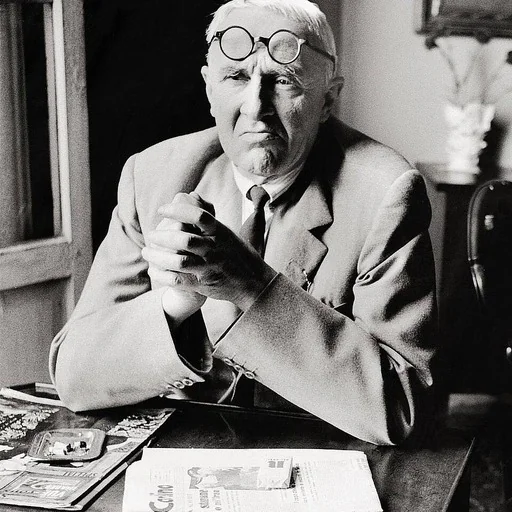
Italian, 1890–1964
Giorgio Morandi was an Italian Realism artist. 15 works are cataloged here, principally at Museum of Modern Art. Giorgio Morandi was born in Bologna.
Overview
Giorgio Morandi (July 20, 1890 – June 18, 1964) was an Italian painter and printmaker widely known for his subtly muted still-life paintings of ceramic vessels, flowers, and landscapes.
Biography
Morandi was born in Bologna, Italy, to Andrea Morandi and Maria Maccaferri, the eldest of five children. He lived first on Via Lame, where his brother Giuseppe and his sister Anna were born. The family then moved to Via Avesella, where two other sisters were born, Dina in 1900 and Maria Teresa in 1906. After the death of his father in 1909, the family moved to Via Fondazza, and Giorgio became the head of the family. From 1907 to 1913, he studied at the Accademia di Belle Arti di Bologna ('Academy of Fine Arts of Bologna'). At the Accademia, which based its traditions on 14th-century painting, Morandi taught himself to etch by studying books on Rembrandt. He was excellent at his studies, although his professors disapproved of the changes in his style during his final two years at the Accademia. In 1910, he visited Florence, where the works of artists such as Giotto, Masaccio, Piero della Francesca, and Paolo Uccello made a profound impression on him. He had a brief digression into a Futurist style in 1914. In that same year, Morandi was appointed instructor of drawing for elementary schools in Bologna, a post he held until 1929. Morandi was influenced by the works of Cézanne, Derain, and Picasso. Morandi began exhibiting in 1914 in Bologna, alongside Mario Bacchelli, Osvaldo Licini, Severo Pozzati and Giacomo Vespignani, and at the First Free Futurist Exhibition at the Sprovieri Gallery in Rome. In 1915, he joined the army, had a breakdown and was discharged. During World War I, Morandi's still life paintings became more reduced in their compositional elements and more pure in form, reflecting an admiration for both Cézanne and Henri Rousseau. Morandi practiced metaphysical painting (Italian: pittura metafisica) from 1918 to 1922. This was his last major stylistic shift; thereafter, he focused increasingly on subtle gradations of hue, tone, and objects arranged in a unifying atmospheric haze, establishing the direction his art was to take for the rest of his life. In the first post-war period he collaborated with Mario Broglio's magazine Valori Plastici, met Giorgio de Chirico, and exhibited with de Chirico, Carlo Carrà and Arturo Martini at the Fiorentina Primaverile in 1922. Morandi showed in the Novecento Italiano exhibitions of 1926 and 1929, but was more specifically associated with the regional Strapaese group by the end of the decade, a fascist-influenced group emphasizing local cultural traditions. He was sympathetic to the Fascist party in the 1920s, although his friendships with anti-Fascist figures led authorities to arrest him briefly in 1943. From 1928, Morandi exhibited his work in Italy and abroad. He participated in some of the Venice Biennale exhibitions, where, in 1948, he won first prize for painting, and in the Rome Quadriennale, in 1931 and 1935. In 1929, he illustrated the work Il sole a picco by Vincenzo Cardarelli, winner of the Premio Bagutta. From 1930 to 1956, Morandi was a professor of etching at Accademia di Belle Arti. He visited Paris for the first time in 1956. That year he also travelled to Winterthur to attend the opening of a solo exhibition and to study works by Chardin and Cézanne in the Oskar Reinhart Collection. Morandi received the Grand Prize for engraving at the São Paulo Art Biennial in 1953, the Grand Prize for painting at the same event in 1957, and the Rubens Prize of the city of Siegen in 1962. Morandi died of lung cancer on June 18, 1964 at age 73. He is buried in the Certosa di Bologna in
Bologna and the Apennine landscape
Morandi's work remained closely connected with Bologna and with the Bolognese Apennines. He spent almost his entire life in Bologna, where his studio and apartment in Via Fondazza became associated with the domestic objects, books and working materials that recur in his still lifes. In his landscapes, he repeatedly returned to familiar places in and around the city. The Vatican Museums note that he favoured the outskirts of Bologna, depicting familiar places without human presence. Works associated with Bologna include The Bridge over the Savena at Bologna and Landscape (The Chimneys of the Arsenal on the Outskirts of Bologna), while the Museum of Modern Art holds prints such as Bridge over the Savena, Bologna and View of Montagnola, Bologna. Grizzana became another central place in Morandi's life and work. He first encountered its landscape in 1913, when the Morandi family spent the summer there after a doctor recommended a stay in healthier air for his sister Anna. The family later returned regularly to Grizzana, and during World War II Morandi and his sisters stayed there to escape the disruption of city life in Bologna. At the end of the 1950s the family built a summer house at Grizzana; the building later became the Casa Museo Morandi, preserving the artist's studio and domestic environment. The Fienili del Campiaro, visible from the Grizzana house, are among the places most closely associated with Morandi's Apennine landscapes. The Centro di Documentazione Giorgio Morandi, founded in 1984, has been housed since 2000 in the Campiaro complex, which includes the Museo degli Allievi, an exhibition space and the artist's family house, now a museum. Another significant Apennine site was Rocca di Roffeno, a hamlet of Castel d'Aiano, where Morandi spent five summers between 1934 and 1938. According to the Museo Morandi, 39 works related to those summers are known, including 32 paintings, one watercolour, four drawings and two etchings. Museum interpretations generally treat Morandi's landscapes not as simple topographical views, but as formally distilled compositions. The Uffizi describe Paesaggio a Grizzana as a work based on observed reality but transformed through a careful synthesis of light, volume and structure, with references to Cézanne and Piero della Francesca.
Style and technique
Morandi's mature work is characterized by a deliberately restricted range of subjects, formats and tones. His paintings are usually small in scale and centred on still lifes and landscapes, but their apparent simplicity has often been described by museums and critics as masking a complex organization of forms, intervals and tonal relationships. The Phillips Collection describes still life as Morandi's ideal subject, since his primary concern was a measured balance of composition and tone. His still lifes were made from ordinary studio objects, including bottles, bowls, boxes, cups, vases, pitchers and jars, which he repeatedly arranged and rearranged on a tabletop. According to the Phillips Collection, Morandi sometimes altered these objects by painting their surfaces, removing labels and reflections in order to emphasize shape and volume. This repeated use of a limited group of objects allowed him to investigate subtle changes in placement, light, scale and spatial tension. Morandi's palette is generally subdued, with earthy colours, greys, creams, browns and muted tonal transitions. In a discussion of Still Life (1920), the Guggenheim Museum Bilbao notes that even apparently monochrome works may contain a range of tones and that Morandi's dense, opaque paint gives body and volume to his forms. His use of dim, diffuse light and restrained colour contributes to the quiet, contemplative quality for which his work is known. Although Morandi briefly engaged with Futurism and metaphysical painting, his mature art moved away from the rhetoric of the avant-garde toward a slow, concentrated exploration of perception. The Guggenheim Museum Bilbao has emphasized the importance of earlier art for Morandi, especially the geometry and intimacy of Chardin, the use of light in Zurbarán, the naturalism of Italian seventeenth-century painting, and details in works by El Greco and Giuseppe Crespi. Printmaking was also central to Morandi's practice. The Metropolitan Museum of Art describes him as widely recognized as one of the great modern masters of copper-plate etching. His etchings often pursue the same problems as his paintings: tonal balance, spatial construction, the weight of objects and the relationship between light and form.
Legacy
Morandi was perceived as one of the few Italian artists of his generation to have escaped the taint of fascism and to have evolved a style of pure pictorial values congenial to modernist abstraction. Through his simple and repetitive motifs and economical use of colour, value, and surface, Morandi became a prescient and important forerunner of minimalism. Artists who have cited Morandi's work as an influence include Philip Guston, Vija Celmins, Wayne Thiebaud, Edmund de Waal, Joseph Cornell, Louise Nevelson, and Stanley Whitney, as well as architect Frank Gehry. Morandi and his work have been reviewed and critiqued by authors including Philippe Jaccottet, Jean Leymarie, Jean Clair, Yves Bonnefoy, Roberto Longhi, Francesco Arcangeli, Cesare Brandi, Lamberto Vitali, Luigi Magnani, Marilena Pasquali, and many other critics.
In popular culture
Federico Fellini paid tribute to Morandi in his 1960 film La dolce vita, which featured Morandi's paintings, as does the film La Notte by Michelangelo Antonioni. One of the main characters in Sarah Hall's novel How to Paint a Dead Man is loosely based on Morandi. Don DeLillo's novel Falling Man notes two Morandi paintings on the wall of a character's New York apartment, and makes mention of "a show of Morandi paintings at a gallery in Chelsea". Morandi was a particular favorite of the eccentric Scottish poet Ivor Cutler, who included a poem about the painter in his first anthology Many Flies Have Feathers (1973).
As a subject of photography
Some of the most famous photographers of the twentieth century photographed Morandi at his house on Via Fondazza, at Morandi's Grizzana house, and at the Venice Biennale. Among those who photographed Morandi or his studio were Herbert List, Duane Michals, Jean Francois Bauret, Paolo Prandi, Paolo Ferrari, Lamberto Vitali, Libero Grandi, Franz Hubmann, Leo Lionni, Antonio Masotti, Carlo Ludovico Ragghianti, Lee Miller, Giancolombo, Ugo Mulas, Luigi Ghirri, Gianni Berengo Gardin, and Luciano Calzolari. In 1989–90, Luigi Ghirri photographed Morandi's places of life and work in Bologna and Grizzana; the project, developed with the writer Giorgio Messori, was published posthumously as Atelier Morandi in 1992. The filmmaker Tacita Dean made the 16 mm films Still Life and Day for Night in Morandi's studio on Via Fondazza, Bologna; the works were commissioned and produced by Fondazione Nicola Trussardi. An exhibition of stills from Still Life was held at the Center for Italian Modern Art, New York, in 2016. In 2016, the American photographer Joel Meyerowitz published Morandi's Objects, a book with photographs of more than 260 objects that the painter had collected during his life.
Museums, house museums and collections
The largest public collection of Morandi's work is held by the Museo Morandi in Bologna, a branch of the Museo d'Arte Moderna di Bologna founded in 1993 by Franco Solmi (previous director of the Galleria d'Arte Moderna, Bologna) and the municipality of Bologna. The Centro Studi Giorgio Morandi and its president, Marilena Pasquali, also contributed to the museum's foundation. Morandi's works and atelier, which were owned by his family, were donated to the museum by his sister Maria Teresa Morandi. Today, the museum includes a reconstruction of Morandi's studio. Morandi is also associated with preserved domestic and museum spaces in the Bologna area. Casa Morandi in Via Fondazza 36, Bologna, preserves the original domestic and studio environment in which the artist lived and worked, including vases, bottles, shells and study models connected with his practice. The Casa Museo Morandi in Grizzana preserves the family summer house, including the artist's studio, rooms, furnishings and objects connected with his life and work. The Grizzana house forms part of the Centro di Documentazione Giorgio Morandi at the Fienili del Campiaro. Other significant public collections of Morandi include those of the Vatican Museums, where an entire room is devoted to his work; the Estorick Collection of Modern Italian Art in London, which owns at least twenty Morandi paintings and etchings; the Magnani-Rocca Foundation in Parma; and the Palazzo Citterio collection of the Pinacoteca di Brera in Milan, which includes paintings and works on paper by Morandi from several phases of his career. Other collections of Morandi's work are owned by major museums around the world, including the Louvre; the Musée d'Orsay; the Tate Modern; the Hermitage Museum; the National Museum of Art, Osaka; the Metropolitan Museum of Art; and the National Gallery of Art, from which two Morandi paintings were chosen by President Barack Obama for inclusion in the White House Collection.
Exhibitions
Although Morandi was reserved in temperament and was not primarily oriented toward public exhibition, his work was shown in Italy and abroad during his lifetime and has been the subject of major retrospectives after his death. He participated in several editions of the Venice Biennale, where he won first prize for painting in 1948, and in the Rome Quadriennale, including the editions of 1931 and 1935. Posthumous exhibitions have often emphasized either the full span of Morandi's career or specific aspects of his still-life practice. From April 30, 1998, the exhibition The Later Morandi. Still Lifes 1950–1964, curated by Laura Mattioli Rossi, was inaugurated at the Peggy Guggenheim Museum in Venice, after having first been held at Galleria dello Scudo, Verona, in winter 1997–98. In 2008, the Metropolitan Museum of Art in New York mounted Giorgio Morandi, 1890–1964, a retrospective of about 110 paintings, watercolours and etchings, organized with MAMbo—Museo d'Arte Moderna di Bologna. In 2009, The Phillips Collection presented Morandi: Master of Modern Still Life, an exhibition of 60 works drawn primarily from Italian collections, with additions from collections in the United States. The exhibition traced Morandi's development from early experiments with Cubism, Futurism and metaphysical painting to his mature still lifes, and also included landscapes, a rare self-portrait and etchings. In 2010, twenty-one works were shown at the Fortuny Museum in Venice, curated by Daniela Ferretti and Franco Calarota. From 1 June to 18 July 2010, the Fundación Juan March in Madrid exhibited Giorgio Morandi. Three Watercolours and Twelve Etchings, a small exhibition of works created between 1927 and 1962; it later travelled to Palma and Cuenca. In 2013, a Morandi exhibition was held at the Centre for Fine Arts in Brussels, Belgium, with Luc Tuymans as guest artist. In 2014–15, Ettore Spalletti exhibited his works in dialogue with Morandi's at Galleria d'Arte Maggiore g.a.m. in Bologna; the show was curated by Franco and Roberta Calarota. The Center for Italian Modern Art in New York devoted its 2015–16 season to Morandi, focusing especially on rarely seen works from the 1930s and on the relationship between his late work and post-war abstraction. Other notable exhibitions of Morandi's work have been held at the David Zwirner Gallery in New York (2015 and 2025); the Museum of Grenoble (2021); the Estorick Collection of Modern Italian Art in London (2023); and the Royal Palace of Milan (2023–24). The 2025 David Zwirner exhibition, curated by Alice Ensabella and organized with the Magnani-Rocca Foundation, presented works from across Morandi's six-decade career and was described by the gallery as one of the largest New York exhibitions devoted to Morandi since the 2008 Metropolitan Museum retrospective. In 2019, the Guggenheim Museum Bilbao staged A Backward Glance: Giorgio Morandi and the Old Masters, an exhibition that placed Morandi's still lifes in dialogue with works by Old Masters he admired, including El Greco, Francisco de Zurbarán, Giuseppe Crespi and Chardin.
Art market
Morandi's paintings rarely appear at auction, but have sold in excess of US$1 million. In 2018, a rare oval-shaped Morandi painting from the collection of David Rockefeller sold at Christie's in New York for US$4.3 million, setting a record for the artist.
Additional references
Abramowicz, Janet (2004), Giorgio Morandi: The Art of Silence, New Haven, [Conn.]: Yale University Press. ISBN 0-300-10036-1. Bell, Jane (1982), "Messages in Bottles: the Noble Grandeur of Giorgio Morandi", ARTnews, March 1982: 114–117. Bandera, Maria Cristina and Miracco, Renato (eds) (2008), Giorgio Morandi 1890-1964, exh. cat. (New York, Metropolitan Museum of Art, 2008–2009), Milan. Cowling, Elizabeth and Mundy, Jennifer (1990), On Classic Ground: Picasso, Léger, de Chirico and the New Classicism 1910–1930, London: Tate Gallery. ISBN 1-85437-043-X. Morandi, Giorgio (1988), Morandi, New York: Rizzoli. ISBN 0-8478-0930-7. Pasquali, Marilena (2008), "Giorgio Morandi: saggi e ricerche 1990-2007", Florence: Noèdizioni. Vitali, Lamberto (1977), Morandi: Catalogo Generale, 2 vols, Milan: Electa. ISBN 978-88435-0849-5.
Collections represented

Museum
Artists in a similar vein