Artist
Marcel Duchamp
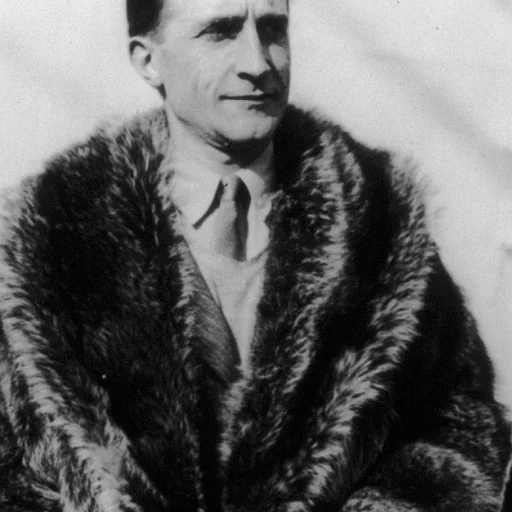
American, 1887–1968
Marcel Duchamp was an American Cubism Analytic artist. 17 works are cataloged here, principally at Museum of Modern Art. Marcel Duchamp was born in Blainville-Crevon.
Henri-Robert-Marcel Duchamp (UK: , US: ; French: ; 28 July 1887 – 2 October 1968) was a French American artist, chess player, and inventor who played a key role in the development of the avant-garde in the United States and in New York City, where he spent the last 25 years of his life. Duchamp was the first artist to elevate a urinal to the status of an art form. For his talk at the American Federation of the Arts in Houston, "On the Creative Act," for which he labeled himself a 'mere artist,' Duchamp said, "Let us consider two important factors, the two poles of the creation of art: the artist, on the one hand, and on the other the spectator who later becomes the posterity...if we give the attributes of a medium to the artist, we must then deny him the state of consciousness on the esthetic plane about what he is doing or why he is doing it. All his decisions in the artistic execution of the work rest with pure intuition and cannot be translated into a self-analysis, spoken or written, or even thought out." Duchamp is commonly regarded, along with Pablo Picasso and Georges Braque, as one of the three artists who helped to establish the post-industrial perspective in art history, and his work is considered the progenitor of conceptual art. His definition of the art coefficient, "an arithmatic relationship between the unexpressed but intended and the unintentionally expressed," lay the groundwork for a more recent generation of artists working through appropriation art, such as Andy Warhol, Beatrice Wood, Sherrie Levine, Richard Prince and Sturtevant.
Overview
Henri-Robert-Marcel Duchamp (UK: , US: ; French: [maʁsɛl dyʃɑ̃]; 28 July 1887 – 2 October 1968) was a French American artist, chess player, and inventor who played a key role in the development of the avant-garde in the United States and in New York City, where he spent the last 25 years of his life. Duchamp was the first artist to elevate a urinal to the status of an art form. For his talk at the American Federation of the Arts in Houston, "On the Creative Act," for which he labeled himself a 'mere artist,' Duchamp said, "Let us consider two important factors, the two poles of the creation of art: the artist, on the one hand, and on the other the spectator who later becomes the posterity...if we give the attributes of a medium to the artist, we must then deny him the state of consciousness on the esthetic plane about what he is doing or why he is doing it. All his decisions in the artistic execution of the work rest with pure intuition and cannot be translated into a self-analysis, spoken or written, or even thought out." Duchamp is commonly regarded, along with Pablo Picasso and Georges Braque, as one of the three artists who helped to establish the post-industrial perspective in art history, and his work is considered the progenitor of conceptual art. His definition of the art coefficient, "an arithmatic relationship between the unexpressed but intended and the unintentionally expressed," lay the groundwork for a more recent generation of artists working through appropriation art, such as Andy Warhol, Beatrice Wood, Sherrie Levine, Richard Prince and Sturtevant.
Early life and education
Eugene and Lucie Duchamp had seven children, one of whom died as an infant and four of whom became successful artists: Jacques Villon (1875–1963), painter, printmaker, Raymond Duchamp-Villon (1876–1918), sculptor and Suzanne Duchamp-Crotti (1889–1963), painter, have been the subject of exhibitions alongside Marcel Duchamp. Duchamp was close to his sister Suzanne. At eight years old, Duchamp began schooling at the Lycée Pierre-Corneille, in Rouen. Two other students in his class also became well-known artists and lasting friends: Robert Antoine Pinchon and Pierre Dumont. He studied art at the Académie Julian from 1904 to 1905, but preferred playing billiards to attending classes, and the Académie Julian was one of several "independent" academies that sprang up in reaction to the Ecole des Beaux-Arts. In 1905, Duchamp began his compulsory military service with the 39th Infantry Regiment, working for a printer in Rouen. There he learned typography and printing processes—skills he would use in his later work.
Early work
Owing to his eldest brother Jacques' membership in the prestigious Académie royale de peinture et de sculpture Duchamp's work was exhibited in the 1908 Salon d'Automne, and the following year in the Salon des Indépendants. Fauves and Paul Cézanne's proto-Cubism influenced his paintings, although the critic Guillaume Apollinaire—who was eventually to become a friend—criticized what he called "Duchamp's very ugly nudes" ("les nus très vilains de Duchamp"), he also prophesized that Duchamp could reconcile art and the people. Alongside many artists of the time, he was intrigued with the concept of depicting the fourth dimension in art. His painting Sad Young Man on a Train embodies this concern:
First, there's the idea of the movement of the train, and then that of the sad young man who is in a corridor and who is moving about; thus there are two parallel movements corresponding to each other. Then, there is the distortion of the young man—I had called this elementary parallelism. It was a formal decomposition; that is, linear elements following each other like parallels and distorting the object. The object is completely stretched out, as if elastic. The lines follow each other in parallels, while changing subtly to form the movement, or the form of the young man in question. I also used this procedure in the Nude Descending a Staircase. Works from this time also included his first "machine" painting, Coffee Mill (Moulin à café) (1911), which he gave to his brother Raymond Duchamp-Villon. The later more figurative machine painting of 1914, Chocolate Grinder (Broyeuse de chocolat), prefigures the mechanism incorporated into the Large Glass on which he began work in New York the following year.
Nude Descending a Staircase, No. 2
Duchamp's first work to provoke significant controversy was Nude Descending a Staircase, No. 2 (Nu descendant un escalier n° 2) (1912). The painting depicts the mechanistic motion of a nude, with superimposed facets, similar to motion pictures. It shows elements of the fragmentation and synthesis of the Cubists, as well as the movement and dynamism of the Futurists. He first submitted the piece to appear at the Cubist Salon des Indépendants, but Albert Gleizes (according to Duchamp in an interview with Pierre Cabanne, p. 31) asked Duchamp's brothers to have him voluntarily withdraw the painting, or to paint over the title that he had painted on the work and rename it something else. Duchamp's brothers did approach him with Gleizes' request, but Duchamp quietly refused. However, there was no jury at the Salon des Indépendants and Gleizes was in no position to reject the painting. The controversy, according to art historian Peter Brooke, was not whether the work should be hung or not, but whether it should be hung with the Cubist group. Of the incident Duchamp later recalled, "I said nothing to my brothers. But I went immediately to the show and took my painting home in a taxi. It was really a turning point in my life, I can assure you. I saw that I would not be very much interested in groups after that." Yet Duchamp did appear in the illustrations to Du "Cubisme", he participated in the La Maison Cubiste (Cubist House), organized by the designer André Mare for the Salon d'Automne of 1912 (a few months after the Indépendants); he signed the Section d'Or invitation and participated in the Section d'Or exhibition during the fall of 1912. The impression is, Brooke writes, "it was precisely because he wished to remain part of the group that he withdrew the painting; and that, far from being ill treated by the group, he was given a rather privileged position, probably through the patronage of Picabia". The painting was exhibited for the first time at Galeries Dalmau, Exposició d'Art Cubista, Barcelona, 1912, the first exhibition of Cubism in Spain. Duchamp later submitted the painting to the 1913 "Armory Show" in New York City. In addition to displaying works of American artists, this show was the first major exhibition of modern trends coming out of Paris, encompassing experimental styles of the European avant-garde, including Fauvism, Cubism, and Futurism. American show-goers, accustomed to realistic art, were scandalized, and the Nude was at the center of much of the controversy.
Leaving "retinal art" behind
At about this time, Duchamp read Max Stirner's philosophical tract, The Ego and Its Own, the study which he considered another turning point in his artistic and intellectual development. He called it "a remarkable book ... which advances no formal theories, but just keeps saying that the ego is always there in everything." While in Munich in 1912, he painted the last of his Cubist-like paintings. He started The Bride Stripped Bare by Her Bachelors, Even image, and began making plans for The Large Glass – scribbling short notes to himself, sometimes with hurried sketches. It would be more than ten years before this piece was completed. Not much else is known about the two-month stay in Munich except that the friend he visited was intent on showing him the sights and the nightlife, and that he was influenced by the works of the sixteenth century German painter Lucas Cranach the Elder in Munich's famed Alte Pinakothek, known for its Old Master paintings. Duchamp recalled that he took the short walk to visit this museum daily. Duchamp scholars have long recognized in Cranach the subdued ochre and brown color range Duchamp later employed. The same year, Duchamp also attended a performance of a stage adaptation of Raymond Roussel's 1910 novel, Impressions d'Afrique, which featured plots that turned in on themselves, word play, surrealistic sets and humanoid machines. He credited the drama with having radically changed his approach to art, and having inspired him to begin the creation of his The Bride Stripped Bare By Her Bachelors, Even, also known as The Large Glass. Work on The Large Glass continued into 1913, with his invention of a repertoire of forms. He made notes, sketches and painted studies, and even drew some of his ideas on the wall of his apartment. Toward the end of 1912, he traveled with Picabia, Apollinaire and Gabrielle Buffet-Picabia through the Jura mountains, an adventure that Buffet-Picabia described as one of their "forays of demoralization, which were also forays of witticism and clownery ... the disintegration of the concept of art". Duchamp's notes from the trip avoid logic and sense, and have a surrealistic, mythical connotation. Duchamp painted few canvases after 1912, and in those he did, he attempted to remove "painterly" effects, and to use a technical drawing approach instead. His broad interests led him to an exhibition of aviation technology during this period, after which Duchamp said to his friend Constantin Brâncuși, "Painting is washed up. Who will ever do anything better than that propeller? Tell me, can you do that?". Brâncuși later sculpted bird forms. U.S. Customs officials mistook them for aviation parts and attempted to collect import duties on them. In 1913, Duchamp withdrew from painting circles and began working as a librarian in the Bibliothèque Sainte-Geneviève to be able to earn a living wage while concentrating on scholarly realms and working on his Large Glass. He studied math and physics – areas where exciting new discoveries were taking place. The theoretical writings of Henri Poincaré particularly intrigued and inspired Duchamp. Poincaré postulated that the laws believed to govern matter were created solely by the minds that "understood" them and that no theory could be considered "true". "The things themselves are not what science can reach..., but only the relations between things. Outside of these relations there is no knowable reality", Poincaré wrote in 1902. Reflecting the influence o
Société Anonyme
Duchamp created the Société Anonyme in 1920, along with Katherine Dreier and Man Ray, as an experimental exhibition context that predates the Museum of Modern Art as the first modern art collection in the US.
Dada
Dada or Dadaism was an art movement of the European avant-garde in the early 20th century. It began in Zürich, Switzerland, in 1916, and spread to Berlin shortly thereafter. To quote Dona Budd's The Language of Art Knowledge,
Dada was born out of negative reaction to the horrors of World War I. This international movement was begun by a group of artists and poets associated with the Cabaret Voltaire in Zürich. Dada rejected reason and logic, prizing nonsense, irrationality, and intuition. The origin of the name Dada is unclear; some believe that it is a nonsense word. Others maintain that it originates from the Romanian artists Tristan Tzara and Marcel Janco's frequent use of the words da, da, meaning yes, yes in the Romanian language. Another theory says that the name "Dada" came during a meeting of the group when a paper knife stuck into a French-German dictionary happened to point to "dada", a French word for "hobbyhorse". The movement primarily involved visual arts, literature, poetry, art manifestoes, art theory, theatre, and graphic design, and concentrated its anti-war politics through a rejection of the prevailing standards in art through anti-art cultural works. In addition to being anti-war, Dada was also anti-bourgeois and had political affinities with the radical left. Dada activities included public gatherings, demonstrations, and publication of art/literary journals; passionate coverage of art, politics, and culture were topics often discussed in a variety of media. Key figures in the movement, apart from Duchamp, included: Hugo Ball, Emmy Hennings, Hans Arp, Raoul Hausmann, Hannah Höch, Johannes Baader, Tristan Tzara, Francis Picabia, Richard Huelsenbeck, Georg Grosz, John Heartfield, Beatrice Wood, Kurt Schwitters, and Hans Richter, among others. The movement influenced later styles, such as the avant-garde and downtown music movements, and groups including surrealism, Nouveau réalisme, pop art, and Fluxus.
Dada is the groundwork to abstract art and sound poetry, a starting point for performance art, a prelude to postmodernism, an influence on pop art, a celebration of antiart to be later embraced for anarcho-political uses in the 1960s and the movement that lay the foundation for Surrealism. New York Dada had a less serious tone than that of European Dadaism, and was not a particularly organized venture. Duchamp's friend Francis Picabia connected with the Dada group in Zürich, bringing to New York the Dadaist ideas of absurdity and "anti-art". Duchamp and Picabia first met in September 1911 at the Salon d'Automne in Paris, where they were both exhibiting. Duchamp showed a larger version of his Young Man and Girl in Spring 1911, a work that had an Edenic theme and a thinly veiled sexuality also found in Picabia's contemporaneous Adam and Eve 1911. According to Duchamp, "our friendship began right there". A group met almost nightly at the Arensberg home, or caroused in Greenwich Village. Together with Man Ray, Duchamp contributed his ideas and humor to the New York activities, many of which ran concurrent with the development of his Readymades and The Large Glass. The most prominent example of Duchamp's association with Dada was his submission of Fountain, a urinal, to the Society of Independent Artists exhibit in 1917. Artworks in the Independent Artists shows were not selected by jury, and all pieces submitted were displayed. However, the show committee insisted that Fountain was not art, and rejected it from the sh
Readymades
"Readymades" were found objects which Duchamp chose and presented as art. In 1913, Duchamp installed a Bicycle Wheel in his studio. The Bicycle Wheel was an idea of Elsa von Freytag-Loringhoven. However, the idea of Readymades did not fully develop until 1915. The idea was to question the very notion of Art, and the adoration of art, which Duchamp found "unnecessary".
My idea was to choose an object that wouldn't attract me, either by its beauty or by its ugliness. To find a point of indifference in my looking at it, you see. Bottle Rack (1914), a bottle-drying rack signed by Duchamp, is considered to be the first "pure" readymade. In Advance of the Broken Arm (1915), a snow shovel, also called Prelude to a Broken Arm, followed soon after. His Fountain, a urinal signed with the pseudonym "R. Mutt", shocked the art world in 1917. Fountain was selected in 2004 as "the most influential artwork of the 20th century" by 500 renowned artists and historians.
In 1919, Duchamp made a parody of the Mona Lisa by adorning a cheap reproduction of the painting with a mustache and goatee. To this he added the inscription L.H.O.O.Q., a phonetic game which, when read out loud in French quickly sounds like "Elle a chaud au cul". This can be translated as "She has a hot ass", implying that the woman in the painting is in a state of sexual excitement and availability. It may also have been intended as a Freudian joke, referring to Leonardo da Vinci's alleged homosexuality. Duchamp gave a "loose" translation of L.H.O.O.Q. as "there is fire down below" in a late interview with Arturo Schwarz. According to Rhonda Roland Shearer, the apparent Mona Lisa reproduction is in fact a copy modeled partly on Duchamp's own face. Research published by Shearer also speculates that Duchamp himself created some of the objects which he claimed to be "found objects". According to Rosa Ulpiano (2024), Duchamp's work can be understood through the logical rule modus tollens, offering insight into the relationship between original and copy in his artistic production.
Antecedent
In 2017–2018, the French expert Johann Naldi found and identified seventeen unpublished works in a private collection, classified as a national treasure on May 7, 2021 by the French Ministry of Culture, including Des souteneurs encore dans la force de l'âge et le ventre dans l'herbe by Alphonse Allais, consisting of a green carriage curtain suspended from a wooden cylinder. This work was certainly exhibited at the Incoherents exhibitions in Paris between 1883 and 1893. According to Johann Naldi, this work is the oldest known readymade and was a source of inspiration for Marcel Duchamp.
The Large Glass
Duchamp worked on his complex Futurism-inspired piece The Bride Stripped Bare by Her Bachelors, Even (The Large Glass) from 1915 to 1923, except for periods in Buenos Aires and Paris in 1918–1920. He executed the work on two panes of glass with materials such as lead foil, fuse wire, and dust. It combines chance procedures, plotted perspective studies, and laborious craftsmanship. He published notes for the piece, The Green Box, intended to complement the visual experience. They reflect the creation of unique rules of physics, and a mythology which describes the work. He stated that his "hilarious picture" is intended to depict the erotic encounter between a bride and her nine bachelors. A performance of the stage adaptation of Raymond Roussel's novel Impressions d'Afrique, which Duchamp attended in 1912, inspired the piece. Notes, sketches and plans for the work were drawn on his studio walls as early as 1913. To concentrate on the work free from material obligations, Duchamp found work as a librarian while living in France. After immigrating to the United States in 1915, he began work on the piece, financed by the support of the Arensbergs. The piece is partly constructed as a retrospective of Duchamp's works, including a three-dimensional reproduction of his earlier paintings Bride (1912), Chocolate Grinder (1914) and Glider containing a water mill in neighboring metals (1913–1915), which has led to numerous interpretations. The work was formally declared "Unfinished" in 1923. Returning from its first public exhibition in a shipping crate, the glass suffered a large crack. Duchamp repaired it, but left the smaller cracks in the glass intact, accepting the chance element as a part of the piece. Joseph Nechvatal has cast a considerable light on The Large Glass by noting the autoerotic implications of both bachelorhood and the repetitive, frenetic machine; he then discerns a larger constellation of themes by insinuating that autoeroticsm – and with the machine as omnipresent partner and practitioner – opens out into a subversive pan-sexuality as expressed elsewhere in Duchamp's work and career, in that a trance-inducing pleasure becomes the operative principle as opposed to the dictates of the traditional male-female coupling; and he as well documents the existence of this theme cluster throughout modernism, starting with Rodin's controversial Monument to Balzac, and culminating in a Duchampian vision of a techno-universe in which one and all can find themselves welcomed. Until 1969 when the Philadelphia Museum of Art revealed Duchamp's Étant donnés tableau, The Large Glass was thought to have been his last major work.
Kinetic works
Duchamp's interest in kinetic art works can be discerned as early as the notes for The Large Glass and the Bicycle Wheel readymade, and despite losing interest in "retinal art", he retained interest in visual phenomena. In 1920, with help from Man Ray, Duchamp built a motorized sculpture, Rotative plaques verre, optique de précision ("Rotary Glass Plates, Precision Optics"). The piece, which he did not consider to be art, involved a motor to spin pieces of rectangular glass on which were painted segments of a circle. When the apparatus spins, an optical illusion occurs, where the segments appear to be closed concentric circles. Man Ray set up equipment to photograph the initial experiment, but when they turned the machine for the second time, a drive belt broke and caught a piece of the glass, which after glancing off Man Ray's head, shattered into bits. After moving back to Paris in 1923, at André Breton's urging, with financing by Jacques Doucet, Duchamp built another optical device based on the first one: Rotative Demisphère, optique de précision (Rotary Demisphere, Precision Optics). This time the optical element was a globe cut in half, with black concentric circles painted on it. When it spins, the circles appear to move backward and forward in space. Duchamp asked that Doucet not exhibit the apparatus as art. Rotoreliefs were the next phase of Duchamp's spinning works. To make the optical "play toys", he painted designs on flat cardboard circles and spun them on a phonographic turntable. When spinning, the flat disks appeared three-dimensional. He had a printer produce 500 sets of six of the designs, and set up a booth at a 1935 Paris inventors' show to sell them. The venture was a financial disaster, but some optical scientists thought they might be of use in restoring three-dimensional stereoscopic sight to people who have lost vision in one eye. In collaboration with Man Ray and Marc Allégret, Duchamp filmed early versions of the Rotoreliefs, and they named the film Anémic Cinéma (1926). Later, in Alexander Calder's studio in 1931, while looking at the sculptor's kinetic works, Duchamp suggested that these should be called mobiles. Calder agreed to use this novel term in his upcoming show. To this day, sculptures of this type are called "mobiles".
Musical ideas
Between 1912 and 1915, Duchamp worked with various musical ideas. At least three pieces have survived: two compositions and a note for a musical happening. The two compositions are based on chance operations. Erratum Musical, written for three voices, was published in 1934. La Mariée mise à nu par ses célibataires même. Erratum Musical is unfinished and was never published or exhibited during Duchamp's lifetime. According to the manuscript, the piece was intended for a mechanical instrument "in which the virtuoso intermediary is suppressed". The manuscript also contains a description for "An apparatus automatically recording fragmented musical periods," consisting of a funnel, several open-end cars and a set of numbered balls. These pieces predate John Cage's Music of Changes (1951), which is often considered the first modern piece to be conceived largely through random procedures. In 1968, Duchamp and John Cage appeared together at a concert entitled "Reunion", playing a game of chess and composing Aleatoric music by triggering a series of photoelectric cells underneath the chessboard.
Rrose Sélavy
"Rrose Sélavy", also spelled Rose Sélavy, was one of Duchamp's pseudonyms. The name, a pun, sounds like the French phrase Éros, c'est la vie, which may be translated as "Eros, such is life." It has also been read as arroser la vie ("to make a toast to life") and has been said to be "a loose anagram for Sorry, Elsa". Sélavy emerged in 1921 in a series of photographs by Man Ray showing Duchamp dressed as a woman. Through the 1920s Man Ray and Duchamp collaborated on more photos of Sélavy. Duchamp later used the name as the byline on written material and signed several creations with it. Duchamp used the name in the title of at least one sculpture, Why Not Sneeze Rose Sélavy? (1921). The sculpture, a type of readymade called an assemblage, consists of an oral thermometer, a couple of dozen small cubes of marble resembling sugar cubes and a cuttlefish bone inside a birdcage. Sélavy also appears on the label of Belle Haleine, Eau de Voilette (1921), a readymade that is a perfume bottle in the original box. Duchamp also signed his film Anémic Cinéma (1926) with the Sélavy name. The inspiration for the name Rrose Sélavy has been thought to be Belle da Costa Greene, J. P. Morgan's librarian at The Morgan Library & Museum (formerly The Pierpont Morgan Library). Following Morgan's death, Greene became the Library's director, working there for a total of forty-three years. Empowered by J. P. Morgan, and then by his son Jack, Greene built the collection buying and selling rare manuscripts, books and art. Duchamp said in an interview, "You think you're doing something entirely your own, and a year later you look at it and you see actually the roots of where your art comes from without your knowing it at all." The Pérez Art Museum Miami, in Florida, holds the piece Boîte-en-valise (De ou par Marcel Duchamp ou Rrose Sélavy), or in English, Box in a Valise (From or by Marcel Duchamp or Rrose Sélavy) created from 1941–61, in the museum's collection. From 1922, the name Rrose Sélavy also started appearing in a series of aphorisms, puns, and spoonerisms by the French surrealist poet Robert Desnos. Desnos tried to portray Rrose Sélavy as a long-lost aristocrat and rightful queen of France. Aphorism 13 paid homage to Marcel Duchamp: Rrose Sélavy connaît bien le marchand du sel ‒ in English: "Rrose Sélavy knows the merchant of salt well"; in French the final words sound like Mar-champ Du-cel. Note that the "salt seller" aphorism – "mar-chand-du-sel" – is a phonetic anagram of the artist's name: "mar-cel-du-champ". (Duchamp's compiled notes are entitled, "Salt Seller".) In 1939 a collection of these aphorisms was published under the name of Rrose Sélavy, entitled, Poils et coups de pieds en tous genres.
Transition from art to chess
In 1918, Duchamp took leave of the New York art scene, interrupting his work on the Large Glass, and went to Buenos Aires, where he remained for nine months and often played chess. He carved his own chess set from wood with help from a local craftsman who made the knights. He moved to Paris in 1919, and then back to the United States in 1920. Upon his return to Paris in 1923, Duchamp was, in essence, no longer a practicing artist. Instead, his main interest was chess, which he studied for the rest of his life to the exclusion of most other activities. Duchamp is seen, briefly, playing chess with Man Ray in the short film Entr'acte (1924) by René Clair. He designed the 1925 poster for the Third French Chess Championship, and as a competitor in the event, finished at fifty percent (3–3, with two draws), earning the title of chess master. During this period his fascination with chess so distressed his first wife that she glued his pieces to the chessboard. Duchamp continued to play in the French Championships and in the Chess Olympiads from 1928 to 1933, favoring hypermodern openings such as the Nimzo-Indian. Sometime in the early 1930s, Duchamp reached the height of his ability, but realized that he had little chance of winning recognition in top-level chess. In the following years, his participation in chess tournaments declined, but he discovered correspondence chess and became a chess journalist, writing weekly newspaper columns. While his contemporaries were achieving spectacular success in the art world by selling their works to high-society collectors, Duchamp observed, "I am still a victim of chess. It has all the beauty of art—and much more. It cannot be commercialized. Chess is much purer than art in its social position." On another occasion, Duchamp elaborated, "The chess pieces are the block alphabet which shapes thoughts; and these thoughts, although making a visual design on the chess-board, express their beauty abstractly, like a poem. ... I have come to the personal conclusion that while all artists are not chess players, all chess players are artists."
In 1932, Duchamp teamed with chess theorist Vitaly Halberstadt to publish L'opposition et cases conjuguées sont réconciliées (Opposition and Sister Squares are Reconciled), known as corresponding squares. This treatise describes the Lasker-Reichhelm position, an extremely rare type of position that can arise in the endgame. Using enneagram-like charts that fold upon themselves, the authors demonstrated that in this position, the most Black can hope for is a draw. The theme of the "endgame" is important to an understanding of Duchamp's complex attitude toward his artistic career. Irish playwright Samuel Beckett was an associate of Duchamp, and used the theme as the narrative device for the 1957 play of the same name, Endgame. In 1968, Duchamp played an artistically important chess match with avant-garde composer John Cage, at a concert entitled "Reunion". Music was produced by a series of photoelectric cells underneath the chessboard, triggered sporadically by normal game play. On choosing a career in chess, Duchamp said, "If Bobby Fischer came to me for advice, I certainly would not discourage him—as if anyone could—but I would try to make it positively clear that he will never have any money from chess, live a monk-like existence and know more rejection than any artist ever has, struggling to be known and accepted." Duchamp left a legacy to chess in the form of an enigmat
Collections represented

Museum
Artists in a similar vein