Artist
Romare Bearden
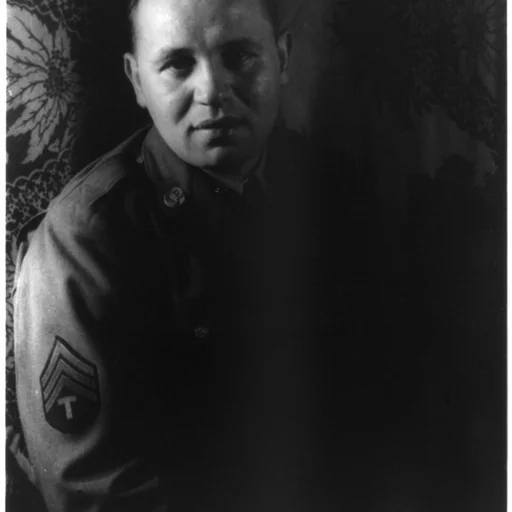
American, 1911–1988
Romare Bearden was an American Abstract Expressionism artist. 13 works are cataloged here, principally at Museum of Modern Art. Romare Bearden was born in Charlotte.
Overview
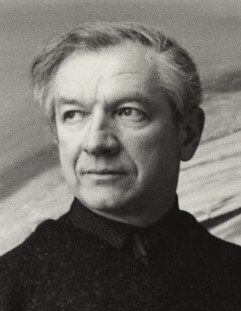
Romare Howard Bearden (, ROH-mə-ree) (September 2, 1911 – March 12, 1988) was an American artist, author, and songwriter. He worked with many types of media including cartoons, oils, and collages. Born in Charlotte, North Carolina, Bearden grew up in New York City and Pittsburgh, Pennsylvania, and graduated from New York University in 1935. He began his artistic career creating scenes of the American South. Later, he worked to express the humanity he felt was lacking in the world after his experience in the US Army during World War II on the European front. He returned to Paris in 1950 and studied art history and philosophy at the Sorbonne. Bearden's early work focused on unity and cooperation within the African-American community. After a period during the 1950s when he painted more abstractly, the theme reemerged in his collage works of the 1960s. The New York Times described Bearden as "the nation's foremost collagist" in his 1988 obituary. Bearden became a founding member of the Harlem-based art group known as Spiral, formed to discuss the responsibility of the African-American artist in the civil rights movement. Bearden was the author or coauthor of several books. He also was a songwriter, known as co-writer of the jazz classic "Sea Breeze", which was recorded by Billy Eckstine, a former high school classmate at Peabody High School, and Dizzy Gillespie. He had long supported young, emerging artists and he and his wife established the Bearden Foundation to continue this work, as well as to support young scholars. In 1987, Bearden was awarded the National Medal of Arts.
Early life and education
Bearden was born September 2, 1911, in Charlotte. Bearden and his family moved to New York City when he was a toddler, as part of the Great Migration. After enrolling in P.S. 5 in 1917, on 141 Street and Edgecombe Avenue in Harlem, he attended P.S. 139 and then DeWitt Clinton High School. In 1927 he moved to East Liberty, Pittsburgh with his grandparents and then returned to New York City. The Bearden household soon became a meeting place for major figures of the Harlem Renaissance. His father, R. Howard Bearden, was a grocer and pianist. Romare's mother, Bessye Bearden née Banks, played an active role with the New York City Board of Education, and also was the founder and president of the Colored Women's Democratic League. She was a New York correspondent for The Chicago Defender, an African-American newspaper. Romare had Cherokee, Italian, and African ancestry. The Washington Post described him as "African American". His fair skin allowed him to cross boundaries which many other Black people were unable to access. In 1929, Romare Bearden graduated from Peabody High School in Pittsburgh. He enrolled in Lincoln University, the nation's second oldest historically Black college, founded in 1854. He transferred to Boston University where he served as the art director for Beanpot, Boston University's student humor magazine. He continued his studies at New York University (NYU), where he started to focus more on his art and less on athletics, and became a lead cartoonist and art editor for The Medley, the monthly journal of the secretive Eucleian Society at NYU. Bearden studied art, education, science, and mathematics graduating with a degree in science and education in 1935. Bearden continued his artistic study under German artist George Grosz at the Art Students League in 1936 and 1937. During this time he supported himself by working as a political cartoonist for African-American newspapers, including the Baltimore Afro-American, where he published a weekly cartoon from 1935 until 1937.
Semi-professional baseball career
As a child, Bearden played baseball in empty lots in his neighborhood. He enjoyed sports, throwing discus for his high school track team and trying out for football. After his mother became the New York editor for the Chicago Defender, he did some writing for the paper, including some stories about baseball. But once Bearden transferred from Lincoln University to Boston University, he became the starting fullback for the school football team (1931-2) and then began pitching - first for the freshman team and eventually for the school's varsity baseball team. He was awarded a certificate of merit for his pitching at BU, which he hung with pride in subsequent homes throughout his life. While at Boston University he played for the Boston Tigers, a semi-professional, all Black team based in the neighborhood of Roxbury. He tended to play with them during the BU baseball off-season and had opportunities to play both iconic Negro League and white baseball teams. For example, he pitched against Satchel Paige while playing for the Pittsburgh Crawfords for a summer, and played exhibition games against teams such as the House of David and the Kansas City Monarchs. When Philadelphia Athletics catcher, Mickey Cochrane, brought a number of teammates to play a game against BU, Bearden gave up only one hit—impressing Athletics owner Connie Mack. Mack offered Bearden a place on the Athletics fifteen years before Jackie Robinson became the first Black player in major league baseball. There are conflicting sources as to whether Mack thought Bearden was white or told Bearden he would have to pass for white. Despite the Athletics winning the World Series in 1929 and 1930, and the American League pennant in 1931, Bearden decided he did not want to hide his identity and chose not to play for the Athletics. After two summers with the Boston Tigers, an injury made him rethink the attention he was giving to baseball and he put greater focus into his art, instead.
Career as an artist
Bearden grew as an artist by exploring his life experiences. His early paintings were often of scenes in the American South, and his style was strongly influenced by the Mexican muralists, especially Diego Rivera and José Clemente Orozco. In 1935, Bearden became a case worker for the Harlem office of the New York City Department of Social Services. Throughout his career as an artist, Bearden worked as a case worker off and on to supplement his income. During World War II, Bearden joined the United States Army, serving from 1942 until 1945, largely in Europe. After serving in the army, Bearden joined the Samuel Kootz Gallery, a commercial gallery in New York that featured avant-garde art. He produced paintings at this time in "an expressionistic, linear, semi-abstract style." He returned to Europe in 1950 to study philosophy with Gaston Bachelard and art history at the Sorbonne, under the auspices of the G.I. Bill. Bearden traveled throughout Europe, visiting Picasso and other artists. Making major changes in his art, he started producing abstract representations of what he deemed as human, specifically scenes from the Passion of Jesus. He had evolved from what Edward Alden Jewell, a reviewer for the New York Times, called a "debilitating focus on Regionalist and ethnic concerns" to what became known as his stylistic approach, which participated in the post-war aims of avant-garde American art. His works were exhibited at the Samuel M. Kootz gallery until it was deemed not abstract enough. During Bearden's success in the gallery, however, he produced Golgotha, a painting from his series of the Passion of Jesus (see Figure 1). Golgotha is an abstract representation of the Crucifixion. The eye of the viewer is drawn to the middle of the image first, where Bearden has rendered Christ's body. The body parts are stylized into abstract geometric shapes, yet are still too realistic to be concretely abstract; this work has a feel of early Cubism. The body is in a central position and darkly contrasted with the highlighted crowds. The crowds of people are on the left and right, and are encapsulated within large spheres of bright colors of purple and indigo. The background of the painting is depicted in lighter jewel tones dissected with linear black ink. Bearden used these colors and contrasts because of the abstract influence of the time, but also for their meanings.
Bearden wanted to explore the emotions and actions of the crowds gathered around the Crucifixion. He worked hard to "depict myths in an attempt to convey universal human values and reactions." According to Bearden, Christ's life, death, and resurrection are the greatest expressions of man's humanism, because of the idea of him that lived on through other men. It is why Bearden focuses on Christ's body first, to portray the idea of the myth, and then highlights the crowd, to show how the idea is passed on to men. Bearden was focusing on the spiritual intent. He wanted to show ideas of humanism and thought that cannot be seen by the eye, but "must be digested by the mind". This is in accordance with his times, during which other noted artists created abstract representations of historically significant events, such as Robert Motherwell's commemoration of the Spanish Civil War, Jackson Pollock's investigation of Northwest Coast Indian art, Mark Rothko's and Barnett Newman's interpretations of Biblical stories, etc. Bearden depicted humanity through abstract expressionism after feeling
Personal life and death
In 1954, at age 42, Bearden married Nanette Rohan, a 27-year-old dancer from Staten Island, New York. She later became an artist and critic. The couple eventually created the Bearden Foundation to assist young artists. Bearden died in New York City on March 12, 1988, due to complications from bone cancer. The New York Times described Bearden in its obituary as "one of America's pre-eminent artists" and "the nation's foremost collagist".
Early works
His early works suggest the importance of African Americans' unity and cooperation. For instance, The Visitation implies the importance of collaboration of Black communities by depicting intimacy between two Black women who are holding hands. Bearden's vernacular realism represented in the work makes The Visitation noteworthy; he describes two figures in The Visitation somewhat realistically but does not fully follow pure realism, and distorts and exaggerates some parts of their bodies to "convey an experiential feeling or subjective disposition." Bearden said, "the Negro artists [...] must not be content with merely recording a scene as a machine. He must enter wholeheartedly into the situation he wishes to convey." In 1942, Bearden produced Factory Workers (gouache on casein on brown kraft paper mounted on board), which was commissioned by Forbes magazine to accompany an article titled The Negro's War. The article "examined the social and financial costs of racial discrimination during wartime and advocated for full integration of the American workplace." Factory Workers and its companion piece Folk Musicians serve as prime examples of the influence that Mexican muralists played in Bearden's early work.
Collage
Bearden had struggled with two artistic sides of himself: his background as "a student of literature and of artistic traditions, and being a black human being involves very real experiences, figurative and concrete," which was at combat with the mid-twentieth century "exploration of abstraction". His frustration with abstraction won over, as he himself described his paintings' focus as coming to a plateau. Bearden then turned to a completely different medium at a very important time for the country. During the civil rights movement, Bearden started to experiment again, this time with forms of collage. After helping to found an artists group in support of civil rights, Bearden expressed representational and more overtly socially conscious aspects in his work. He used clippings from magazines, which in and of itself was a new medium, as glossy magazines were fairly new. He used these glossy scraps to incorporate modernity in his works, trying to show how African-American rights were moving forward, and so was his socially conscious art. In 1964, he held an exhibition he called Projections, where he introduced his new collage style. These works were very well received and are generally considered to be his best work. Bearden had numerous museum and gallery shows of his work since then, including a 1971 show at the Museum of Modern Art entitled Prevalence of Ritual; an exhibition of his prints, entitled A Graphic Odyssey showing the work of the last fifteen years of his life; Exactitude Ain't Interesting, a 1992 show at Louis Stern's gallery in Beverly Hills which included late collages and watercolor; and the 2005 National Gallery of Art retrospective entitled The Art of Romare Bearden. In 2011, Michael Rosenfeld Gallery exhibited its second show of the artist's work, Romare Bearden (1911–1988): Collage, A Centennial Celebration, an intimate grouping of 21 collages produced between 1964 and 1983. One of his most famous series, Prevalence of Ritual, concentrates mostly on southern African-American life. He used these collages to show his rejection of the Harmon Foundation's (a New York City arts organization) emphasis on the idea that African Americans must reproduce their culture in their art. Bearden found this approach to be a burden on African artists, because he saw the idea as creating an emphasis on reproduction of something that already exists in the world. He used this new series to speak out against this limitation on Black artists, and to emphasize modern art. In this series, one of the pieces is entitled Baptism. Bearden was influenced by Francisco de Zurbarán, and based Baptism on Zurbarán's painting The Virgin Protectress of the Carthusians. Bearden wanted to show how the water that is about to be poured on the subject being baptized is always moving, giving the whole collage a feel and sense of temporal flux. He wanted to express how African Americans' rights were always changing, and society itself was in a temporal flux at the time. Bearden wanted to show that nothing is fixed, and expressed this idea throughout the image: not only is the subject about to have water poured from the top, but the subject is also to be submerged in water. Every aspect of the collage is moving and will never be the same more than once, which was congruent with society at the time. In "The Art of Romare Bearden", Ruth Fine describes his themes as "universal". "A well-read man whose friends were other artists, writers, poets and jazz musicians, B
Music
In addition to painting, collage, and athletics, Bearden enjoyed music and even composed a number of songs. In 1960, Loften Mitchell released the three act play, Star of the Morning, for which he wrote the script and music, and Bearden and Clyde Fox wrote the lyrics.
A selection of them can be heard on the 2003 album Romare Bearden Revealed, created by the Branford Marsalis Quartet.
Legacy
The Romare Bearden Foundation was founded two years after his death. The non-profit organization is not only Bearden's official estate; it helps "to preserve and perpetuate the legacy of this preeminent American artist." As of 2015 it has been developing grant-giving programs aimed at funding and supporting children, young (emerging) artists, and scholars. In Charlotte, a street was named after Bearden, intersecting West Boulevard on the west side of the city. Romare Bearden Drive is lined by the West Boulevard Public Library and rows of townhouses. Inside the Charlotte-Mecklenburg Main Library (310 N. Tryon Street) is Bearden's mosaic, Before Dawn. After Bearden's death Nanette Rohan, his widow, selected a 12-by-18-inch (300 mm × 460 mm) collage of his to be recreated in smalti (glass tiles) by Crovatto Mosaics in Spilimbergo, Italy for the grand reopening gala (June 18, 1989) of the "new" library. She was honored at the ceremony for her contribution. The reinterpreted work is 9 feet (2.7 m) tall and 13.5 feet (4.1 m) wide. The ground breaking for Romare Bearden Park in Charlotte was on September 2, 2011 and the completed park opened in late August 2013. It is situated on a 5.2-acre (2.1 ha) parcel which is located in Third Ward between Church and Mint streets. Bearden lived near the new park for a time as a child, at the corner of what is now MLK Boulevard and Graham Street. The park design is based on work of public artist Norie Sato. Her concepts were inspired by his multimedia collages. Fittingly, the park serves as an entryway to a minor league baseball stadium, BB&T Charlotte Knights Ballpark.
Bearden's home in Harlem, New York is a Historic Landmark Preservation site. In 2004, the Metropolitan Museum of Art exhibited Romare Bearden at the Met, drawing on works in the Metropolitan Museum of Art collection including his 1971 The Block. DC Moore Gallery currently represents the estate of Romare Bearden. The first exhibition of his works at the gallery was in September 2008. In 2014-15, Columbia University hosted a major Smithsonian Institution travelling exhibition of Bearden's work and an accompanying series of lectures, readings, performances, and other events celebrating the artist. On display at the Miriam and Ira D. Wallach Gallery on Columbia's Morningside campus, and also at Columbia's Global Centers in Paris and Istanbul, Romare Bearden: A Black Odyssey focused on the cycle of collages and watercolors Bearden completed in 1977 based on Homer's epic poem, The Odyssey. For a 2005 U.S. postal stamp sheet commemorating ten important milestones of the Civil Rights Movement, Beardon's 1984 lithograph "The Lamp" was selected to illustrate the 1954 Brown v. Board of Education Supreme Court decision. In 2011, the U.S. Postal Service released a set of Forever stamps featuring four of Bearden's paintings during a first-day-of-issuance ceremony at the Schomburg Center for Research in Black Culture. From January 15–August 8, 2010, the Metropolitan Museum of Art exhibited Romare Bearden's The Block, Bearden's 1971 mural collage, including preliminary sketches and photographs (all in the Met's collection). From August 30, 2011 – March 4, 2012, the Metropolitan Museum of Art exhibited Romare Bearden (1911–1988): A Centennial Celebration. Bearden was the subject of two exhibits at the High Museum of Art. The first, A Painter’s Profile: The High Celebrates Romare Bearden, was exhibited January 10 – July 5, 2015, and celebrated their “recen
Published works
Lil Dan, the Drummer Boy, New York: Simon & Schuster, 2003 coauthor:
with Harry Henderson, Six Black Masters of American Art, New York: Doubleday, 1972 with Carl Holty, The Painter's Mind, Taylor & Francis, originally published in 1969 with Harry Henderson, of A History of African-American Artists. From 1792 to The Present, New York: Pantheon Books 1993
Honors and awards
Founded the 306 Group, a club for Harlem artists In 1966 he was elected to the American Academy of Arts and Letters In 1972 he was elected to the National Institute of Arts and Letters In 1978, Bearden was elected into the National Academy of Design as an Associate member In 1987, the year before he died, he was awarded the National Medal of Arts In 2002, scholar Molefi Kete Asante listed Romare Bearden on his list of 100 Greatest African Americans. Guggenheim Fellowship, 1970 Ford Foundation Fellowship, 1973 Medal of the State of North Carolina, 1976 Frederick Douglas Medal, New York Urban League, 1978 James Weldon Johnson Award, Atlanta Chapter of NAACP, 1978
Works of art
Abstract (painting) Baltimore Uproar, 1982, Upton–Avenue Market station The Blues (collage) – 1975, Honolulu Museum of Art The Calabash (collage) – 1970, Library of Congress Carolina Shout (collage) This is eponymous with the musical composition by Bearden family friend, the "dean of jazz pianists" and composer, James P. Johnson. This appears to be more than a coincidence, as the name of Bearden's mother, Bessye (sic), is listed on the letterhead of an organization called, " Friends of James P. Johnson" An audio recording of Carolina Shout, featuring Harry Connick Jr. on piano, is included on the companion CD to the National Gallery of Art Exhibition, Romare Bearden Revealed, by Branford Marsalis. – The Mint Museum of Art City of Glass, 1988, Westchester Sq-E Tremont Av station, NY Common Man, 1963 The Dove, 1964 Falling Star (painting) The Family, 1941 The Family, 1975 Fisherman (painting) "Jammin' at the Savoy" (painting) The Lantern (painting) Last of the Blue Devils Madonna and Child, (collage) – ca. 1968-1970, Minnesota Museum of American Art Morning of the Rooster Patchwork Quilt (collage) – 1970, Museum of Modern Art Pepper Jelly Lady (color lithograph), Minnesota Museum of American Art Piano Lesson (painting) – Pennsylvania Academy of the Fine Arts, inspired the play The Piano Lesson Pittsburgh Memory (collage) – 1964, Collection of w, New York. Used as album art for the Roots album ...And Then You Shoot Your Cousin. Prevalence of Ritual: Tidings (collage) Recollection Pond (tapestry) – 1974–1990, 7 plus 1 artist's proof/8 made, Mount Holyoke College Art Museum; Port Authority of NY & NJ; York College, City University of New York; The Metropolitan Museum of Art Return of the Prodigal Son – 1967, Albright-Knox Art Gallery Rocket to the Moon (collage) She-Ba Showtime (painting) Soul Three (collage) – 1968, Dallas Museum of Art Summertime (collage) – 1967, Saint Louis Art Museum The Woodshed Wrapping it up at the Lafayette
Selected collections
Art Museum of Southeast Texas, Beaumont, Texas Art Museum of West Virginia University, Morgantown, West Virginia Madison Museum of Contemporary Art, Madison, Wisconsin Metropolitan Museum of Art, New York, New York Minneapolis Institute of Art, Minneapolis, Minnesota Minnesota Museum of American Art, St. Paul, Minnesota Museum of Fine Arts, Boston, Massachusetts Museum of Modern Art National Gallery of Art, Washington, D. C. Pérez Art Museum Miami, Florida Saint Louis Art Museum, Saint Louis, Missouri Whitney Museum of American Art, New York, New York
Collections represented

Museum
Artists in a similar vein