Artist
Henry Stacy Marks
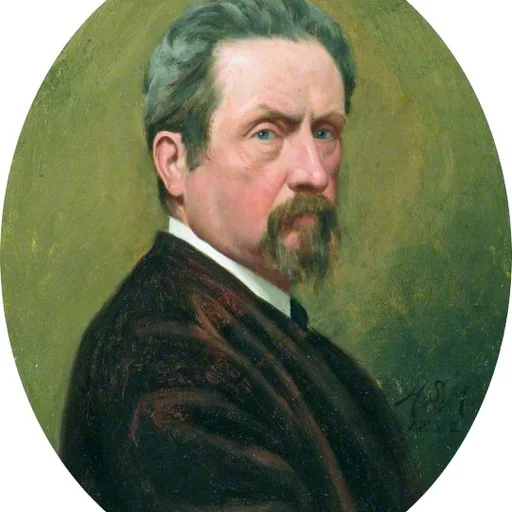
British, 1829–1898
Henry Stacy Marks was a British Realism artist. 2 works are cataloged here, principally at Victoria and Albert Museum. Henry Stacy Marks was born in London.
Overview
Henry Stacy Marks (13 September 1829 – 9 January 1898) was a British artist who took a particular interest in Shakespearean and medieval themes in his early career and later in decorative art depicting birds and ornithologists as well as landscapes. Most of his early works were oils but he also worked on murals and with watercolours. He was a founding member of the St John's Wood Clique and was well known for his humorous performances.
Life and work
Marks was the fourth child of John Isaac Marks and Elizabeth (née Pally). His father was a solicitor who later became a coach builder. One of his brothers was the writer John George Marks. Henry studied in small schools near Regent's Park and at Eythorne, Kent where he learned to paint heraldry symbols so as to assist his father in his carriage making business. In 1845 he worked for a friend of his father as a clerk in a warehouse. He later went to work with his father and around 1846 he attended evening classes at James Mathews Leigh's art school where he would become a friend of Frederick Walker (Marks' younger brother later married Walker's twin sister). For some time he worked for magazines like Home Circle producing wood-cut illustrations. After being rejected once, Henry enrolled successfully at the Royal Academy Schools in December 1851. In 1852 his father sold off the carriage-making business leaving Henry free to attend classes. He however decided to move to Paris with his friend Philip Hermogenes Calderon to study at the atelier of François-Edouard Picot and the École des Beaux-Arts. He returned in June 1852, leaving Calderon in Paris and first exhibited at the Royal Academy in 1853, painting a scene from Shakespeare's Much Ado about Nothing: Dogberry Examining Conrad and Borachio. His works during the 1850s and 1860s were predominantly based on Shakespeare's plays and depicted medieval scenes. Marks' father emigrated to Australia leaving Henry to support his mother, three brothers and from October 1856, his wife, Helen Drysdale (1829–1892). He supplemented his income from painting by carrying out decorative work for various patrons. These included the Minton works, for the stained-glass manufacturers Clayton and Bell, by designing a frieze for the outside wall of the Royal Albert Hall, and for the house of the artist Lawrence Alma-Tadema. His early works on medieval themes included Toothache in the Middle Ages (1856) which was bought by the publisher Charles Edward Mudie with whom he became a friend. Marks' most important patron was Hugh Grosvenor, 1st Duke of Westminster. He was briefly an art critic for The Spectator, writing under the pen-name of "dry-point". Marks worked on decorations for the house of the Duke of Westminster at Eaton Hall, Cheshire, between 1874 and 1880. For this purpose he painted two canvasses 35 feet (11 m) long of Chaucer's pilgrims in the saloon, and twelve panels of birds in the drawing room.
Marks was a founding member of the St John's Wood Clique in 1862 along with Calderon. The aim of the clique was to improve each other by critique and the motto framed by Calderon was "the better each man's picture, the better for all." Marks was also an entertainer in the group with his fake sermons and songs. He was much loved in the club and was known as "Marco". He is shown in a cartoon A vision of the clique by Frederick Walker. Marks was a good friend of several of the cartoonists of Punch including John Tenniel and Charles Keene. In 1888 the Fine Art Society planned an exhibition on birds and Marks decided to use this opportunity to take up an intensive study of birds and he became a regular visitor at the zoo. In 1890 he had a private exhibition on his bird works. As his career progressed, he became increasingly interested in painting birds. Possibly his most famous painting is A Select Committee (1891) which is now in the Walker Art Gallery. He was elected as a member of the Royal Academy following h
Personal life
Marks was married in 1856, to Helen Drysdale. Helen died in 1892, and the following year Marks married Mary Harriet Kempe, who was also a painter. Although baptised in an Anglican church, Marks was brought up as a dissenter. A childhood of listening to sermons led him to rebel in later age to religious and other forms of authority by lampooning clerics and preaching bogus sermons. In an interview to Strand Magazine in 1891 he recalled with his typical wit an anecdote: "I took home a picture to the Dook of Wellington one day, and, as I was taking it up in the hall, he comes by, and says, "Oh, you comes from Messrs. Bennett." "Yes, sir," I says. With that he passes on, and out comes at the front door a man dressed all in black, and comes up to me—his butler, I suppose. He says, "Do you know who you were a talking to just now?" "Yes, sir," I says, "Arthur Wellesley, better known as Dook of Wellington." Then, why don't you say "Your Grace to him ?" "Grace ?" says I, " why should I say grace for? there's no meat here. Where's the viands? Why, I said sir to him—a common title of respect between man and man." " Well," says he, " you are a rum sort of customer, you are. What do you call the Duke ?" "What do I call him ?" I says ; "a wholesale carcase butcher! Look at his career. He begins by going to France to learn the art of war, and then he goes to India and kills thousands of natives who were only defending their own country, and at last turns his arms against the country where he first learned the art of war, and murders thousands more. A wholesale carcase butcher: that's what I call him." Marks considered the Royal Academy of Arts to be a clique and wrote on its politics as a parody ballad. He published a two-volume autobiography towards the end of his life titled Pen and Pencil Sketches (1894).
Death and legacy
Marks died on 9 January 1898 in his London home and was buried in Hampstead Cemetery. His estate amounted to a little over £9,600. The Victoria and Albert Museum holds three of Marks' finished watercolour studies of birds and eleven sketches for larger paintings. Some of his works are exhibited in the Parrot House of Eaton Hall.
Collections represented

Museum
Artists in a similar vein
Artist
Artist