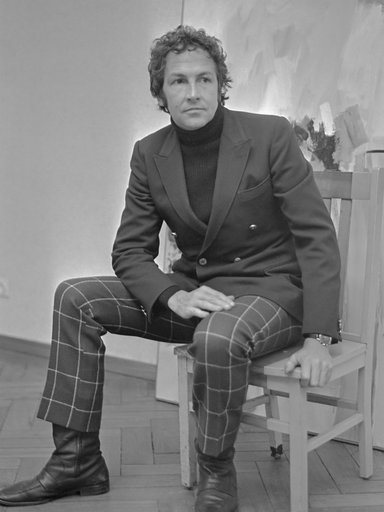
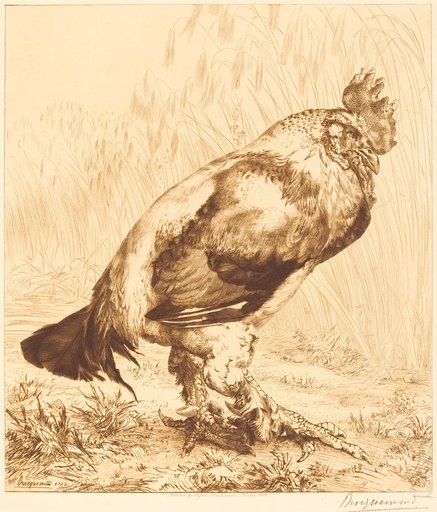
Artist
Nancy Spero
American, 1926–2009
Nancy Spero was an American artist. 8 works are cataloged here, principally at Museum of Modern Art. Nancy Spero was born in Cleveland.
Overview
Nancy Spero (August 24, 1926 – October 18, 2009) was an American visual artist known for her political and feminist paintings and hand pulled art prints. Born in Cleveland, Ohio, Spero lived for much of her life in New York City. She married and collaborated with artist Leon Golub. As both artist and activist, Nancy Spero had a career that spanned fifty years. She is known for her continuous engagement with contemporary political, social, and cultural concerns. Spero chronicled wars and apocalyptic violence as well as articulating visions of ecstatic rebirth and the celebratory cycles of life. Her complex network of collective and individual voices was a catalyst for the creation of her figurative lexicon representing women from prehistory to the present in such epic-scale paintings and collage on paper as Torture of Women (1976), Notes in Time on Women (1979) and The First Language (1981). In 2010, Notes in Time was posthumously reanimated as a digital scroll in the online magazine Triple Canopy. Spero has had a number of retrospective exhibitions at major museums.
Early years
Spero was born in Cleveland, Ohio in 1926. A year later her family moved to Chicago, where she grew up. After graduating from New Trier High School, she studied at the School of the Art Institute of Chicago, and graduated in 1949. Among Spero's peers at the Art Institute was a young GI who had returned from service in World War II, Leon Golub. Spero and Golub exhibited at the Hyde Park Art Center in Chicago as part of the group the Monster Roster. After graduating from the Art Institute of Chicago, Spero continued to study painting in Paris at the École nationale supérieure des Beaux-Arts and at the Atelier of André Lhote, an early Cubist painter, teacher and critic. Soon after her return to the United States in 1950, she married Leon Golub, and the two artists settled in Chicago. From 1956 to 1957, Spero and Golub lived and collaborated in Italy, while raising their three sons. Spero and Golub were equally committed to exploring a modernist representation of the human form, with its narratives and art historical resonances, even as Abstract Expressionism was becoming the dominant idiom. In Florence and Ischia, Spero became intrigued by the format, style and mood of Etruscan and Roman frescoes and sarcophagi which would have influence on her later work. Finding a more varied, inclusive and international atmosphere in Europe than in the New York art world of the time, Spero and her family moved to Paris, living there from 1959 to 1964. Spero's third son was born in Paris, and the artist had major solo exhibitions in Paris at Galerie Breteau in 1962, 1964, and 1968. During this period, Spero painted a series titled Black Paintings depicting themes including mothers and children, lovers, prostitutes, and hybrid, human-animal forms. This collection of works has a more personal meaning for her, rather than political.
Later years
Spero and Golub returned to New York in 1964, where the couple remained to live and work. The Vietnam War was raging and the Civil Rights Movement was exploding. Affected by images of the war broadcast nightly on television and the unrest and violence evident in the streets, Spero began her War Series from 1966 to 1970. These small gouache and inks on paper, executed rapidly, represented the obscenity and destruction of war. An activist and early feminist, Spero was a member of the Art Workers Coalition (1968–69), Women Artists in Revolution (1969), and Ad Hoc Committee of Women Artists (1971) the work of which developed into the first women's cooperative gallery, A.I.R. Gallery (Artists in Residence) in SoHo, of which she was a founding member. It was during this period that Spero completed her "Artaud Paintings" (1969–70), finding her artistic "voice" and developing her signature scroll paintings, the Codex Artaud (1971–1972), in which she directly quoted the writings of the poet and playwright Antonin Artaud. Uniting text and image, printed on long scrolls of paper, glued end-to-end and tacked on the walls of A.I.R., Spero violated the formal presentation, choice of valued medium and scale of framed paintings. Although her collaged and painted scrolls were Homeric in both scope and depth, the artist shunned the grandiose in content as well as style, relying instead on intimacy and immediacy, while also revealing the continuum of shocking political realities underlying enduring myths. In a 2008 interview in The Brooklyn Rail with publisher Phong Bui, Spero says of her early identification with Artaud: "For me, the spoken words were part of the body, as if whatever I was trying to paint, and my own awareness of pain and anger—you can call it the destruction of the self—was an integral part, that duality. Things get split up right in the middle, which I was very much interested in at that moment in my life." In 1974, Spero chose to focus on themes involving women and their representation in various cultures. Her Torture in Chile (1974) and the long scroll, Torture of Women (1976, 20 inches x 125 feet), interweave oral testimonies with images of women throughout history, linking the contemporary governmental brutality of Latin American dictatorships (from Amnesty International reports) with the historical repression of women. Spero re-presented previously obscured women's histories, cultural mythology, and literary references with her expressive figuration. Rarely exhibited, Torture of Women was translated into book form in 2009. Spero manifested a desire for women to be a part of the art conversation. Spero's most mature work lives along the lines of a peinture feminine. This is when a woman is the subject as well as the "artistic consciousness". Spero's open-ended, thought provoking compositions of ruthless uncomfortable subject matter was depicted in hangings and friezes. This is seen in Helicopter, Victim, Astronaut, made in 1968 of gouache and ink on paper. Spero uses the crimes and assaults on women from all eras and cultures to provide intense and emotional imagery for her art and text. Political violence, sexism, and life-threatening situations that women endure are subjects she explored throughout her career, but especially in the 1960s and 19702. These interests are evidence of Spero's conviction that "the personal and the political are indistinguishable." Spero was influenced by Jean Dubuffet, Antonin Artaud, Simone de Beauvoi
Honors
2006
Elected a member of the American Academy of Arts and Letters. 2005
Lifetime Achievement Award from the College Art Association 2003
Honor Award from the Women's Caucus for Art 1995
Hiroshima Art Prize (awarded jointly to Spero and Golub) from the Hiroshima City Museum of Contemporary Art 1995
Skowhegan Medal from the Skowhegan School of Painting and Sculpture
Media appearances
Spero as herself, Nancy Spero: Becoming an Artist, 2008 Spero as herself, !Women Art Revolution, 2010 Spero as herself, Nancy Spero: Collaboration, 2012 Spero as herself, Nancy Spero: Paper Mirror, 2019
Collections represented

Museum
Artists in a similar vein