Artist
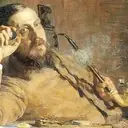
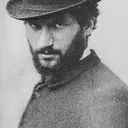
Giovanni Segantini
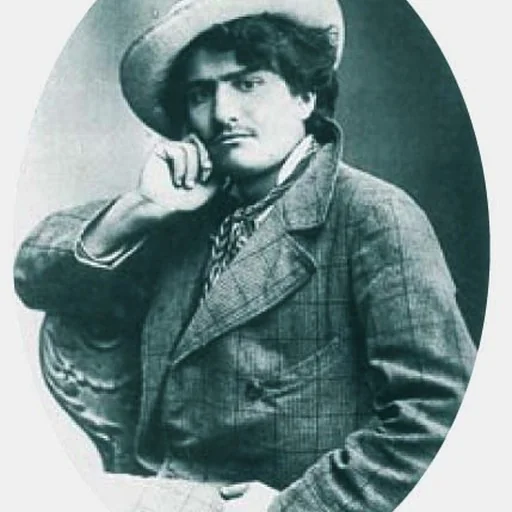
Italian, 1858–1899
Giovanni Segantini was an Italian Post-Impressionism artist. 17 works are cataloged here, principally at Kunsthaus Zürich. Giovanni Segantini was born in Arco.
Overview
Giovanni Segantini (15 January 1858 – 28 September 1899) was an Austrian then stateless painter known for his large pastoral landscapes of the Alps. He was one of the most famous artists in Europe in the late 19th century, and his paintings were collected by major museums. In later life, he combined a Divisionist painting style with Symbolist images of nature. He was active first in Italy then in Switzerland during the last period of his life.
Biography
Giovanni Battista Emanuele Maria Segatini was born at Arco in Trentino, which was then part of the County of Tyrol in the Austrian Empire. He later changed his family name by adding an "n" after the "a". He was the second child of Agostino Segatini (1802–1866) and Margarita De Girardi (1828–1865). His older brother, Lodovico, died in a fire the year Giovanni was born. During the first seven years of his life, his father, who was a tradesman, traveled extensively while looking for work. Except for a six-month period in 1864 when Agostino returned to Trentino, Segantini spent his early years with his mother, who experienced severe depression due to the death of Lodovico. These years were marked by poverty, hunger and limited education due to his mother's inability to cope. In the spring of 1865, his mother died after spending the past seven years in increasingly poor health. His father left Giovanni under the care of Irene, his second child from a previous marriage, and again traveled in search of work. He died a year later without returning home and leaving his family nothing. Without money from her father, Irene lived in extreme poverty. She was forced to spend most of her time working menial jobs while leaving Giovanni to maintain on his own. Irene hoped to better her life by moving to Milan, and in late 1865 she submitted an application to relinquish Austrian citizenship for both her brother and her. She either misunderstood the process or simply did not have enough time to follow through, and although their Austrian citizenship was revoked she neglected to apply for Italian citizenship. As a result, both Segantini and his sister remained stateless for the rest of their lives. After he became famous Switzerland offered him citizenship on more than one occasion, but he refused in spite of many hardships, saying Italy was his true homeland. After his death the Swiss government successfully awarded him citizenship. At age seven, Segantini ran away and was later found living on the streets of Milan. The police committed him to the Marchiondi Reformatory, where he learned basic cobbling skills but little else. For much of his early life, he could barely read or write; he finally learned both skills when he was in his mid-30s. Fortunately, a chaplain at the reformatory noticed that he could draw quite well, and he encouraged this talent in an attempt to lift his self-esteem. In 1873, Segantini's half-brother Napoleon claimed him from the reformatory, and for the next year Segantini lived with Napoleon in Trentino. Napoleon ran a photography studio, and Segantini learned the basics of this relatively new art form while working there with his half-brother. He would later use photography to record scenes that he incorporated into his painting.
Career
The following year, Segantini returned to Milan and attended classes at the Brera Academy. While there, he became friends with members from a transformative movement known as Scapigliatura (the "Disheveleds"), which included artists, poets, writers and musicians who sought to erase the differences between art and life. Among his closest friends at the time were Carlo Bugatti and Emilio Longoni, both of whom profoundly influenced his work and his interests. His first major painting, The Chancel of Sant Antonio (Il Coro di Sant'Antonio), was noticed for its powerful quality, and in 1879 it was acquired by Milan's Società per le Belle Arti. That work attracted the attention of painter and gallery owner Vittore Grubicy de Dragon, who became his advisor, dealer and his life-long financial supporter. Grubicy and his brother, Alberto, who was a co-owner of the gallery, introduced Segantini to the works of Anton Mauve and Jean-François Millet. Both of these artists influenced Segantini's work for many years. That same year, he met Bugatti's sister, Luigia Pierina Bugatti (1862–1938), known as "Bice", and they began a life-long romance. Although Segantini tried to marry Bice the next year, due to his stateless status he could not be granted the proper legal papers. In opposition to this bureaucratic technicality, they decided to live together as an unmarried couple. This arrangement led to frequent conflicts with the Catholic church that dominated the region at this time, and they were forced to relocate every few years to avoid local condemnation. In spite of these difficulties, Segantini was thoroughly devoted to Bice throughout his life. He wrote many love letters when he was away from her, sometimes including wild flowers that he had picked. Once he wrote, "Take these unsightly flowers, these violets, as a symbol of my great love, When a spring comes in which I fail to send you such violets, you will no longer find me among the living." In 1880, he and Bice moved to Pusiano and soon thereafter to the village of Carella, where they shared a house with their friend Longoni. It was in this mountain scenery that Segantini began to paint en plein air, preferring to work in the outdoors than in a studio. While he worked outside, Bice would read to him, and eventually he learned to read and write. Later he would write articles for Italian art magazines, and he was a prolific letter writer to Bice when he traveled and to other artists throughout Europe. At this time, he painted the first version of Ave Maria (Segantini Museum, St. Moritz), which took a gold medal at the 1883 World's Fair in Amsterdam. As his fame rose, Segantini entered into a formal agreement with the Grubicys to be the sole representatives of his work. While this allowed Segantini more freedom to pursue his artistry, the dealers were consistently slow in fulfilling their financial obligations to the artists. The family struggled for many years in relative poverty, even as Bice gave birth to four children: Gottardo (1882–1974), Alberto (1883–1904), Mario (1885–1916) and Bianca (1886–1980). To help Bice care for his family, Segantini employed a young maid, Barbara "Baba" Uffer, who also became his favorite model for his paintings. Baba stayed with the family throughout their periods of penury and many households, but unlike many artist/model relationships of the time there is no evidence that they had any romantic involvement. During this period Segantini produced several important
Themes
More than anything else, Segantini's work represents the quintessential transition from traditional nineteenth-century art to the changing styles and interests of the twentieth century. He began with simple scenes of common people living off of the earth— peasants, farmers, shepherds—and moved toward a thematic symbolist style that continued to embody the landscapes around him while intertwining pantheistic images representing "a primeval Arcadia". Over the course of his life, he moved from both the physical and emotional internal, such as his scene of motherhood in a stable, to the grand external views of the mountain scenery where he chose to live. Nature and the connections of people to nature are the core themes of his art. After he moved to the mountains he wrote "I am now working passionately in order to wrest the secret of Nature's spirit from her. Nature utters the eternal word to the artist: love, love; and the earth sings life in spring, and the soul of things reawakens."
His 1896 painting Love at the Fountain of Life (Galleria Civica d'Arte Moderna, Milan) reflects Segantini's philosophical approach to his art. Set in the high mountain landscape near his home, it pictures an angel with large wings spread over a small waterfall flowing from some rocks. In the distance two lovers, clothed in white flowing robes, walk along a path coming toward the spring. Around them are flowers that would have been seen by viewers at the time as symbols of love and life. Art historian Robert Rosenblum described Segantini as transforming "the earthbound into the spiritual", and the artist himself referred to his work as "naturalist Symbolism". He said "I've got God inside me. I don't need to go to church."
Personal life
In 1879, Segantini met Luigia Pierina "Bice" Bugatti (1862–1938), daughter of Luigi Bugatti and aunt of Ettore Bugatti and Rembrandt Bugatti, whom he tried to marry in 1880. However, due to his stateless status, he was not granted the legal papers required to do so. They remained together in concubinage. They had four children illegitimately;
Gottardo Guido Segantini (1882–1974), became a sculptor, married German-born Charlotte Poertner (1852–1912), originally of Darmstadt. Alberto Segantini (1883–1904) Mario Segantini (1885–1916), Bianca Segantini (1886–1980), an author Segantini died on 28 September 1899 in Pontresina, Switzerland aged 41. In 1902, all his children were naturalized as Swiss citizens whilst living in Davos.
Graubünden area
A signposted multiday trekking route passes areas that were common to the painter for his En plein air painting.
Works by Giovanni Segantini
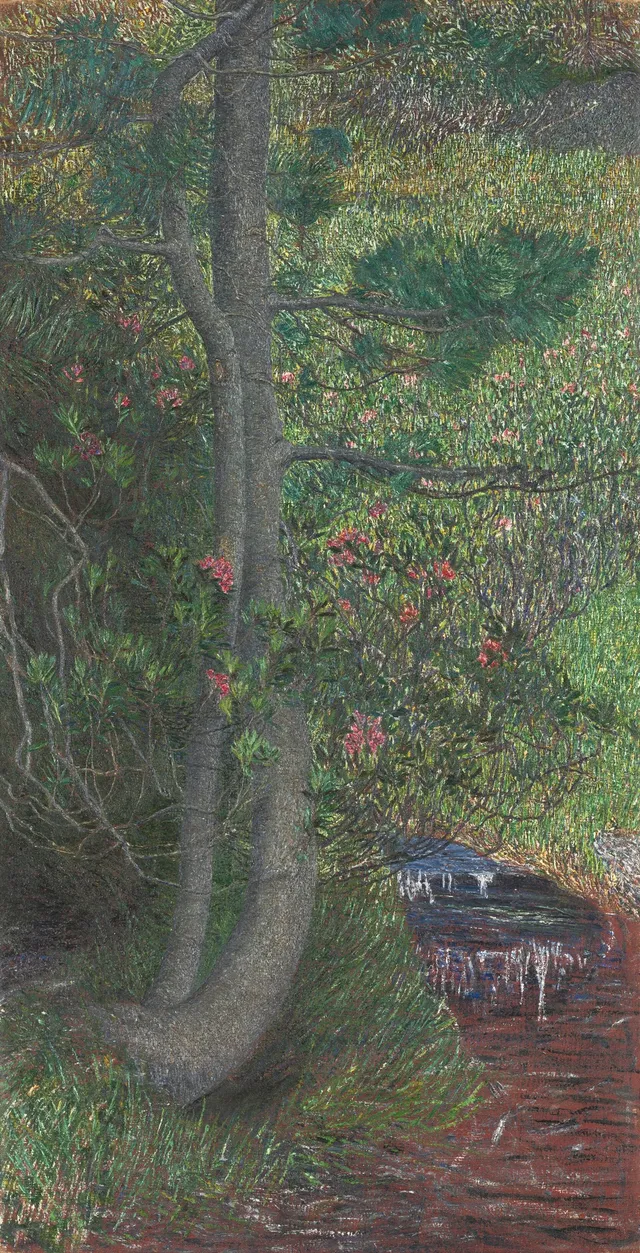
Collections represented

Museum

Museum

Museum

Artists in a similar vein