Artist
Maxime Dethomas
French, 1867–1929
Maxime Dethomas was a French Realism artist. 6 works are cataloged here, principally at National Gallery of Art. Maxime Dethomas was born in Garges-lès-Gonesse.
Maxime-Pierre Jules Dethomas (French: ; October 13, 1867 – January 21, 1929) was a French painter, draughtsman, printmaker, illustrator, and was among the best known theater-set and costume designers of his era. As an artist, Dethomas was highly regarded by his contemporaries and exhibited widely, both within France and abroad. He was a regular contributor to the Impressionistes et Symbolistes, and a founding committee member of the Salon d'Automne. In 1912, he was awarded the Chevalier de la Légion d'honneur for his contributions to French art. During the latter part of his career, he is remembered for his work overseeing set and costume design for the Théâtre des Arts and the Paris Opera. His works appear in many important national collections, including the Musée d'Orsay, the Hermitage Museum and the National Gallery of Art. A large collection of his theatrically related work is held at the Bibliothèque-Musée de l'Opéra National de Paris. Dethomas is also remembered for his close friendship with the artist Henri de Toulouse-Lautrec, his brother in-law Ignacio Zuloaga and his association with Les Nabis and other important Post-Impressionist and Symbolist artists and writers. Dethomas died in 1929 at the age of 61, and was buried at the Passy Cemetery, Paris.
Overview
Maxime-Pierre Jules Dethomas (French: [maksim dətɔma]; October 13, 1867 – January 21, 1929) was a French painter, draughtsman, printmaker, illustrator, and was among the best known theater-set and costume designers of his era. As an artist, Dethomas was highly regarded by his contemporaries and exhibited widely, both within France and abroad. He was a regular contributor to the Impressionistes et Symbolistes, and a founding committee member of the Salon d'Automne. In 1912, he was awarded the Chevalier de la Légion d'honneur for his contributions to French art. During the latter part of his career, he is remembered for his work overseeing set and costume design for the Théâtre des Arts and the Paris Opera. His works appear in many important national collections, including the Musée d'Orsay, the Hermitage Museum and the National Gallery of Art. A large collection of his theatrically related work is held at the Bibliothèque-Musée de l'Opéra National de Paris. Dethomas is also remembered for his close friendship with the artist Henri de Toulouse-Lautrec, his brother in-law Ignacio Zuloaga and his association with Les Nabis and other important Post-Impressionist and Symbolist artists and writers. Dethomas died in 1929 at the age of 61, and was buried at the Passy Cemetery, Paris.
Early life and formal education
Born in the Paris suburb of Garges-lès-Gonesse in 1867, Maxime Dethomas was the eldest of six children, including four half-siblings. His family came from a long line of painter-printers on one side, and lawyers on the other. His father, Jean-Albert Dethomas (1842–1891), was an important Parisian politician and lawyer. His mother, Laure-Elizabeth Antoinette Béchet, died at the age of 27 in 1874. His step mother, Marie Louise Thierrée, belonged to the affluent middle-class of Bordeaux.
During 1885, Dethomas first met Augustine Bulteau (1860–1922), matriarch of the Parisian arts community and one-time wife of prominent author and playwright, Jules Ricard (1848–1903). Bulteau would go on to become a pivotal figure in his life, helping him navigate a difficult relationship with his father, guiding his academic direction and encouraging his development as an artist. Each year, Dethomas would take extended breaks at Bulteau's estates in Léry and Venice – trips that would feature prominently in his art.
In 1887, Dethomas enrolled at the École des Arts Décoratifs at which he studied briefly, preferring instead to pass much of his time at the bookshop of the Revue Indépendante, a favourite haunt of young artists and writers run by Édouard Dujardin. It was here that he first met Louis Anquetin and Henri de Toulouse-Lautrec. It is an often repeated, yet erroneous claim that Dethomas' relationship with Toulouse-Lautrec was one of master and student – at least in the formal sense of the term – though their shared experiences and mutual respect for each other as artists was of undeniable consequence. In an 1898 letter, Dethomas reflected on Toulouse-Lautrec's art: The things I see by him always give me an intense desire to work. The things of this boy, who, if he has no talent, certainly has a little genius, are always for me a whiplash [coup de fouet]. It's as if I was shown the way with a sudden invitation to advance. The master paintings do not give me that, we are stupefied with admiration. We are blocked, discouraged, after them we are let down, we are in prison.
Disgruntled with his experiences at the École des Arts Décoratifs, Dethomas began taking informal instruction at the private workshop of the young master, Henri Gervex. In 1888, Gervex began his tenure as instructor at l'Académie Libre on rue Verniquet – Dethomas applied and was accepted, continuing his formal education under Gervex. During this period, Dethomas became firm friends with fellow Gervex student and future brother-in-law, Ignacio Zuloaga. Through Dethomas, Zuloaga gained entrée into French artistic circles; reciprocally, Zuloaga introduced Dethomas to other Spanish expatriate artists, including the so-called Catalan Band: Santiago Rusiñol, Ramon Casas, and Miquel Utrillo. The final phase of Dethomas' formal education commenced from 1891 onwards, where he followed a more varied course at the Académie de La Palette, 104 Boulevard de Clichy, Montmartre, under Henri Gervex, Puvis de Chavannes and Eugène Carrière. Carrière's tutelage played a significant role in the early development of Dethomas' art, and he would go on to be a close friend of both the artist and his family.
Art
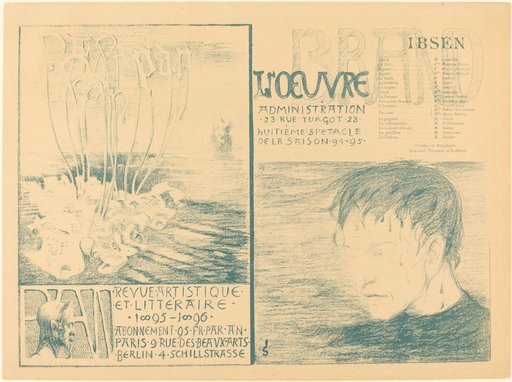
Dethomas' early style owes most to the influence of Carrière and Degas, whilst later works tend more towards that of Toulouse-Lautrec, Anquetin and Forain. Dethomas claimed that his inspiration was guided by artists of earlier generations, particularly Goya, Delacroix and Manet, but his individuality of style ensured he would "not be influenced in his work by any methods or thoughts other than his own". In 1905, influential critic Louis Vauxcelles praised Dethomas as a "shrewd and penetrating observer" that captured his subjects "with a powerful sobriety". He realised vigorous drawings, and some few oil paintings, showing portraits, cafe scenes, and urban landscapes of Italy and Spain. He primarily worked with broad strokes in conté, graphite, charcoal and pastel, often enhanced by watercolour and the masterful use of the spatter brush, with drizzles and sprays of gouache reminiscent of Lautrec lithographs. From the late 1890s, he drew inspiration from Japanese prints – said to have been introduced to him by Toulouse-Lautrec – and developed a bold xylographic style which lent itself to woodcut reproduction. Like many of his contemporaries, Dethomas explored various artistic mediums, including book illustrations, posters and print making. By 1895, he was designing programmes for Lugné-Poe's Théâtre de l'Œuvre and exhibition and advertising posters with print makers such as Edward Ancourt, Eugène Verneau and Auguste Clot. With his drawings engraved by Léon Pichon and Emile Gasperini, he illustrated close to thirty books by many prominent authors including Maurice Donnay and Octave Mirbeau. Dethomas engaged models from both within his social circle, as well as otherwise unremarkable characters from urban life, searching out peculiarities of appearance that betrayed the social facades of the fin de siècle. Having cut ties with his bourgeois pretensions during an 1891 move to Montmartre, Dethomas followed in the footsteps of his mentors, hungry to find authentic expression of the human condition amongst the daily struggles of the urban poor. "His characters are all scoundrels", joked Degas. Two such 'scoundrels' would go on to lead remarkable lives, in no small part due to their association with Dethomas. Then artist's model Suzanne Desprès became romantically involved with Dethomas in June, 1894, and continued to feature prominently in his art for some years, later becoming a famous actress and wife of theater director Lugné-Poe. Prior to meeting Picasso in 1904, Fernande Olivier would also model for Dethomas with some regularity, her memoirs painting a vivid picture of her time in Dethomas' studio:
He was tall and stout, with a pallid complexion, the type of slightly fleshy giant who spent his nights making sketches in night clubs. He had great difficulty staying awake after meals, which for him always had to be enormous. I used to arrive after lunch around two o'clock and would take up a pose, and he would begin to work. He had a litter of pretty little Siamese cats that would climb all over me or play with my bare feet in a way that was often quite fierce. Dethomas sketched, putting down a line on the paper or canvas with a steady hand, then he would get up, go and lie on the couch and fall asleep for at least an hour. During this time I was free to play with the cats, to read and eat the candies lying around in various dishes, even to sleep myself, in fact to wait for him to wake up in whatever way I felt like. And this happened frequ
Theatre
From 1910 to 1913, Dethomas worked under Jacques Rouché during his tenure at the Théâtre des Arts. Upon assuming management of the theater, Rouché enlisted the talents of several artists who had contributed to his magazine, La Grande Revue, including Jacques Dresa, René Piot and Maxime Dethomas, none of which had previously worked for the stage. As director of the services plastiques, Dethomas embarked on a career that would last for the remainder of his life. The Théâtre des Arts represented a major shift away from facile acting, shallow content and the painted-canvas drawing rooms of commercial theater that were the norm. The inaugural production, Le Carnaval des Enfants (1910), marked a major theatrical revolution by which Dethomas' settings accentuated line and colour, rather than a focus on painted detail and endless props. Against blue, ochre, grey and steel, black costumed characters created striking pictorial compositions in lighting effects that "varied like inflections in a conversation".
The Théâtre des Arts went on to present nearly twenty plays, including Jacques Copeau's adaptation of The Brothers Karamazov (1911), and the stage production of La Tragédie de Salomé (1912), both a popular and critical success. Dethomas' reputation as a set and costume designer was such that by early 1912, he was commissioned by the British aristocracy to design a set and costumes for a London masked ball with some two thousand guests. Hired to direct and decorate at the Paris Opera in 1914, Rouché and Dethomas went on to offer fresh interpretation of old material and to make inroads into stale scenic convention. By 1917, Dethomas was also designing sets and costumes for the Comédie Française; the Théâtre Sarah-Bernhardt in 1919; the Théâtre Femina and Le Trianon in 1920; and the Opéra-Comique in 1926 as it celebrated Manuel de Falla's 50th birthday. With a program consisting of La Vida Breve, El Amor Brujo, and Master Peter's Puppet Show, Falla's close friend Ignacio Zuloaga and Dethomas collaborated to create sets and marionettes. During his seventeen years in the theatre, Dethomas was artistic designer for over fifty plays, ballets and operas, featuring many of the era's most notable actors, dancers, singers, playwrights and composers, including Roussel, Stravinsky and Ravel. In his colour schemes Dethomas used visual analogy paired with the play-writer's thematic intent, "the progression of each scene following perfectly the progression of the drama". Dethomas once wrote that above all else decor should be a good servant of the play and that a designer must get beyond a "painterly feel" to something more solid. Guillaume Apollinaire declared that Dethomas' influence on French Theatre had "transformed the art of scenery, costume design and staging."
Henri de Toulouse-Lautrec
During 1887 Dethomas began frequenting the library-bookshop of the Revue Indépendante, a favorite haunt of young artists and writers, in which he first befriended Louis Anquetin and Henri de Toulouse-Lautrec. Their friendship blossomed – so much so, that Dethomas would go on to become Toulouse-Lautrec's "favourite companion" and "closest friend". Always drawn to physical eccentricity, Toulouse-Lautrec nicknamed the 6'6" Dethomas 'Gros n'abre' (roughly: Big Tree), for his imposing height and dead-pan face; Thadée Natanson described him as a gentle giant, polished and discreet – "He was so frightened of wearing anything that might draw attention to himself that even the black of his clothes seemed duller than that worn by others." Dethomas' placidity, corpulence and extreme shyness – he always blushed when he had to raise his voice – endeared him to Toulouse-Lautrec. Paul Leclercq claimed that Lautrec was fascinated by Dethomas' "ability to preserve an impassive appearance even in a place of amusement". Whilst much has been made of the comical dynamic of their friendship, Toulouse-Lautrec also derived an element of utility from his companion. Calm and seemingly distant, Dethomas generally walked through life a discreet and unassuming character. However, when he accompanied Toulouse-Lautrec, their contrasting heights invariably attracted attention, the bowler hat of the little man barely reaching Maxime's elbow. Yet the jeers stopped at the quiet strength of Gros n'arbre. Contemporaries, like Gustave Coquiot, bear witness to this: "Lautrec loved Maxime Dethomas very much. This tall and strong fellow towered over him. With him, he felt under real protection. When together in the street, Lautrec never heard any ridicule. Dethomas, impassive and cold, always muzzled the crowd." Philippe Berthelot recalled that Toulouse-Lautrec playfully attributed his companion super-human strength and would loudly declare with mock seriousness that Dethomas "could have anyone's hide at his leisure!".
In the first days of 1891, Dethomas moved to an apartment at 8, Cité Pigalle, Montmartre – selected no-less for its proximity to the workshop of Eugène Carrière, than to that of his friends Toulouse-Lautrec and the photographer Paul Sescau. They lived but streets apart, often visiting the cafes, cabarets, shady bars and brothels of Montmartre, including the Moulin rouge and Le Chat Noir, or extended stays at the notorious closed-houses, the Rue de' Amboise or the Rue Joubert. By 1894, Toulouse-Lautrec and Dethomas were exhibiting together at le Barc de Boutteville.
On the 16th February, 1895, an infamous soiree was held by the Natansons to celebrate the unveiling of new murals by Vuillard. Chosen from among his friends more for the comedic effect than for his bartending skill, Dethomas assisted Toulouse-Lautrec serving drinks, replete with absurd costumes and flourishes of theatrical drama. Together they served over two thousand cocktails to three hundred guests. The event was long remembered as one of the most debaucherous evenings of the fin-de-siècle. Such escapades played an essential role in the development and themes of both Dethomas' and Toulouse-Lautrec's art.
Dethomas and Toulouse-Lautrec's adventures together were not limited to the streets of Paris. If Dethomas' close friend Gabrielle Dorziat is to be believed, during the month of October, 1894, Dethomas and Toulouse-Lautrec travelled to Spain together, stopping at Madrid, Cordoue and Seville. I
Jean de Tinan
In 1895 Dethomas formed what would become a brief but significant friendship with the young writer, Jean de Tinan. The charismatic twenty-one year old was a new arrival in Paris, and was soon a daily participant in the circuit of bars, cafes and theatres that Dethomas and Lautrec would frequent. Tinan quickly become their "young cadet", Lautrec illustrating the cover of his novel L'Example de Ninon de Lenclos amoureuse, published in May, 1898. Dethomas introduced Tinan to Augustine Bulteau, and she “took charge” of the young writer, guiding him as she had Maxime years before. It was to her Venice estate that Tinan retreated during the final harrowing months of his short life. A failing heart did not keep him from his work, though his final “sentimental little story” remained unfinished at the time of his death on November 18, 1898. Aimienne, ou le détournement de mineure, was published posthumously; Tinan's final act was to dedicate the unfinished novel to Dethomas, as a “testimony of his deep affection.” As had Lautrec at the beginning of the year, Dethomas contributed lithographs to the publication which adorn the cover – his first such foray into the world of literature and a fitting tribute to his dear friend.
Ignacio Zuloaga
Arriving in Paris at the end of 1889 after a disappointing stay in Rome, the young Basque painter Ignacio Zuloaga first met Maxime Dethomas as a fellow student at the studio of Henri Gervex. They shared a deep admiration for Degas and Carrière, and would both later study under Carrière at the Académie de La Palette. More hungry for recognition and success than Dethomas, Zuloaga exhibited enthusiastically at the Salon des Artistes Français, the Barc de Boutteville, the Salon des Indépendants, and the Société Nationale des Beaux-Arts. Fame, however, did not come quickly. Disappointed, he returned to Andalusia, where he intended to renew his inspiration and craft a new artistic vision – one which would appease the fickle tastes of the Paris art community. By rare chance, Zuloaga and Dethomas ran into each other in Seville, a meeting that proved fortuitous for Zuloaga. Since his return to Spain, he had battled disappointment and poverty, but knew that if he could return again to Paris, he would surely find success.
Dethomas' joy at finding his old Montmartre companion under such circumstances soon turned to sadness as Zuloaga explained his dire financial straits and his desperation to return to Paris to revive his artistic career. The seemingly intractable problems of a well-discouraged Ignacio were at once alleviated with a generous offer: "My workshop will be yours as much as it takes. Come to Paris. It's at 9 rue Duperré. Models, I'll find you. Home." The difficulties thus managed by the goodwill of Maxime, Ignacio returned to Paris in 1894. Presented to Mrs. Marie-Louise Dethomas, mother of Maxime's half-sisters Valentine, Germaine and Alice, Zuloaga was asked to make a portrait of the eldest. This portrait of Valentine would perhaps mark the moment at which their romance was kindled.
Before the end of 1894, as he did for all his interesting friends, Maxime presented Zuloaga at the salon of Madame Augustine Bulteau. Her considerable reach within the arts community would smooth his path to recognition and ultimately lead to several commissions from her network of expatriate Spanish-speaking habitués, most notably, the 1913 portrait of the writer Anna de Noailles, which would stand as one of Zuloaga's most important works. On May 18, 1899, in Saint-Philippe-du-Roule, Ignacio Zuloaga, to whom success has just smiled at the Société Nationale des Beaux-Arts, married Valentine Dethomas, with Eugène Carrière and Isaac Albéniz as witnesses. From a friendship born under the auspices of painting; re-invigorated by chance; and nourished by unbridled generosity; the family ties were thus consolidated between the two artists. For the next three decades the pair would stay firm friends.
Pierre Louys
The author Pierre Louys was also a close companion of Dethomas and had collaborated with him on the first edition of Le Centaure in 1896. During August and September, 1898, Dethomas acted as a marriage broker of sorts, attempting to bring together his half-sister Germaine and Louys, a plot that was thwarted by Maxime's stepmother, Marie-Louise Thierrée.
Marcel Proust
Dethomas had a number of prominent writer-friends, one of which was Marcel Proust. Proust made a glowing mention of Dethomas' landscapes of Venice in The Sweet Cheat Gone and discussed the quality of his work after attending an exhibition held at Galerie Durand-Ruel. In a March, 1903 letter to Dethomas, Proust wrote that after having seen his exhibition, he received "a profound initiation to the understanding of nature and love of life." He continued, "it seems that one has gotten from you new eyes to look at life and men and even down to those little windows on the Grand Canal that I would love to juxtapose with yours."
Exhibitions
1894 - Exhibited at the 6th (sixième) Impressionistes et Symbolistes exhibition at the Galerie Le Barc de Boutteville, commenced March 2, with Gauguin, Maufra, Jacquemin and others. (Review in Journal des débats politiques et littéraires – March 3, 1894.) 1894 - Exhibited at the 7th (septième) Impressionistes et Symbolistes exhibition at the Galerie Le Barc de Boutteville, commenced July 10, with Toulouse-Lautrec, Ibels, Maufra and others. Review makes particular mention of "a delightful pastel, Etude de femme, by M. Dethomas", and "the Woman with the Cup (Femme à la tasse) and Sleep (Sommeil) by Dethomas". (Review in Le Matin : derniers télégrammes de la nuit - July 22, 1894.) 1895 - Exhibited at the 8th (huitième) Impressionistes et Symbolistes exhibition at the Galerie Le Barc de Boutteville (commenced November 8). With Anquetin, Toulouse-Lautrec, Roussel and others. Dethomas received a notable mention. (Reviewed in Le Petit Parisien : journal quotidien du soir – November 12, 1894.) 1895 - Exhibited at the 9th (neuvième) Impressionistes et Symbolistes exhibition at the Galerie Le Barc de Boutteville (commenced April 27). With Maurice Denis, d'Espagnet, Robbe and others. 1895 - Exhibited at the 10th (dixième) Impressionistes et Symbolistes exhibition at the Galerie Le Barc de Boutteville, with Anquetin, Leheutre, d'Espagant, Loiseau, Maillol, Regnier and others. (Reviewed September 19, 1895.) 1895 - Exhibited at the Maison de l'Art Nouveau : [Galerie Samuel Bing, December 26, 1895 - January 1896] with Vuillard, Lautrec, Rodin and others. Lot 75 — "Étude de femme en robe orange". An exhibition review of January 4 makes particular mention of "une jolie petite femme en rouge de M. Maxime Dethomas". 1896 - Exhibited at the 11th (onzième) Impressionistes et Symbolistes exhibition at the Galerie Le Barc de Boutteville (commenced January 27) with Roussel, Piet and others. Lot entitled "Des fleurs". 1896 - Exhibited at the 13th (treizième) Impressionistes et Symbolistes exhibition at the Galerie Le Barc de Boutteville. Mercure de France exhibition review of September, 1896 states: "J'y retins avant tout le monde Dethomas, dont les esquisses sombres sont d'une coloration interessante, d'un gout sur, d'une elegance nerveuse qui fait augurer de serieux resultats." 1897 - Exhibited at the 14th (quatorzième) Impressionistes et Symbolistes exhibition at the Galerie Le Barc de Boutteville. La Justice review of July 8 states "Maxime Dethomas a composé une affiche originale pour cette quatorzième exposition, ainsi que des études d'intérieur avec do délicats profils de femmes." 1900 - First solo exhibition took place at the Galerie des Artistes Modernes, 19 rue Caumartin (Apr.26 - May 5). Exhibition revue in La Vie Parisienne of May 5, 1900 states: Rue Caumartin, l'exposition Maxime Dethomas (une quarantaine tout au plus de cadres), au contraire de tant de déballages picturaux, laisserait désirer un supplément de spectacle. Une série de femmes à mi-corps, décrites d'un fusain gras que réchauffe parfois un peu de pastel ou d'aquarelle. Il y en a deux, vues de dos, avec une Venise froide et bleue dans le fond, qui sont d'une pâte vraiment régalante (no. 47); et une autre, assise de face, avec un corsage arrondi, fait de vermicelles rouges, et des yeux qui ont l'air d'avoir longtemps contemplé une prairie (n" 17). Notez que ces jeunes personnes sont enveloppées d'air respirable, ce qui est, en peinture, plus rare qu'on ne l'imagine, et qu'elles ont pour
Collections represented

Museum

Museum
Artists in a similar vein