Artist
Damien Hirst
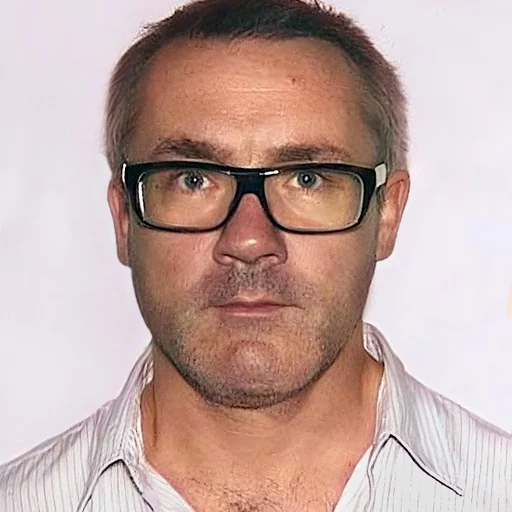
British, b. 1965
Damien Hirst is a British artist. 3 works are cataloged here, principally at Museum of Modern Art. Damien Hirst was born in Bristol.
Overview
Damien Steven Hirst (; né Brennan; born 7 June 1965) is an English artist and art collector. He was one of the Young British Artists (YBAs) who dominated the art scene in the UK during the 1990s. He is reportedly the United Kingdom's richest living artist, with his wealth estimated at US$384 million in the 2020 Sunday Times Rich List. During the 1990s his career was closely linked with the collector Charles Saatchi, but increasing frictions came to a head in 2003 and the relationship ended. Death is a central theme in Hirst's works. He became famous for a series of artworks in which dead animals (including a shark, a sheep, a pig, and a cow) are preserved, sometimes having been dissected, in formaldehyde. The best-known of these is The Physical Impossibility of Death in the Mind of Someone Living, a 14-foot (4.3 m) tiger shark immersed in formaldehyde in a clear display case. In September 2008, Hirst made an unprecedented move for a living artist by selling a complete show, Beautiful Inside My Head Forever, at Sotheby's by auction and bypassing his long-standing galleries. The auction raised £111 million ($198 million), breaking the record for a one-artist auction as well as Hirst's own record with £10.3 million for The Golden Calf, an animal with 18-carat gold horns and hooves, preserved in formaldehyde. Since 1999, Hirst's works have been challenged and contested as plagiarised 16 times. In one instance, after his sculpture Hymn was found to be closely based on a child's toy, legal proceedings led to an out-of-court settlement.
Early life and training
Hirst was born Damien Steven Brennan in Bristol and grew up in Leeds with his Irish mother who worked for the Citizens Advice Bureau. He never met his father; his mother married his stepfather when Hirst was two, and the couple divorced 10 years later. His stepfather was reportedly a motor mechanic. His mother stated that she lost control of her son when he was young; he was arrested on two occasions for shoplifting. Hirst sees her as someone who would not tolerate rebellion: she cut up his bondage trousers and heated one of his Sex Pistols vinyl records on the cooker to turn it into a fruit bowl (or a plant pot). He says, "If she didn't like how I was dressed, she would quickly take me away from the bus stop". She did, though, encourage his liking for drawing, which was his only successful educational subject. His art teacher at Allerton Grange School "pleaded" for Hirst to be allowed to enter the sixth form, where he took two A-levels, achieving an "E" grade in art. He was refused admission to Jacob Kramer College when he first applied, but attended the art school after a subsequent successful application to the Foundation Diploma course. He went to an exhibition of work by Francis Davison, staged by Julian Spalding at the Hayward Gallery in 1983. Davison created abstract collages from torn and cut coloured paper which, Hirst said, "blew me away", and which inspired his own work for the next two years. He worked for two years on London building sites, then studied Fine Art at Goldsmiths College (1986–89), although again he was refused a place the first time he applied. In 2007, Hirst was quoted as saying of An Oak Tree by Goldsmiths' senior tutor, Michael Craig-Martin: "That piece is, I think, the greatest piece of conceptual sculpture. I still can't get it out of my head." While a student, Hirst had a placement at a mortuary, an experience that influenced his later themes and materials. While an art student, Hirst was an assistant at Anthony d'Offay's gallery.
Early career—student and warehouse shows
In July 1988, in his second year at Goldsmiths College, Hirst was the main organiser of an independent student exhibition, Freeze, in a disused London Port Authority administrative block in London's Docklands. He gained sponsorship for this event from the London Docklands Development Corporation. The show was visited by Charles Saatchi, Norman Rosenthal and Nicholas Serota, thanks to the influence of his Goldsmiths lecturer Michael Craig-Martin. Hirst's own contribution to the show consisted of a cluster of cardboard boxes painted with household paint. After graduating, Hirst was included in New Contemporaries show and in a group show at Kettle's Yard gallery in Cambridge. Seeking a gallery dealer, he first approached Karsten Schubert, but was turned down. Hirst, along with his friend Carl Freedman and Billee Sellman, curated two enterprising "warehouse" shows in 1990, Modern Medicine and Gambler, in a Bermondsey former Peek Freans biscuit factory they designated "Building One". Saatchi arrived at the second show in a green Rolls-Royce and, according to Freedman, stood open-mouthed with astonishment in front of (and then bought) Hirst's first major "animal" installation, A Thousand Years, consisting of a large glass case containing maggots and flies feeding on a rotting cow's head. They also staged Michael Landy's Market. At this time, Hirst said, "I can't wait to get into a position to make really bad art and get away with it. At the moment if I did certain things people would look at it, consider it and then say 'f off'. But after a while you can get away with things."
1987–1990
1987 – Damien Hirst and Holden Rowan, Old Court Gallery, Windsor Arts Centre, Windsor, UK – Curator Derek Culley 1988 – Damien Hirst: Constructions and Sculpture, Old Court Gallery, Windsor, UK -Curator Derek Culley 1988 – Freeze, Surrey Docks, London, UK 1989 – New Contemporaries, Institute of Contemporary Arts, London, UK 1990 – Modern Medicine, Building One, London, UK 1990 – Gambler, Building One, London, UK 1990 – Building One, Emmanuel Perrotin Gallery, Paris, FR
1991–1994
His first solo exhibition, organised by Tamara Chodzko (now Dial), In and Out of Love, was held in an unused shop on Woodstock Street in central London in 1991; already in 1989 he had been part of a group exhibition at the Institute of Contemporary Arts, and the Emmanuel Perrotin Gallery in Paris. The Serpentine Gallery presented the first survey of the new generation of artists with the exhibition Broken English, in part curated by Hirst. In 1991 Hirst met the up-and-coming art dealer, Jay Jopling, who then represented him. In 1991, Charles Saatchi had offered to fund whatever artwork Hirst wanted to make, and the result was showcased in 1992 in the first Young British Artists exhibition at the Saatchi Gallery in North London. Hirst's work was titled The Physical Impossibility of Death in the Mind of Someone Living and was a shark in formaldehyde in a vitrine, and sold for £50,000. The shark had been caught by a commissioned fisherman in Australia and had cost £6,000. The exhibition also included In a Thousand Years. As a result of the show, Hirst was nominated for that year's Turner Prize, but it was awarded to Grenville Davey. Hirst's first major international presentation was in the Venice Biennale in 1993 with the work, Mother and Child Divided, a cow and a calf cut into sections and exhibited in a series of separate vitrines. He curated the show Some Went Mad, Some Ran Away in 1994 at the Serpentine Gallery in London, where he exhibited Away from the Flock (a sheep in a tank of formaldehyde). On 9 May, Mark Bridger, a 35-year-old artist from Oxford, walked into the gallery and poured black ink into the tank, and retitled the work Black Sheep. He was subsequently prosecuted, at Hirst's wish, and was given two years' probation. The sculpture was restored at a cost of £1,000. When a photograph of Away from the Flock was reproduced in the 1997 book by Hirst I want to spend the rest of my life everywhere, with everyone, one-to-one, always, forever, now, the vandalism was referenced by allowing the tank to be obscured by pulling a card, reproducing the effect of ink being poured into the tank; this resulted in Hirst being sued by Bridger for violating his copyright on Black Sheep. In 1994, Hirst wrote and directed an advertisement for TNT UK's 100% Weird television strand. The advert followed a man taking his pet canary for a walk to the local butcher, and featured a slew of surreal and bizarre imagery, including a group of eyeless men playing cards while a skinned dead cow drops onto the floor, a man on a high-rise chair defecating a kidney bean, and a businessman (played by Malcolm McLaren, who also composed the music for the advert) wearing earrings. While TNT were initially "delighted" by the advert, which was intended to play in cinemas and then have brief snippets shown on television, it was eventually rejected due to its "inappropriate" imagery.
1995–1999
In 1995, Hirst won the Turner Prize. New York public health officials banned Two Fucking and Two Watching featuring a rotting cow and bull, because of fears of "vomiting among the visitors". There were solo shows in Seoul, London and Salzburg. He directed the video for the song "Country House" for the band Blur. No Sense of Absolute Corruption, his first solo show in the Gagosian Gallery in New York was staged the following year. In London the short film, Hanging Around, was shown—written and directed by Hirst and starring Eddie Izzard. In 1997 the Sensation exhibition opened at the Royal Academy in London. A Thousand Years and other works by Hirst were included, but the main controversy occurred over other artists' works. It was nevertheless seen as the formal acceptance of the YBAs into the establishment. In 1997, his autobiography and art book, I Want To Spend the Rest of My Life Everywhere, with Everyone, One to One, Always, Forever, Now, was published. With Alex James of the band Blur and actor Keith Allen, he formed the band Fat Les, achieving a number 2 hit with a raucous football-themed song Vindaloo, followed up by Jerusalem with the London Gay Men's Chorus. Hirst also painted a simple colour pattern for the Beagle 2 probe. This pattern was to be used to calibrate the probe's cameras after it had landed on Mars. He turned down the British Council's invitation to be the UK's representative at the 1999 Venice Biennale because "it didn't feel right". He threatened to sue British Airways claiming a breach of copyright over an advert design with coloured spots for its low budget airline, Go.
2000–2004
In 2000, Hirst's sculpture Hymn (which Saatchi had bought for a reported £1m) was given pole position at the show Ant Noises (an anagram of "sensation") in the Saatchi Gallery. Hirst was then sued himself for breach of copyright over this sculpture (see Appropriation below). Hirst sold three more copies of his sculpture for similar amounts to the first. In September 2000, in New York, Larry Gagosian held the Hirst show, Damien Hirst: Models, Methods, Approaches, Assumptions, Results and Findings. 100,000 people visited the show in 12 weeks and all the work was sold. On 10 September 2002, on the eve of the first anniversary of the 9/11 World Trade Center attacks, Hirst said in an interview with BBC News Online:
The thing about 9/11 is that it's kind of like an artwork in its own right. It was wicked, but it was devised in this way for this kind of impact. It was devised visually... You've got to hand it to them on some level because they've achieved something which nobody would have ever have thought possible, especially to a country as big as America. So on one level they kind of need congratulating, which a lot of people shy away from, which is a very dangerous thing. The next week, following public outrage at his remarks, he issued a statement through his company, Science Ltd:
I apologise unreservedly for any upset I have caused, particularly to the families of the victims of the events on that terrible day. In 2002, Hirst gave up smoking and drinking after his wife Maia had complained and "had to move out because I was so horrible". He had met Joe Strummer (former lead singer of The Clash) at Glastonbury in 1995, becoming good friends and going on annual family holidays with him. Just before Christmas 2002, Strummer died of a heart attack. This had a profound effect on Hirst, who said, "It was the first time I felt mortal". He subsequently devoted a lot of time to founding a charity, Strummerville, to help young musicians. In April 2003, the Saatchi Gallery opened at new premises in County Hall, London, with a show that included a Hirst retrospective. This brought a developing strain in his relationship with Saatchi to a head (one source of contention had been who was most responsible for boosting their mutual profile). Hirst disassociated himself from the retrospective to the extent of not including it in his CV. He was angry that a Mini car that he had decorated for charity with his trademark spots was being exhibited as a serious artwork. The show also scuppered a prospective Hirst retrospective at Tate Modern. He said Saatchi was "childish" and "I'm not Charles Saatchi's barrel-organ monkey ... He only recognises art with his wallet ... he believes he can affect art values with buying power, and he still believes he can do it." In September 2003, he had an exhibition Romance in the Age of Uncertainty at Jay Jopling's White Cube gallery in London, which made him a reported £11m, bringing his wealth to over £35m. It was reported that a sculpture, Charity, had been sold for £1.5m to a Korean, Kim Chang-Il, who intended to exhibit it in his department store's gallery in Seoul. The 22-foot (6.7m), 6-ton sculpture was based on the 1960s Spastic Society's model, which is of a girl in leg irons holding a collecting box. In Hirst's version the collecting box is shown broken open and is empty. Charity was exhibited in the centre of Hoxton Square, in front of White Cube. Inside the gallery downstairs were 12 vitrines representing Jesus's
2005–2009
Hirst exhibited 30 paintings at the Gagosian Gallery in New York in March 2005. These had taken 3½ years to complete. They were closely based on photos, mostly by assistants (who were rotated between paintings) but with a final finish by Hirst. Also in 2005, Hirst founded the art book publisher Other Criteria. In February 2006, he opened a major show in Mexico, at the Hilario Galguera Gallery, called The Death of God, Towards a Better Understanding of Life without God aboard The Ship of Fools, an exhibition that attracted considerable media coverage as Hirst's first show in Latin America. In June that year, he exhibited alongside the work of Francis Bacon (Triptychs) at the Gagosian Gallery, Britannia Street, London, an exhibition that included the vitrine, A Thousand Years (1990), and four triptychs: paintings, medicine cabinets and a new formaldehyde work entitled The Tranquility of Solitude (For George Dyer), influenced by Bacon. A Thousand Years (1990) contains an actual life cycle. Maggots hatch inside a white minimal box, turn into flies, then feed on a bloody, severed cow's head on the floor of a claustrophobic glass vitrine. Above, hatched flies buzz around in the closed space. Many meet a violent end in an insect-o-cutor; others survive to continue the cycle. A Thousand Years was admired by Bacon, who in a letter to a friend a month before he died, wrote about the experience of seeing the work at the Saatchi Gallery in London. Margarita Coppack notes that "It is as if Bacon, a painter with no direct heir in that medium, was handing the baton on to a new generation." Hirst has openly acknowledged his debt to Bacon, absorbing the painter's visceral images and obsessions early on and giving them concrete existence in sculptural form with works like A Thousand Years. Hirst gained the world record for the most expensive work of art by a living artist—his Lullaby Spring in June 2007, when a 3-metre-wide steel cabinet with 6,136 pills sold for 19.2 million dollars to Sheikh Hamad bin Khalifa Al-Thani, the Emir of Qatar.
In June 2007, Beyond Belief, an exhibition of Hirst's new work, opened at the White Cube gallery in London. The centre-piece, a Memento Mori titled For the Love of God, was a human skull recreated in platinum and adorned with 8,601 diamonds weighing a total of 1,106.18 carats. Approximately £15,000,000 worth of diamonds were used. It was modelled on an 18th-century skull, but the only surviving human part of the original is the teeth. The asking price for For the Love of God was £50,000,000 ($100 million or 75 million euros). It didn't sell outright, and on 30 August 2008 was sold to a consortium that included Hirst himself and his gallery White Cube. In November 2008, the skull was exhibited at the Rijksmuseum in Amsterdam next to an exhibition of paintings from the museum collection selected by Hirst. Wim Pijbes, the museum director, said of the exhibition, "It boosts our image. Of course, we do the Old Masters but we are not a 'yesterday institution'. It's for now. And Damien Hirst shows this in a very strong way." Responding to this show at the Rijksmuseum and to the piece more generally in a feature-length article on the entwined histories of European art and double-entry bookkeeping, the art historian Rachel Cohen wrote:
Two years [after the sale of For the Love of God], with financial markets imploding on every side, it was reported that the work had in fact been sold to a holding company that turned out to co
2010–2014
In 2011, Damien Hirst designed the cover of the Red Hot Chili Peppers album I'm with You.
Hirst's representation of the British Union Flag formed the arena centrepiece for the 2012 Summer Olympics closing ceremony in London. In January 2013, Hirst became the third British artist to design the Brit Awards statue using his signature NEO-Pop art style inspired by his 2000 LSD "spot painting." In October 2014, Hirst exhibited big scale capsules, pills and medicines at the Paul Stolper Gallery titled, Schizophrenogenesis.
2015–present
In April 2016, a study published in Analytical Methods claimed Hirst's preserved carcasses leaked formaldehyde gas above legal limits at Tate Modern; however, this study was shown to be flawed. In 2017, he organised with Pinault Foundation a solo exhibition, in Venice contemporarily to the Biennale in two places in the city: Palazzo Grassi and Punta della Dogana. The title was Treasures from the Wreck of the Unbelievable, purporting to present ancient treasures from a sunken Greek ship, with pieces that range from Ancient Egyptian-alike items to Disney character reproductions, encrusted with shells and corals. In July 2021 through January 2022, Hirst's series Cherry Blossoms was exhibited at the Foundation Cartier in Paris. The exhibition was then moved to the National Art Center in Tokyo in 2022. The show marked Hirst's first major solo exhibition in Japan.
The Physical Impossibility of Death in the Mind of Someone Living
This artwork features a large tiger shark suspended in formaldehyde. The tank in which the shark is floating creates the illusion of the animal being cut into three pieces due to the container looking like three separate sections. The work was created in 1991, and since then, the formaldehyde preserving the shark has slowly eaten away at the animal's body, which shows signs of decay. Hirst says that the formaldehyde surrounding the shark is the process of death and decay. Some critics argue that the minimalistic qualities of the work, coinciding with the 'stereotypical' death theme, are too bland for such a prestigious artist. One critic, Craig Raine wrote, "But the famous shark, shackled to its coffeebar-existentialist title – The Physical Impossibility of Death in the Mind of Someone Living – seems ever more dilapidated, more fairground sideshow, with every dowdy showing. What clichéd menace it may once have theoretically possessed has evaporated." In his essay Damien Hirst's Shark: Nature, Capitalism and the Sublime, art critic Luke White connects the work to the concept of the "Burkean Sublime", but challenges Hirst's own idea of the shark as a primordial "universal trigger" of horror in humans by tracing the different attitudes towards sharks (both real and artistically rendered) in various times and places throughout history. With this view, he describes Hirst "not [as an] exemplary artist, but rather a symptomatic one, who tells us much about our own time," and views the work as a reflection of the contradictions and anxieties of modern life imposed by systems of capitalism, and of "growing fears about environmental catastrophe" which threatens to limit "human power, progress and wealth," if not completely destroy us.
Beautiful Inside My Head Forever
Beautiful Inside My Head Forever was a two-day auction of Hirst's new work at Sotheby's, London, taking place on 15 and 16 September 2008. It was unusual as he bypassed galleries and sold directly to the public. Writing in The Independent, Cahal Milmo said that the idea of the auction was conceived by Hirst's business advisor of 13 years, Frank Dunphy, who had to overcome Hirst's initial reluctance about the idea. Hirst eventually defended the concept and refuted the accusation that he was only interested in making money:People always worry that money somehow tarnishes art, but I always thought it was disgusting that people like Van Gogh never made any money. It's important to make sure that the art takes precedence over the money. Most people worry that somehow you lose your integrity. Frank said to me a long time ago: "Always have to make sure that you use the money to chase the art and not the art to chase the money." And I think that's true; you have to look at that very carefully. The sale raised £111 million ($198 million) for 218 items. The auction exceeded expectations, and was ten times higher than the existing Sotheby's record for a single artist sale, occurring as the financial markets plunged. The Sunday Times said that Hirst's business colleagues had "propped up" the sale prices, making purchases or bids which totalled over half of the £70.5 million spent on the first sale day: Harry Blain of the Haunch of Venison gallery said that bids were entered on behalf of clients wishing to acquire the work.
Hirst art collecting
In November 2006, Hirst was curator of In the darkest hour there may be light, shown at the Serpentine Gallery, London, the first public exhibition of (a small part of) his own collection. Now known as the 'murderme collection', this significant accumulation of works spans several generations of international artists, from well-known figures such as Francis Bacon, Jeff Koons, Tracey Emin, Richard Prince, Banksy and Andy Warhol, to British painters such as John Bellany, John Hoyland, and Gary Hume, and artists in earlier stages of their careers Rachel Howard, David Choe, Ross Minoru Laing, Nicholas Lumb, Tom Ormond, and Dan Baldwin. Hirst is currently restoring the Grade I listed Toddington Manor, near Cheltenham, where he intends to eventually house the complete collection. In 2007, Hirst donated the 1991 sculptures The Acquired Inability to Escape and Life Without You and the 2002 work Who is Afraid of the Dark? (fly painting), and an exhibition copy from 2007 of Mother and Child Divided to Tate from his own personal collection of works. In 2010, Hirst was among the unsuccessful bidders to take over the Magazine Building, a 19th-century structure in Kensington Gardens, which reopened in 2013 as the Serpentine Sackler Gallery after its conversion by Zaha Hadid. In March 2012, he outlined his plans to open a gallery in Vauxhall, London specifically designed to exhibit his personal collection, which includes five pieces by Francis Bacon. The Newport Street Gallery opened in October 2015. It is located in a former theater carpentry and scenery production workshops redesigned by Peter St John and Adam Caruso, and runs the length of Newport Street in Vauxhall.
Awards and recognition
Hirst was nominated for the Turner Prize in 1992, for his first Young British Artists exhibition at the Saatchi Gallery in North London, which included his The Physical Impossibility of Death..., with the award going to Grenville Davey that year. Hirst won the Turner Prize in 1995. He was asked to represent the UK in the Venice Biennale in 1999 or to become a Royal Academian but refused. In 2012, Hirst was among the British cultural icons selected by artist Sir Peter Blake to appear in a new version of his album cover for the Beatles' Sgt. Pepper's Lonely Hearts Club Band, to celebrate the British cultural figures of his life that he most admires.
Collections represented

Museum
Artists in a similar vein
Artist