Artist
Georgy Yakulov
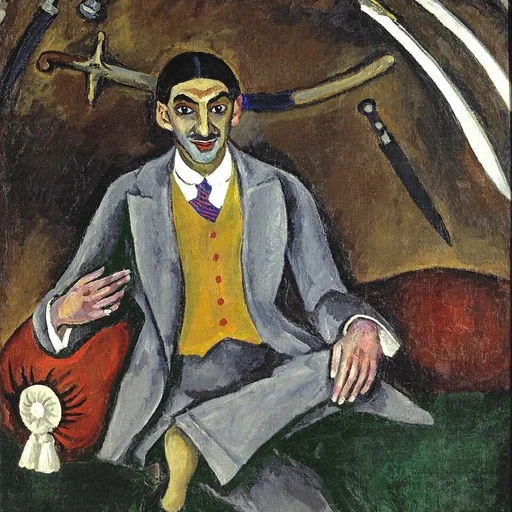
Russian, 1884–1928
Georgy Yakulov was a Russian Cubism Synthetic artist. 4 works are cataloged here, principally at National Gallery of Armenia. Georgy Yakulov was born in Tbilisi.
Overview
Georgy Bogdanovich Yakulov (January 2 (14), 1884, — December 28, 1928) was a Russian painter and art theorist of Armenian descent. A notable artisan in Moscow during the Silver Age and early Soviet era, he was close to the circle of avant-garde innovators, he actively interacted with various artistic movements (cubism, futurism, imaginism, constructivism), but was not a member of any of the art groups, was looking for his own visual method, combining the culture of the East and the culture of the West. The ideas put forward by him "the theory of light and the origin of styles in art", called the "theory of multi-colored suns", developed by the French artist Robert Delaunay.
Early years
The future artist was born in Tiflis, in the Armenian family of the famous lawyer Bogdan Galustovich Yakulov (Yakulyan): George was the youngest, ninth child, a darling and a favorite of his parents. Father died in 1893, and mother, Susanna Artemievna (née Kananova), taking six children with her, she moved to Moscow, where George in the same year was assigned to the boarding school of the Lazarev Institute of Oriental Languages (expelled from the sixth grade in 1898 for disobeying the rules of the boarding school). Unlike older brothers, Alexandra and Yakov, who have chosen a legal career, George showed interest in art and in 1901, after two months of classes at the school of K.F. Yuon, he entered the Moscow school painting, sculpture and architecture, however, for failure to attend classes in May 1903, he was expelled from the head class of the painting department and was soon drafted into the army. Served in the Caucasus (where he managed to paint), participated in the Russo-Japanese War, in a battle near Harbin he was wounded and in 1905 he returned to Moscow.
Becoming an artist
The very first work "Horse Racing", created by Georgy Yakulov upon his return to Moscow and shown by him in 1906 at the exhibition "Moscow associations of artists", attracted attention in art circles and was noted by Pavel Muratov in the magazine "Vesy": "The paradoxical drawing" Horse Racing "by G. Yakulov is carried out sharply, the artist interestingly applied the colored spots of chinese vases to his theme". A strong impression on contemporaries was made by bright entertainment and organicity, with which Yakulov connected in this work the traditions of the East with the aesthetics of late modernism, and when, in 1908, Kazimir Malevich showed his flat gouaches with an entertaining crowd, they were perceived as an imitation of Yakulov.
The artist consolidated his creative success by participating in the exhibition "Wreath" (1907) a variety of graphic and painting works ("Man of the Crowd", "Roosters", "Sukhum under the Snow", "Hermitage Garden", "Arab Symphony" etc.) but now Muratov spoke very restrainedly about his recent debutant, in which, according to the critic, "sharpness and lethargy, originality and imitation are strangely mixed". From the earliest works, Yakulov surprised by the combinations of the incompatible inherent in his style: in a small, reminiscent of an old miniature, "To the Street" (1909), the emphasized decorativeness of the enamel painting was combined with the methods of transmitting the light-air medium, realistic multi-storey building foreground - with a semi-fantastic view "on the blue street-bowl, in which not so much moving as resting black-red-white carriages with smart riders and pedestrians". At the exhibition "Wreath", he became close to the artists of the association "Blue Rose" - M. Saryan, P. Kuznetsov, N. Sapunov, S. Sudeikin, N. Krymov. In the second half of the 1900s, Yakulov first appeared as an architectural decorator, decorating the premises for the "Evening of Russian Writers" (1907) and did first steps in book graphics - small works in the magazines "Libra" and "Golden Fleece". In 1908, his works were presented at the VI exhibition of the Union of Russians artists, in 1909 - at the exhibition "Secession" in Vienna, since 1911 have been exhibited at exhibitions of the "World of Art". At the beginning of 1911 G. Yakulov together with P. Konchalovsky, A. Lentulov, M. Larionov, N. Goncharova, K. Malevich, A. Exter took part in the exhibition "Moscow Salon".
In 1908 he made a trip to Italy (visiting Venice, Padua, Florence, Siena and Rome), in 1911-1913 he spent a long time in Paris (where he met and communicated with R. Delaunay), in 1913 he took part in the Autumn salon "Storm" in Berlin. In 1913, Yakulov, together with the blue-rozovites Saryan and N. Milioti, illustrated the book of poems "Purple Kifera" V. Elsner, with Sudeikin created the scenery for the theatrical program "Dog Carousel" in the artistic cabaret "Stray Dog" in St. Petersburg. At the end of December 1913, at meetings in Stray Dog, a controversy arose about the priority of ideas, put forward by R. Delaunay in his theory of "simultanism-orphism" - after the report of the philologist A. Smirnov, who promulgated the concept of Delaunay, Yakulov protested against the appropriation of ideas from his own theory, which a week later, on December 30, he stated in his report: "Natural light (archaic solar), artificial light (modern electric)". On January 1, 1914, together with the "Budelians" A. Lurie and B. Livshits, he wrote the man
Years flourishing
One of the "special points" in the creative biography of Georgy Yakulov, which marked the artist's transition from easel painting to theatrical and decorative and monumental art became his work on the design of the Moscow artistic cafe "Pittoresque" (pittoresque - "picturesque"). Even in the pre-revolutionary years Yakulov designed a number of club interiors as a decorator for various charity and entertainment events - an evening on the theme "China" at the Hunting Club (1908/1909), in the same place "Tiflis Maidan" together with B. Lopatinsky and A. Lentulov (1912), "Night in Spain" at the Merchant Club together with P. Konchalovsky (1912) and others. Retrofitting the high hall of the former Passage of San Galli on Kuznetsky Most, (commissioned by N. Filippov, one of the heirs of the famous moscow baker) was not only a more ambitious project, but also of particular professional complexity.
When I entered the room, I saw that this building was formed from the space between two houses, the windows of which looked into this room, and the semicircular glass ceiling, like that of a greenhouse, was formed by iron arcs. Having experience in decoration from my past, I drew attention to the square lattice of glass, the importunity of which could not be changed by any forces other than to weave them into the overall composition. To do this, it was necessary to introduce this principle of lattice and planks into the decoration. Architecture of this order was well known from the chinese models, and i have resorted to this form. In view of the impossibility of ordering fittings and seeing the vulgarity of the existing one, I decided to make it out of abstract forms and build it on rotating parts. <...> Thus, the form was born, which later received the name "constructive".
In the design of the cafe "Pittoresk" G. Yakulov acted as the author of the project and the head of the work, lasted from July 1917 to January 1918, and attracted a large group to carry them out constructivist artists and non-objects: L. Bruni, K. Boguslavskaya, S. Dymshits-Tolstaya, L. Golov, V. Tatlin, N. Udaltsova, B. Shaposhnikov, A. Rybnikov. Together with Tatlin, A. Osmerkin took part in the painting of the glass ceiling, A. Rodchenko was engaged in the development of lamps based on Yakulov's rough sketches (this was his first design job), sculptor P. Bromirsky helped to create chandeliers, the rotating elements of the hall's decorative solution were embodied in the material by N. Goloshchapov. For the artists invited by Yakulov, it was an opportunity not only to make money, but also to implement ideas in the material, which they previously developed only in sketches.
Yakulov's overall design solution separated the decoration from the walls and brought him into a constructively and dynamically organized space of the hall. But decorativeness, as an artistic principle, was preserved, which contradicted the main ideology of the constructivists and led to a purely formal participation in the work on the cafe "Pittoresk" of their leader Tatlin. The cafe was opened on January 30, 1918. A string quartet played on the stage every day, artistic performances were played, writers read their works, there were disputes. A. Lunacharsky performed here, V. Bryusov, V. Mayakovsky, S. Yesenin, V. Kamensky, Sun. Meyerhold, A. Tairov, A. Mariengof often visited, V. Shershenevich, D. Shterenberg, A. Lentulov, K. Malevich, M. Saryan, A. Shchusev, M. Ippolitov-Ivanov, V.Kachalov, I. Moskvin, V.
Death and farewell
In the spring of 1928, the People's Commissariat for Education applied for the awarding of the title of Honored Artist to G. Yakulov, in connection with the 25th anniversary of his creative activity, a committee for the celebration of the anniversary was organized under the chairmanship of A. Tairov. However, the issue of awarding the title and the organization of the anniversary evening was delayed, Yakulov's lung tuberculosis progressed, and in August 1928 he left for Dilijan for treatment. In Armenia, he made a series of landscape sketches and wrote two programmatic articles: "Theater and Painting" and "Revolution and Art". In November, Yakulov caught a cold and fell ill with pneumonia. He was admitted to the hospital in Yerevan, where he drew up detailed notes for the anniversary committee: "My biography and artistic activity", "My artistic activity from 1918 - 1928" and sent to the Chamber Theater, Tairov. These documents summed up the artist's creative life: on December 28, Georgy Yakulov died. The upcoming jubilee celebration became a civil funeral service. By order of A. Lunacharsky, the coffin with the artist's body was sent by a special funeral carriage to Moscow. Farewell ceremony with Yakulov was held in Yerevan on December 31 - Armenian leaders and friends paid a debt to the artist - M. Saryan, A. Tamanian, M. Shaginyan, E. Lansere. On the way to Moscow, the funeral car was uncoupled from the train in Tiflis and on January 2, on the day of the 45th birthday of Georgy Yakulov, representatives of the Georgian public said goodbye to him - Sh. Eliava, T. Tabidze, L. Gudiashvili, V. Anjaparidze, Y. Nikoladze. On January 6, a train with a funeral carriage arrived in Moscow, where the committee for organizing the funeral was created, headed by Lunacharsky. One of the organizers of an unusual farewell ceremony, Yakulov's student, artist N. Denisovsky, described in his memoirs this meeting, which involved an orchestra of 40 cavalrymen on horseback, 40 torches and a hearse wagon on a sleigh, draped with black cloth, with a red rectangular pedestal for the coffin; four lamps were lit on its sides, made at the Chamber Theater according to Yakulov's sketches for the play "Rosita":
The hearse was carried by four horses harnessed in a train, three pairs under black and silver blankets, and were accompanied by their guides in white coats with metal buttons. White top hats were worn on their heads. The actors of the Chamber Theater walked in pairs in procession with lighted torches in their hands, illuminating Yakulov's road to eternity. Three black squares on subframes - two by three meters - were hung on the buildings with inscriptions in white paint: "I lived here, worked here, studied here G. B. Yakulov ". One shield was hung on the building of the Lazarev Institute in the Armenian lane, another, at 10 Bolshaya Sadovaya, where Yakulov lived, and the third - on the building of the Chamber theater, where he worked. ...Forty horsemen of the military band opened the procession, making their way through the crowd of people that filled the entire station square <...> the procession moved to the Kuznetsky Most, and when the front part of it with wreaths was already on Petrovka and climbed up Kamergersky lane, all Kuznetsky was in torches and flowers, and the coffin itself and the people seeing off were still in Furkasovsky lane ... On January 7, Georgy Yakulov was buried at the Novodevichy cemetery. The committee for the perpetuation of his m
Family
Wife - Natalya Yulievna Yakulova (Shif) (1891-1974) Nephew - virtuoso violinist Alexander Yakulov (1927-2007).
The fate of the creative legacy
Georgy Yakulov's posthumous exhibition of works in Moscow could not be organized, as it turned out that there was not a single painting in the artist's studio after his death, and his entire creative archive was missing. Yakulov had left about 100 of his paintings in Paris with Mikhail Larionov and Natalia Goncharova, but the French exhibition did not take place either, and Yakulov's paintings became the property of Goncharova's and Larionov's heirs after their death. In 1968 A.K. Larionova-Tomilina donated 11 works by Yakulov to the Tretyakov Gallery. A year before, the artist Rafael Kherumyan created the "Society of Friends of Georgy Yakulov" in Paris (whose members were Sonia Delaunay, spouses, art historians Valentina and Jean-Claude Marcade). In 1972, the Society acquired most of Yakulov's works from Larionov's heirs and donated them to the Art Gallery of Armenia. In the 1930s, Robert Delaunay organized a committee to publish a monograph about Georgy Yakulov, which included P. Picasso, B. Sandrard, A. Glez, M. Chagall, S. Prokofiev, however the project was not implemented. Scattered works of the artist are in the collections of the Pompidou Center, Russian Museum, State Literary Museum, Perm Art Gallery, Kaluga Museum of Fine Arts, Samara Art Museum, Krasnodar Art Museum, remain in domestic and foreign private collections, but the total number of paintings by Yakulov is small and the location of many of his paintings is not known.
More fortunate for the theatrical legacy of Georgy Yakulov: a significant collection of it is kept in the Theater Museum Bakhrushina: sketches for scenery and stage costumes, models, dolls made according to the artist's sketches. Several costumes for the ballet "Steel Gallop" are in the National Gallery of Australia. Separate Yakulov sketches are in the collections of the St. Petersburg Museum of Theater and Musical Art, the museums of the Bolshoi Theater and the Shota Rustaveli Georgian Theater. The Library-Museum of the Paris Opera in the B. Kokhno fund contains two sketches by G. Yakulov for costumes for "Steel Dap", as well as a number of letters from the artist to S. Diaghilev (three of them, which are of significant importance in the theoretical legacy of Yakulov, were published in the article by G. Kovalenko). The main sets of documents and photographs related to the life and work of Georgy Yakulov are kept in the National Art Gallery of Armenia, in the Department of Manuscripts of the Theater Museum. Bakhrushin and at RGALI. The first retrospective exhibitions of the artist's works were held in Yerevan in 1959, 1967 and 1975. In 2015, the Tretyakov Gallery organized the exhibition "Georgy Yakulov. Master of multicolored suns", presenting about 130 works from several museums and private collections.
Easel painting
The small number of surviving paintings by G. Yakulov makes it impossible to characterize his pictorial work as a whole, compose its periodization, correlate with the searches of other artists and forms the belief that, although Yakulov began as a painter, "but his talent had to develop and prove himself really not in easel painting". Attempts by researchers to identify the distinctive features of the artist's painting style using such a small amount of material give conflicting results: according to some authors, Yakulov "remained alien to both Cubism and Futurism", others have challenged this view by analyzing such works of the late 1910s, as "Tverskaya", still others believed that "it came rather from the Italian classics... His paintings "Fight of the Amazons", "There lived a poor knight", "Fight", "Lombardy", "Tverskaya" - were entirely inspired by his trip to Venice, Padua, Florence, Rome". In other cases, it is practiced to avoid direct comparisons of Yakulov painting with the mainstream of the avant-garde - they are replaced by the analysis of its individual qualities: "The life of light in Yakulov's painting is strikingly diverse: not only images of the rays themselves, but their refraction, scattering, endless reflections in showcases, shiny surfaces... The artist introduces into his compositions a variety of screens, curtains, curtains, screens that transmit and attenuate the light flux in different ways. No less often in Yakulov's painting there are systems of mirrors, thanks to them, light plots acquire a special drama, subjugating spatial forms, involving the hero in a complex spatial intrigue: "Before the Mirror" (State Picture Gallery of Armenia, 1920), "Portrait of Alisa Koonen" (Private collection, Moscow, 1920) and others".
In addition to early decorative compositions that transformed visual images of the East in Western figurative forms ("Roosters", "Decorative Motif") and a series of paintings from the mid-1910s, embodying in practice the Yakulov theory of "multi-colored suns" ("Spring Walk", "Fantasy", "Bar" - all 1915), the cross-cutting themes of different years in Yakulov's painting were urbanism and the atmosphere of public entertainment: crowd in urban and suburban landscapes or in confined spaces of bars and cafes, masquerade, fairgrounds, characters from the Italian commedia dell'arte. These motives were developed by the artist in numerous versions of "Cafe", "Horse Racing", "Streets" and in individual works: "Tverskaya", "Circus", "Monte Carlo" and so on. The ironic perception of reality was mixed in these works of Yakulov with his stormy and fabulous fantasy, but sometimes it turned into a dark expression - both in the years of late modernity and in new, "constructivist" times, and took out of the modern Soviet artistic context such works of Yakulov, as the phantasmagoric painting "The Man of the Crowd" (1922; first version - 1907).
Theatrical and decorative art
Theatrical works fully revealed the synthetic character of Yakulov's work. A one-of-a-kind combination of constructivism with decorativeism, wild imagination and practical ingenuity, innovative searches and striving to preserve the generic specificity of theatrical art, wide intellectual outlook and lively reaction to the latest events in life and art - all this acquired an organic whole in the scenography of the outstanding theater artist. Yakulov, the set designer, sought to co-write with the director: if in unrealized productions of "Hamlet" and "Mystery-Buff" this became the reason for the conflict with Meyerhold, then in partnership with Tairov - led to a true triumph in the play "Girofle-Girofle". At the same time, Yakulov not only created an enchanting spectacle, but also proved himself as an innovator in stage technology:
"For Girofle-Girofle, he found forms that were the most durable of anything he had done before. Yakulov's technique went over all the scenes. It was continued by the theater itself in a number of subsequent performances, when the Stenberg brothers came to replace Yakulov, and it was widely used by other theaters in the works of young decorators who seized on the opportunities that Yakulov's solution gave them. Its essence was in the transformation of the scenery. However, what was on the stage could not be called scenery. These were "constructions" - colorful constructions of a theatrical nature. <...> They worked with an actor and for an actor. Before our very eyes, they served what was needed during the game. They pushed out some parts, took out others, rolled out platforms, lowered stairs, opened hatches, built passages, were always at hand or under foot along with a balustrade, step, barbell, device, which could be touched to find a fulcrum for a moment". Carnival eccentricity of the Yakulov theater performances, who showed herself two years earlier in "Princess Brambill" and which seemed to the audience a cascade of impromptu, was strictly organized by the artist: this is evidenced by the preparatory sketches with the consistent development of mise-en-scenes and all the details of the spatial composition. The same careful study of many details distinguished Yakulov's preparation of the scenography of the ballet "Steel Skok" - all his drawings were accompanied by detailed verbal explanations of the nature of the interactions of the dynamics of movements of ballet dancers with the kinetics of the moving parts of the scenery, schematic indications of sources and directions of complex lighting scores and so on. "Steel Skok" was created in collaboration with the composer Prokofiev, whose music was written "simultaneously with Yakulov's script - by scenes, by episodes", and for the first time in the history of Diaghilev's" Russian ballets "the script prescribed" literally in seconds, not only the development of the plot, but also the nature of the movements and the number of characters".
The kinetic techniques of Yakulov's scenography reached their maximum amplification in "Steel Skok": criticism noted that at each site and at each level of space "something happens simultaneously and often completely independently of what is happening nearby". But this radical constructivist experiment of Yakulov remained only an episode in his theatrical work. He "did not consolidate his positions" did not repeat itself. Having exhausted one artistic technique, in parallel he developed another, depending on the genre specific
Theoretical ideas
Despite the significant number of Yakulov's appearances in print, he did not carry out a systematic presentation of his theoretical views. The theory of "multi-colored suns", declared by him in the articles "Blue Sun" and "Ars solis. Color Painter's Sporades ", remained unfinished and, according to researchers, was not so much a theory, how much by the presentation of the artist's philosophical ideas about the stylistic differences of cultures of different regions in the bizarre terminology of his own invention. According to the brief and generalizing formulation of his fellow futurist B. Livshits, Yakulov "had a kind of epistemological concept opposing the art of the West, as the embodiment of geometric perception, directed from object to subject, - the art of the East, the algebraic worldview, going from subject to object". In more specific issues - distinguishing the types of painting of previous eras by the prevailing color spectra and the search for color-space solutions for modern painting of the "electric sun" - Yakulov, according to his autobiography and the testimony of M. Larionov, in the summer of 1913 he collaborated with R. Delaunay, in parallel developing their theory of simultanism, but, unlike his French colleague, his ideas did not have a noticeable influence on the work of other artists. At the same time, in a number of Yakulov's articles on the art of theater, the materials of his speeches, unfinished works and letters contain many theoretical statements, related to practical issues of theatrical work, often complementary to each other and in a complex constituting a single whole. At the end of a lecture given in 1926 to the troupe of the newly created Belarusian Jewish Theater Yakulov, answering the question, he makes a quick note: "We confuse kinetics with dynamics", left at that moment without explanation. In the work "Theater and Painting" written shortly before his death (published in 2010 in the book by V. Badalyan) Yakulov explains in detail the connection of these conceptual concepts in his theoretical system of concepts, comprehended by him independently of the then not yet arisen kinetic art:
"Kinetics is the area of consciousness, rhyming and metering. Dynamics - winding the clock spring, kinetics - exponential movement of the hands on the dial. Dynamics exists "in spite of reason, in spite of the elements". Kinetics, on the contrary, subordinates everything to reason. and must take into account the elements. <...> In the new eccentric theater, the actor has to control the set just like a pilot an airplane. The sets and costumes must be kinetic and only one actor is dynamic". Describing in the same lecture the pace of audience perception in different historical epochs a simple comparison of the speed of movement of a car wheel relative to a cart wheel, Yakulov makes a fundamental conclusion about the dependence of theatrical production on the specifics of the psychology of modern audience perception: "Every theater is looking for its own design, because the modern viewer, surrounded by modern everyday objects, to a certain extent accustomed, both in the sense of auditory and sound and in the sense of technology, to see things this way and not otherwise. <...> When you see this terrible speed of visual [perception] in a modern European city, experiences of impressions, then it will become quite obvious to you that the measured Greek tragedy, calculated for the whole day, is not suitable for us". In August 1
Articles about art
An artist's diary. Blue sun // Alcyone. Almanac. Book. 1. - M., 1914. - S. 233–239. The principle of staging "Measure for Measure" // Theater Bulletin. - M., 1919. - No. 47. - P. 11. More about three-dimensionality // Theater Bulletin. - M., 1920. - No. 59. - P. 5–7. From the artist's diary // Rampa. - M., 1921. - No. 8. - P. 4. From the artist's diary // Art and Labor. - M., 1921. - No. 1. - P. 9. The value of the artist in modern theater // Theater Bulletin. - M., 1921. - No. 80-81. - p. 17. Ars solis. Colorist's Sporades // Hotel for travelers in the beautiful. - M., 1922. - No. 1. My counterattack // Hermitage. - M., 1922. - No. 7. - P. 10–11. On the problem of synthesis "East - West" // Screen. - M., 1922. - No. 22. - P. 13. On eccentric art // Screen. - M., 1922. - No. 31. - P. 4. "Signor Formica" (on the principles of Hoffmann's design) // Screen. - M., 1922. - No. 31. - P. 5. Two productions of the season // Teatralnaya Moscow. - M., 1922. - No. 4. - P. 12; No. 46. - P. 7. Ex oriente lux. "Eternal Jew", or the Second Exodus of Jews in Palestine // Spectacles. - M., 1923. - No. 43. - P. 3. In memory of the 26 // Baku worker. - Baku, 1923, September 23. Revolution and art (Artist Yakulov about his project of the monument to 26) // Baku worker. - Baku, 1923, September 25. From the artist's diary // Spectacles. - M., 1923. - No. 69. - P. 6. Artist's notebook // Ramp. - M., 1924. - No. 8-21. - P. 4. About Meyerhold's "Forest" // Spectacles. - M., 1924. - No. 72. - P. 7. Yakulov talks about philistinism // New ramp. - M., 1924. - No. 2. - P. 6. "Stenka Razin" (What is your opinion about the play?) // Spectacles. - M., 1924. - No. 73. - P. 5. Evaluation of artistic work // New ramp. - M., 1924. - No. 6. - P. 14. An artist's diary. "Man of the Crowd" // Life of Art. - P. - M., 1924. - No. 2. P. 9–10; No. 3. - P. 7–9. Monument 26 // Baku worker. - Baku, 1924, August 25. "Arsonists". New Drama Theater // Art for the Working People. - M., 1925. - No. 8. - P. 12. Sculptor Mendelevius // Krasnaya Niva. - M., 1925. - No. 6. - P. 125. Trial of the theatrical season // New spectator. - M., 1925. - No. 19. - P. 11. The paths of artistic culture in the TSFSR (Conversation with the artist Yakulov) // Dawn of the East. - Tiflis, 1926, December 15. Picasso // Ogoniok. - M., 1926. - No. 20. - P. 10 About theater, cinema and art of the Transcaucasus (Fugitive notes) // Dawn of the East. - Tiflis, 1927, March 12. Niko Pirosmanishvili (From the cycle "East - West") // Dawn of the East. - Tiflis, 1927, March 31. "Steel skok" S. Prokofiev // Rabis. - M., 1928. - No. 25. - P. 5. Easelism and modernity. Artist's Notes // Art. - M., 1929. - No. 1-2. - P. 103–105. Arts parade and theater boundaries. Lecture (1926) // Mnemosyne: Documents and facts from the history of Russian theater of the twentieth century. Issue 5. / Publ., Entry. article and comment. V.V. Ivanova. - M .: Indrik, 2014. - P. 241–271. Theater and Painting (1928) // Badalyan V. Georgy Yakulov (1884-1928) Artist, art theorist. - Yerevan: Edith Print, 2010.
Links
Georgy Yakulov "Waves of Happiness" 1981 - Essays by Telman Zurabyan Honoring the artist Yakulov Grave of G. B. Yakulov and N. Yu. Yakulova at the Novodevichy cemetery (section 2, row 9, place 24)
Collections represented

Museum
Artists in a similar vein
Artist