Artist
Yoko Ono
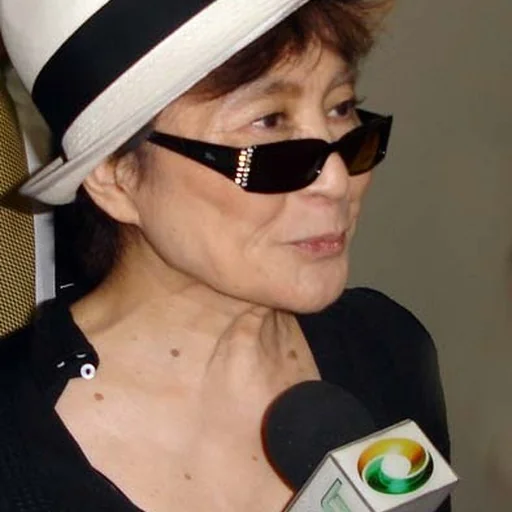
American, b. 1933
Yoko Ono is an American artist. 5 works are cataloged here, principally at Museum of Modern Art. Yoko Ono was born in Tokyo.
Overview
Yoko Ono (Japanese: 小野 洋子, romanized: Ono Yōko, usually spelled in katakana as オノ・ヨーコ; born February 18, 1933) is a Japanese artist, musician, and peace activist. Her work also encompasses performance art and filmmaking. Ono was born and grew up in Tokyo and moved to New York City in 1952 to join her family. She became involved with New York City's downtown artists scene in the early 1960s, which included the Fluxus group, and became widely known outside the contemporary art world in 1969 when she married English musician John Lennon of the Beatles, with whom she would subsequently record as a duo in the Plastic Ono Band. The couple used their honeymoon as a stage for public protests against the Vietnam War with what they called a bed-in. She and Lennon remained married until he was murdered in front of the couple's apartment building, The Dakota, on December 8, 1980. Together, they had one son, Sean, who later also became a musician. Ono began a career in popular music in 1969, forming the Plastic Ono Band with Lennon and producing a number of avant-garde music albums in the 1970s. She achieved commercial and critical success in 1980 with the chart-topping album Double Fantasy, a collaboration with Lennon which was released three weeks before his murder, winning the Grammy Award for Album of the Year. To date, she has had twelve number one singles on the US Dance charts, and in 2016 was named the 11th most successful dance club artist of all time by Billboard magazine. Many musicians have paid tribute to Ono as an artist in her own right and as a muse and icon, including Elvis Costello who recorded his version of "Walking on Thin Ice" with the Attractions for the Every Man Has a Woman tribute album to Yoko Ono, the B-52's, Sonic Youth and Meredith Monk. As Lennon's widow, Ono works to preserve his legacy. She funded the Strawberry Fields memorial in Manhattan's Central Park, the Imagine Peace Tower in Iceland, and the John Lennon Museum in Saitama, Japan (which closed in 2010). She has made significant philanthropic contributions to the arts, peace and disaster relief in Japan and the Philippines, and other such causes. In 2002, she inaugurated a biennial $50,000 LennonOno Grant for Peace. In 2012, she received the Dr. Rainer Hildebrandt Human Rights Award and co-founded the group Artists Against Fracking.
Early life and family
Ono was born in Tokyo on February 18, 1933, to father Eisuke Ono (小野 英輔, Ono Eisuke) and mother Isoko Ono (小野 磯子, Ono Isoko) (1911–1999). Eisuke was a wealthy banker and former classical pianist who came from a long line of samurai warrior-scholars. Isoko was the granddaughter of Zenjiro Yasuda (安田 善次郎, Yasuda Zenjirō), an affiliate of the Yasuda clan and zaibatsu. Her brother-in-law was the diplomat Toshikazu Kase, who was present at the signing of the Japanese Instrument of Surrender, which ended World War II. The kanji characters of Yoko's given name (洋子) mean "ocean child". Two weeks before her birth, Eisuke was transferred to San Francisco, California, by his employer, the Yokohama Specie Bank. The rest of the family followed soon after, with Ono first meeting her father when she was two years old. Her younger brother Keisuke was born in December 1936. In 1937, the family was transferred back to Japan, and Ono enrolled at Tokyo's elite Gakushūin (also known as the Peers School), one of the most exclusive schools in Japan. Ono was enrolled in piano lessons from the age of 4, until the age of 12 or 13. She attended kabuki performances with her mother, who was trained in shamisen, koto, otsuzumi, kotsuzumi, nagauta, and could read Japanese musical scores. The family moved to New York City in 1940. The next year, Eisuke was transferred from New York City to Hanoi in French Indochina, and the family returned to Japan. Ono was enrolled in Keimei Gakuen, an exclusive Christian primary school run by the Mitsui family. She remained in Tokyo throughout World War II and the fire-bombing of March 9, 1945, during which she was sheltered with other family members in a special bunker in Tokyo's Azabu district, away from the heavy bombing. Ono later went to the Karuizawa mountain resort with members of her family. Starvation was rampant in the destruction that followed the Tokyo bombings. Ono said it was during this period in her life that she developed her "aggressive" attitude. Stories tell of her mother bringing a large number of goods to the countryside, where they were bartered for food. In one anecdote, her mother traded a German-made sewing machine for 60 kilograms (130 lb) of rice to feed the family. During this time, Ono's father, who had been in Hanoi, was believed to be in a prisoner of war camp in China. Ono told Amy Goodman of Democracy Now! on October 16, 2007, that "He was in French Indochina, which is Vietnam actually ... in Saigon. He was in a concentration camp." After the war ended in 1945, Ono remained in Japan when her family moved to the United States and settled in Scarsdale, New York, an affluent town 25 miles (40 km) north of midtown Manhattan. By April 1946, Gakushūin was reopened and Ono re-enrolled. The school, located near the Tokyo Imperial Palace, had not been damaged by the war, and Ono found herself a classmate of Prince Akihito, the future emperor of Japan. At 14 years old, she took up vocal training in lieder-singing.
College and downtown beginnings
Ono graduated from Gakushūin in 1951 and was accepted into the philosophy program of Gakushuin University as the first woman to enter the department. However, she left the school after two semesters. Ono joined her family in New York in September 1952, enrolling at nearby Sarah Lawrence College. Ono's parents approved of her college choice, but disapproved of her lifestyle and chastised her for befriending people they felt were beneath her. At Sarah Lawrence, Ono studied poetry with Alastair Reid, English literature with Kathryn Mansell, and music composition with the Viennese-trained André Singer. Ono has said that her heroes at this time were the twelve-tone composers Arnold Schoenberg and Alban Berg. She said, "I was just fascinated with what they could do. I wrote some twelve-tone songs, then my music went into [an] area that my teacher felt was really a bit off track, and... he said, 'Well, look, there are people who are doing things like what you do, and they're called avant-garde.'" Singer introduced her to the work of Edgar Varèse, John Cage, and Henry Cowell. In 1956 Ono dropped out of Sarah Lawrence College feeling "asphyxiated by conservative teachers". The same year Ono married Japanese composer Toshi Ichiyanagi, who was studying at Juilliard and later became a star in Tokyo's experimental community. Ono's parents opposed the marriage, and even though they hosted a reception, they cut off Ono financially after the wedding. After leaving college Ono moved to New York in 1957, supporting herself through secretarial work and lessons in the traditional Japanese arts at the Japan Society. Ono has often been associated with the Fluxus group, a loose association of Dada-inspired avant-garde artists which was founded in the early 1960s by Lithuanian-American artist George Maciunas. Maciunas promoted her work, giving Ono her first solo exhibition at his AG Gallery in New York in 1961. He formally invited Ono to join Fluxus, but she declined because she wanted to remain independent. However, she did collaborate with Maciunas, Charlotte Moorman, George Brecht, and the poet Jackson Mac Low, among others associated with the group.
Ono first met John Cage through his student Ichiyanagi Toshi, in Cage's experimental composition class at the New School for Social Research. She was introduced to more of Cage's unconventional neo-Dadaism first hand, and via his New York City protégés Allan Kaprow, Brecht, Mac Low, Al Hansen and the poet Dick Higgins. After Cage finished teaching at the New School in the summer of 1960, Ono was determined to rent a place to present her works along with the work of other avant-garde artists in the city. She eventually found an inexpensive loft in downtown Manhattan at 112 Chambers Street and used the apartment as a studio and living space, also allowing composer La Monte Young to organize concerts in the loft. They both held a series of events there from December 1960 through June 1961; the events were attended by people such as Marcel Duchamp and Peggy Guggenheim. Ono and Young both claimed to have been the primary curator of these events, with Ono claiming to have been eventually pushed into a subsidiary role by Young. Ono presented work only once during the series. In 1961, Ono had her first major public performance in a concert at the 258-seat Carnegie Recital Hall (smaller than the "Main Hall"). This concert featured radical experimental music and performances. The Chambers Street series hosted some of
Early career and motherhood
On November 28, 1962, Ono married Anthony Cox, an American film producer and art promoter who had been instrumental in securing her release from the mental institution. Ono's second marriage was annulled on March 1, 1963, because she had neglected to finalize her divorce from Ichiyanagi. After finalizing that divorce, Cox and Ono married again on June 6, 1963. She gave birth to their daughter Kyoko Chan Cox two months later, on August 8, 1963. The marriage quickly fell apart, but the couple continued working together for the sake of their joint careers. They performed at Tokyo's Sogetsu Hall, with Ono lying atop a piano played by John Cage. Soon, the couple returned to New York with Kyoko. In the early years of the marriage, Ono left most of Kyoko's parenting to Cox while she pursued her art full-time, with Cox also managing her publicity. Ono had a second engagement at the Carnegie Recital Hall in 1965, in which she debuted Cut Piece. In September 1966, Ono visited London to meet artist and political activist Gustav Metzger's Destruction in Art Symposium in September 1966. She was the only woman artist chosen to perform her own events and one of only two invited to speak. She premiered The Fog Machine during her Concert of Music for the Mind at the Bluecoat Society of Arts in Liverpool, England in 1967. Ono and Cox divorced on February 2, 1969, and she married John Lennon later that same year. During a 1971 custody battle, Cox disappeared with their eight-year-old daughter. He won custody after successfully claiming that Ono was an unfit mother due to her drug use. Ono's ex-husband changed Kyoko's name to "Ruth Holman" and subsequently raised the girl in an organization known as the Church of the Living Word. Ono and Lennon searched for Kyoko for years, but to no avail. She would finally see Kyoko again in 1998.
Relationship with John Lennon
Ono's first contact with any member of the Beatles occurred when she visited Paul McCartney at his home in London to obtain a Lennon–McCartney song manuscript for a book John Cage was working on, Notations. McCartney declined to give her any of his manuscripts but suggested that Lennon might oblige. Lennon later gave Ono the original handwritten lyrics to "The Word". Ono and Lennon first met on November 7, 1966, at the Indica Gallery in London, where she was preparing Unfinished Paintings, her conceptual art exhibit about interactive painting and sculpture. They were introduced by gallery owner John Dunbar. One piece, Ceiling Painting/Yes Painting, had a ladder painted white with a magnifying glass at the top. When Lennon climbed the ladder, he looked through the magnifying glass and was able to read the word YES which was written in miniature. He greatly enjoyed this experience as it was a positive message, whereas most concept art he encountered at the time was anti-everything. Lennon was also intrigued by Ono's Hammer a Nail where viewers were invited to hammer a nail into a wooden board painted white. Although the exhibition had not yet opened, Lennon wanted to hammer a nail into the clean board, but Ono stopped him. Dunbar asked her, "Don't you know who this is? He's a millionaire! He might buy it." Ono feigned not knowing of the Beatles (even as she had gone to see Paul McCartney asking for a Beatle song score), but relented on the condition that Lennon pay her five shillings, to which Lennon replied, "I'll give you an imaginary five shillings and hammer an imaginary nail in." In a 2002 interview, Ono said, "I was very attracted to him. It was a really strange situation." Ono started writing to Lennon, sending him her conceptual artworks, and soon the two began corresponding. In September 1967, Lennon sponsored Ono's solo Half-A-Wind Show, at Lisson Gallery in London. When Lennon's wife Cynthia asked for an explanation of why Ono was telephoning them at home, he told her that Ono was only trying to obtain money for her "avant-garde bullshit". In early 1968, while the Beatles were making their visit to India, Lennon wrote the song "Julia" and included a reference to Ono: "Ocean child calls me"; "ocean child" being the literal translation of the name "Yoko" (洋子). In May 1968, while his wife was on holiday in Greece, Lennon invited Ono to visit. They spent the night recording a selection of avant-garde tape loops, after which, he said, they "made love at dawn". The recordings made by the two during this session ultimately became their first collaborative album, the musique concrete work Unfinished Music No. 1: Two Virgins. When Lennon's wife returned home, she found Ono wearing her bathrobe and drinking tea with Lennon, who simply said, "Oh, hi." On September 24 and 25, 1968, Lennon wrote and recorded "Happiness Is a Warm Gun", which contains sexual references to Ono. Ono became pregnant, but had a miscarriage of a male child on November 21, 1968, a few weeks after Lennon's divorce from Cynthia was granted. On December 12, 1968, Lennon and Ono participated in the BBC documentary about The Rolling Stones, The Rolling Stones Rock and Roll Circus, along with several other high-profile musicians. Lennon performed his Beatles composition "Yer Blues" towards the end, with an improvised vocal performance by Ono rounding out the set. The film would not be released until 1996, due to the death of The Rolling Stones' founding member Brian Jone
Early collaborations, marriage and "bed-ins"
During the final two years of the Beatles, Lennon and Ono created and attended public protests against the Vietnam War. They collaborated on a series of avant-garde recordings, beginning in 1968 with Unfinished Music No.1: Two Virgins, which notoriously featured an unretouched image of the two artists nude on the front cover. The same year, the couple contributed an experimental sound collage to The Beatles' self-titled "White Album" called "Revolution 9", with Ono contributing additional vocals to "Birthday", and one lead vocal line on "The Continuing Story of Bungalow Bill", marking the only occasion in a Beatles recording in which a woman sings lead vocals. On March 20, 1969, Lennon and Ono were married at the registry office in Gibraltar and spent their honeymoon in Amsterdam, campaigning with a week-long bed-in for peace. They planned another bed-in in the US, but were denied entry to the country. They held one instead at the Queen Elizabeth Hotel in Montreal, where they recorded "Give Peace a Chance". Lennon later stated his regrets about feeling "guilty enough to give McCartney credit as co-writer on my first independent single instead of giving it to Yoko, who had actually written it with me." The couple often combined advocacy with performance art, such as in "bagism", first introduced during a Vienna press conference, where they satirised prejudice and stereotyping by wearing a bag over their entire bodies. Lennon detailed this period in the Beatles' song "The Ballad of John and Yoko". During the Amsterdam Bed-In press conference, Yoko also earned controversy in the Jewish community for saying during the press conference that, "If I was a Jewish girl in Hitler's day, I would approach him and become his girlfriend. After 10 days in bed, he would come to my way of thinking. This world needs communication. And making love is a great way of communicating." Lennon changed his name by deed poll on April 22, 1969, switching out Winston for Ono as a middle name. Although he used the name John Ono Lennon after that, official documents referred to him as John Winston Ono Lennon. The couple settled at Tittenhurst Park at Sunninghill, Berkshire, in southeast England. When Ono was injured in a car crash, Lennon arranged for a king-sized bed to be brought to the recording studio as he worked on the Beatles' last recorded album, Abbey Road.
The Plastic Ono Band
After "The Ballad of John and Yoko", Lennon and Ono decided it would be better to form their own band to release their newer, more personally representative art work, rather than release the sound material as the Beatles. To this end they formed the Plastic Ono Band, a name based on their 1968 Fluxus conceptual art project of the same name. Plastic Ono Band was first conceived of by Ono in 1967 as an idea for an art exhibition in Berlin but the Plastic Ono Band was first physically realized in 1968 as a multi-media machine maquette by John Lennon, also called The Plastic Ono Band. In 1968, Lennon and Ono began a personal and artistic relationship in which they decided to credit their future endeavours as work of the Plastic Ono Band. Under that name Ono and Lennon collaborated on several art exhibitions, concerts, happenings and experimental noise music recording projects, including a sound and light installation in the Apple press office that consisted of four perspex columns, each representing a member of the Beatles, with one holding a tape recorder and amplifier, the second a closed-circuit TV and camera, the third a record player and amplifier, and the fourth a miniature light show and loud speaker. Soon after the Plastic Ono Band name was used in recording and releasing somewhat more standard rock-based albums. In July 1969, Lennon's first solo single, "Give Peace a Chance" (backed by Ono's "Remember Love") was the first release to be credited to the Plastic Ono Band. It was followed in October by "Cold Turkey" (backed by Ono's "Don't Worry Kyoko (Mummy's Only Looking for Her Hand in the Snow)"). The singles were followed in December by the group's first album, Live Peace in Toronto 1969, which had been recorded live at the Toronto Rock and Roll Revival festival in September. This incarnation of the group also consisted of guitarist Eric Clapton, bass player Klaus Voormann, and drummer Alan White. The first half of their performance consisted of rock standards. During the second half, Ono took to the microphone and performed two original feedback-driven compositions, "Don't Worry Kyoko" and "John John (Let's Hope for Peace)", constituting the entirety of the second half of the live album.
Yoko Ono/Plastic Ono Band and Fly
Ono released her first solo album, Yoko Ono/Plastic Ono Band in 1970, as a companion piece to Lennon's John Lennon/Plastic Ono Band. The two albums also had companion covers: Ono's featured a photo of her leaning on Lennon, and Lennon's a photo of him leaning on Ono. Her album included raw, harsh vocals, which bore a similarity with sounds in nature (especially those made by animals) and free jazz techniques used by wind and brass players. Performers included Ornette Coleman, other renowned free jazz performers, and Ringo Starr. Some songs on the album consisted of wordless vocalizations, in a style that would influence Meredith Monk and other musical artists who have used screams and vocal noise instead of words. The album reached No. 182 on the US charts.
When Lennon was invited to play with Frank Zappa at the Fillmore (then the Filmore West) on June 5, 1971, Ono joined them. Later that year, she released Fly, a double album. In it, she explored slightly more conventional psychedelic rock with tracks including "Midsummer New York" and "Mind Train", in addition to a number of Fluxus experiments. She also received minor airplay with the ballad "Mrs. Lennon". The track "Don't Worry, Kyoko (Mummy's Only Looking for Her Hand in the Snow)" was an ode to Ono's missing daughter, and featured Eric Clapton on guitar. In 1971, while studying with Maharishi Mahesh Yogi in Mallorca, Spain, Ono's ex-husband Anthony Cox accused Ono of abducting their daughter Kyoko from the kindergarten. They reached an out-of-court agreement and the charges were dismissed. Cox eventually moved away with Kyoko. Ono would not see her daughter until 1998. During this time, she wrote "Don't Worry Kyoko", which also appears on Lennon and Ono's album Live Peace in Toronto 1969, in addition to Fly. Kyoko is also referenced in the first line of "Happy Xmas (War Is Over)" when Yoko whispers "Happy Christmas, Kyoko", followed by Lennon whispering, "Happy Christmas, Julian." The song reached No. 4 in the UK, where its release was delayed until 1972, and has periodically reemerged on the UK Singles Chart. Originally a protest song about the Vietnam War, "Happy Xmas (War Is Over)" has since become a Christmas standard. That August the couple appeared together at a benefit in Madison Square Garden with Roberta Flack, Stevie Wonder, and Sha Na Na for mentally disabled children organized by WABC-TV's Geraldo Rivera. In a 2018 issue of Portland Magazine, editor Colin W. Sargent writes of interviewing Yoko while she was visiting Portland, Maine, in 2005. She spoke of driving along the coast with Lennon and dreamed of buying a house in Maine. "We talked excitedly in the car. We were looking for a house on the water… We did examine the place! We kept driving north along the water until I don't really remember the name of the town. We went quite a ways up, actually, because it was so beautiful." In 1973, Ono recorded a single, "Joseijoi Banzai, Parts 1 and 2" with musicians billed as the Plastic Ono Band and Elephants Memory and released it only in Japan. She cheered feminism by combining lyrics inspired by Japanese war songs with Pop rhythms, signalling a new direction.
Separation and reconciliation
After the Beatles disbanded in 1970, Ono and Lennon lived together in London and then moved permanently to Manhattan to escape tabloid racism towards Ono. Their relationship became strained because Lennon was facing deportation due to drug charges that had been filed against him in England, and because of Ono's separation from her daughter. The couple separated in July 1973, with Ono pursuing her career and Lennon living between Los Angeles and New York with personal assistant May Pang; Ono had given her blessing to Lennon and Pang's relationship. By December 1974, Lennon and Pang considered buying a house together, and he refused to accept Ono's phone calls. The next month, Lennon agreed to meet Ono, who claimed to have found a cure for smoking. After the meeting, Lennon failed to return home or call Pang. When she telephoned the next day, Ono told her Lennon was unavailable, because he was exhausted after a hypnotherapy session. Two days later, Lennon reappeared at a joint dental appointment with Pang; he was stupefied and confused to such an extent that Pang believed he had been brainwashed. He told her his separation from Ono was now over, though Ono would allow him to continue seeing her as his mistress, which did not happen. Ono and Lennon's son, Sean, was born on October 9, 1975, Lennon's 35th birthday. Following the birth of Sean, both Lennon and Ono took a hiatus from the music industry, with Lennon becoming a stay-at-home dad to care for his infant son. Sean has followed in his parents' footsteps with a career in music; he performs solo work, works with Ono and formed bands as, The Ghost of a Saber Tooth Tiger and The Claypool Lennon Delirium.
Return to music and murder of Lennon
In early 1980, Lennon heard Lene Lovich and the B-52's' "Rock Lobster" while on vacation in Bermuda. The latter reminded him of Ono's musical sound and he took this as an indication that she had reached the mainstream (the band had in fact been influenced by Ono). Ono and Lennon began trading songs over the phone with each other, quickly accumulating enough material to record. The emerging album was structured as a dialogue, and was to be credited to John Lennon and Yoko Ono as a duo. It would also mark the return of Lennon to the public eye after a five-year absence, as well as a public reconciliation of Ono and Lennon. Double Fantasy was released on November 17, 1980, and received tepid initial reviews, with much of the criticism centering on the idealization of Lennon and Ono's marriage and supposed domestic bliss. However, the reception and the legacy of the album would be forever linked with what happened just weeks after its release. On the evening of December 8, 1980, Lennon and Ono were at the Record Plant Studio and working on Ono's song "Walking on Thin Ice". When they returned to their Manhattan home The Dakota, Lennon was shot dead by Mark David Chapman, who had been stalking Lennon for two months. Yoko cradled the dying Lennon in her arms, and for a time afterward, lived in constant fear of her own and her son Sean's assassination. After John's death, the interior decorator Sam Havadtoy moved in to support her. "Walking on Thin Ice (For John)" was released as a single less than a month later, and became Ono's first chart success as a solo artist, peaking at No. 58 and gaining significant underground airplay. Double Fantasy received an instant critical reappraisal, eventually becoming a landmark album of the 1980s, and winning Ono the 1981 Grammy Award for Album of the Year at the 24th Annual Grammy Awards. In 1981, she released the album Season of Glass, which featured the striking cover photo of Lennon's bloody spectacles next to a half-filled glass of water, with a window overlooking Central Park in the background. This photograph sold at an auction in London in April 2002 for about $13,000. In the liner notes to Season of Glass, Ono explained that the album was not dedicated to Lennon because "he would have been offended—he was one of us." The album received highly favorable reviews and reflected the public's mood after Lennon's assassination. In 1982, she released It's Alright. The cover featured Ono in her wrap-around sunglasses, looking towards the sun, while on the back the ghost of Lennon looks over her and their son. The album scored minor chart success and airplay with the single "Never Say Goodbye". In 1984, a tribute album titled Every Man Has a Woman was released, featuring a selection of songs written by Ono performed by artists such as Elvis Costello, Roberta Flack, Eddie Money, Rosanne Cash, and Harry Nilsson. Later that year, Ono and Lennon's final album, Milk and Honey, was released as a mixture of unfinished Lennon recordings from the Double Fantasy sessions, and new Ono recordings. It peaked at No. 3 in the UK and No. 11 in the U.S., going gold in both countries as well as in Canada. Ono funded the construction and maintenance of the Strawberry Fields memorial in Manhattan's Central Park, directly across from the Dakota, which was the scene of the murder. It was officially dedicated on October 9, 1985, which would have been his 45th birthday. Ono's final album of the 1980s was Starpeace, a concept album
Resurgence and collaborations
In 1990, Ono collaborated with music consultant Jeff Pollack to honor what would have been Lennon's 50th birthday with a worldwide broadcast of "Imagine". Over 1,000 stations in over 50 countries participated in the simultaneous broadcast. Ono felt the timing was perfect, considering the escalating conflicts in the Middle East, Eastern Europe, and Germany. Ono went on a musical hiatus following the release of Starpeace, until she signed with Rykodisc in 1992 and released the comprehensive six-disc box set Onobox. The box set included remastered highlights from Ono's solo albums and previously unreleased material from the 1974 "lost weekend" sessions. She also released a one-disc sampler of highlights from Onobox, simply titled Walking on Thin Ice. That year, she sat down for an extensive interview with music journalist Mark Kemp for a cover story in the alternative music magazine Option. The story took a revisionist look at Ono's music for a new generation of fans more accepting of her role as a pioneer in the blending of pop and avant-garde music. In 1994, Ono produced her own off-Broadway musical entitled New York Rock, which featured Broadway renditions of her songs. In 1995, Ono released Rising, a collaboration with her son Sean and his then-band, Ima. Rising spawned a world tour that traveled through Europe, Japan, and the United States. The following year, she collaborated with various alternative rock musicians for an EP entitled Rising Mixes. Guest remixers of Rising material included Cibo Matto, Ween, Tricky, and Thurston Moore. In 1997, Rykodisc reissued Ono's catalog of solo recordings on CD, from Yoko Ono/Plastic Ono Band through Starpeace. Ono and her engineer Rob Stevens personally remastered the audio, and various bonus tracks were added, including outtakes, demos, and live cuts. In the same year, Ono and the BMI Foundation established an annual music competition program for songwriters of contemporary musical genres to honor John Lennon's memory and his large creative legacy. Over $350,000 has been given through BMI Foundation's John Lennon Scholarships to talented young musicians in the United States, making it one of the most respected awards for emerging songwriters. In 2000, Ono founded the John Lennon Museum in Saitama, Japan, which housed over 130 pieces of Lennon and Beatles memorabilia from Ono's private collection. The museum closed in 2010. Ono's feminist concept album Blueprint for a Sunrise was released in 2001. A month after the 9/11 attacks, Ono organized the concert "Come Together: A Night for John Lennon's Words and Music" at Radio City Music Hall. Hosted by the actor Kevin Spacey and featuring Lou Reed, Cyndi Lauper and Nelly Furtado, it raised money for September 11 relief efforts and aired on TNT and the WB.
Later life and dance chart hits
In 2002, Ono joined the B-52's in New York for their 25th anniversary concerts; she came out for the encore and performed "Rock Lobster" with the band. In March 2002, she was present with Cherie Blair at the unveiling of a seven-foot statue of Lennon to mark the renaming of Liverpool airport to Liverpool John Lennon Airport. Beginning in 2003, some DJs remixed other Ono songs for dance clubs. For the remix project, she dropped her first name and became known simply as "ONO", in response to the "Oh, no!" jokes that dogged her throughout her career. Ono had great success with new versions of "Walking on Thin Ice", remixed by top DJs and dance artists including Pet Shop Boys, Orange Factory, Peter Rauhofer, and Danny Tenaglia. In April 2003, Ono's Walking on Thin Ice (Remixes) was rated number 1 on Billboard's Dance/Club Play chart, gaining Ono her first no. 1 hit. She would have a second no. 1 hit on the same chart in November 2004 with "Everyman... Everywoman...", a reworking of her song "Every Man Has a Woman Who Loves Him". During the Liverpool Biennial in 2004, Ono flooded the city with two images on banners, bags, stickers, postcards, flyers, posters and badges: one of a woman's naked breast, the other of the same model's vulva. During her stay in Lennon's city of birth, she said she was "astounded" by the city's renaissance. The piece, titled My Mummy Was Beautiful, was dedicated to Lennon's mother, Julia, who had died when he was a teenager. According to Ono, the work was meant to be innocent, not shocking; she was attempting to replicate the experience of a baby looking up at its mother's body, those parts of the mother's body being a child's introduction to humanity. Ono performed at the opening ceremony for the 2006 Winter Olympic Games in Turin, Italy, Like many of the other performers during the ceremony, she wore white to symbolize the snow of winter. She read a free verse poem calling for world peace as an introduction to Peter Gabriel's performance of "Imagine". On December 13, 2006, one of Ono's bodyguards was arrested after he was allegedly taped trying to extort $2 million from her. The tapes revealed that he threatened to release private conversations and photographs. His bail was revoked, and he pleaded not guilty to two counts of attempted grand larceny. On February 16, 2007, a deal was reached where extortion charges were dropped, and he pleaded guilty to attempted grand larceny in the third degree, a felony, and was sentenced to the 60 days that he had already spent in jail. After reading an unapologetic statement, he was released to immigration officials because he had also been found guilty of overstaying his business visa.
Ono released the album Yes, I'm a Witch in February 2007, a collection of remixes and covers from her back catalog by various artists including The Flaming Lips, Cat Power, Anohni, DJ Spooky, Porcupine Tree, and Peaches, along with a special edition of Yoko Ono/Plastic Ono Band. Yes I'm a Witch was critically well received. A similar compilation of Ono dance remixes entitled Open Your Box was also released in April. On June 26, 2007, Ono appeared on Larry King Live along with McCartney, Starr and Olivia Harrison. She headlined the Pitchfork Music Festival in Chicago on July 14, 2007, performing a full set that mixed music and performance art. She sang "Mulberry", a song about her time in the countryside after the Japanese collapse in World War II for only the third time ever, with Thurston Moo
The new Plastic Ono Band
In 2009, Ono recorded Between My Head and the Sky, which was her first album to be released as "Yoko Ono/Plastic Ono Band" since 1973's Feeling the Space. The all-new Plastic Ono Band lineup included Sean Lennon, Cornelius, and Yuka Honda. On February 16, 2010, Sean organized a concert at the Brooklyn Academy of Music called "We Are Plastic Ono Band", at which Yoko performed her music with Sean, Clapton, Klaus Voormann and Jim Keltner for the first time since the 1970s. Guests including Bette Midler, Paul Simon and his son Harper, and principal members of Sonic Youth and the Scissor Sisters interpreted her songs in their own styles. On April 1, 2010, she was named the first "Global Autism Ambassador" by the Autism Speaks organization. She had created an artwork the year before for autism awareness and allowed it to be auctioned off in 67 parts to benefit the organization. In April 2010, RCRD LBL made available free downloads of Junior Boys' mix of "Give Me Something", a single originally released 10 years prior on Blueprint for a Sunrise. That song and "Wouldnit (I'm a Star)", released September 14, made it to Billboard's end of the year list of favorite Dance/Club songs at No. 23 and No. 50 respectively. Ono appeared with Starr on July 7 at New York's Radio City Music Hall in celebration of Starr's 70th birthday, performing "With a Little Help from My Friends" and "Give Peace a Chance". On September 16, she and Sean attended the opening of Julian Lennon's photo exhibition at the Morrison Hotel in New York City, appearing for the first time photos with Cynthia and Julian. She also promoted his work on her website. On October 1 and 2, Sean was musical director for two subsequent shows at the Orpheum Theater in Los Angeles, featuring Yoko Ono Plastic Ono Band with Perry Farrell, Cornelius, Carrie Fisher, Vincent Gallo, Yuka Honda, Haruomi Hosono, Joseph Gordon-Levitt, RZA, Harper Simon, Tune-Yards, Nels Cline, Iggy Pop, Mike Watt, Lady Gaga, Kim Gordon and Thurston Moore. She performed 'It's Getting Very Hard' with Lady Gaga, whom she deeply admires.
On February 18, 2011 (her 78th birthday), Ono took out a full-page advert in the UK free newspaper Metro for "Imagine Peace 2011". It took the form of an open letter, inviting people to think of, and wish for, peace. With son Sean, she held a benefit concert to aid in the relief efforts for earthquake and tsunami-ravaged Japan on March 27 in New York City. The effort raised a total of $33,000. The same year, "Move on Fast" became her sixth consecutive number-one hit on the Billboard Hot Dance Club Songs chart and her eighth number-one hit overall. She also collaborated with The Flaming Lips on an EP entitled The Flaming Lips with Yoko Ono/Plastic Ono Band.
In July 2011, she visited Japan to support earthquake and tsunami victims and tourism to the country. During her visit, Ono gave a lecture and performance entitled "The Road of Hope" at Tokyo's Mori Art Museum, during which she painted a large calligraphy piece entitled "Dream" to help raise funds for construction of the Rainbow House, an institution for the orphans of the Great East Japan earthquake. She also collected the 8th Hiroshima Art Prize for her contributions to art and for peace, that she was awarded the year prior. In January 2012, a Ralphi Rosario mix of her 1995 song "Talking to the Universe" became her seventh consecutive No. 1 hit on the Billboard Hot Dance Club Songs chart. In March of the same year, she was awarded the 2
Instructions for Paintings, 1961–62
A conceptual artwork of 22 instructions for paintings, handwritten in Japanese by Ono's then-husband, the avant-garde composer Toshi Ichiyanagi. There were no associated paintings, just a set of written instructions to create the paintings.
Collections represented

Museum
Artists in a similar vein