Artist
Manuel Barrón y Carrillo
Spanish, 1814–1884
Manuel Barrón y Carrillo was a Spanish artist. 2 works are cataloged here, principally at Museo del Prado. Manuel Barrón y Carrillo was born in Seville.
Overview
Manuel Barrón y Carrillo (1814–1884) was a Spanish painter from Seville and one of the most important representatives of Romantic landscape painting in Andalusia. Although his name is not always widely known outside specialized studies of nineteenth-century Spanish art, he played a key role in the development of landscape painting linked to local customs and traditions. His work reflects both artistic skill and a deep connection to Andalusian culture, especially the city of Seville.
Biography
Manuel Barrón y Carrillo was born in Seville in 1814. He spent his entire life in this city, which strongly influenced his artistic vision. He studied at the School of Fine Arts of Seville, where he received formal artistic training. One of his most important teachers was Antonio Cabral Bejarano, a well-known painter of the time. Cabral Bejarano had a strong influence on Barrón, especially in the development of landscape painting and the interest in local scenery. He was probably also influenced by the ideas of the Scottish painter David Roberts and the Spanish artist Jenaro Pérez Villaamil, whom he likely met during his youth in Seville. He became a lecturer at the School of Fine Arts, teaching subjects such as drawing, perspective, and landscape painting. Later, he was appointed director of this school. Barrón was also a founding member of the Liceo Artístico (Artistic Lyceum), an institution dedicated to promoting art and culture. He continued working throughout his life. However, most of the works that survive today date from the period between 1852 and 1869. Barrón died in Seville on January 15, 1884, at the age of seventy.
Work
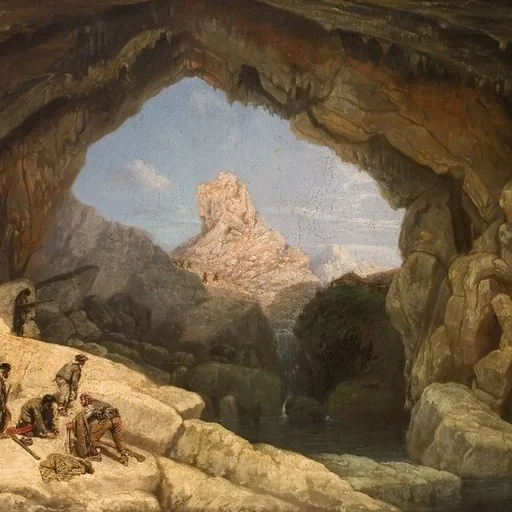
The central element of Barrón's work is landscape painting. He specialized in views of both rural and urban environments, especially those of Seville and its surroundings. His landscapes are not empty or purely natural. Instead, they often include buildings, monuments, and human figures. This combination creates a lively and realistic image of Andalusian life. In Barrón's paintings, landscapes are often populated with people engaged in daily activities. These figures may include peasants, travelers, merchants, or local residents. Their presence adds narrative interest and cultural meaning to the scenes. His urban scenes often depict well-known monuments of Seville, such as churches, streets, and squares. His rural scenes, on the other hand, focus on the countryside, including fields, rivers, and roads. These paintings often convey a sense of calm and harmony with nature. The human figures in Barrón's paintings introduce a costumbrista element, showing traditional clothing, activities, and social interactions. This gives the paintings a theatrical or staged quality, as if they were scenes from everyday life. Barrón used academic techniques learned during his training. His compositions are well-structured, with careful use of perspective and balance.
Legacy
Manuel Barrón is considered one of the most important landscape painters of Romantic Andalusia. His work represents a key moment in the development of Spanish landscape painting. Barrón's paintings play an important role in the representation of Andalusian identity. By depicting local landscapes and customs, he created images that reflect the culture and traditions of the region. He regularly took part in the Liceo Artístico's public exhibitions from the beginning, winning a silver medal at the 1862 Exhibition in Jerez de la Frontera for his painting Cattle Crossing a River. He also sent works to the National Exhibition of Fine Arts in 1864, including An Inn of Huesúa Next to the Pedroso Factory and View of the Countryside of Córdoba. In 1862, he signed his famous View of Seville from the Triana Bridge (National Heritage), one of his best-known works, which was bought that same year by Queen Isabella II during her visit to the city. Despite his importance, Barrón has not received as much attention as other artists of his time. Many art history books mention him only briefly.
Collections represented

Museum
Artists in a similar vein
Artist