Artist
Arkhip Kuindzhi
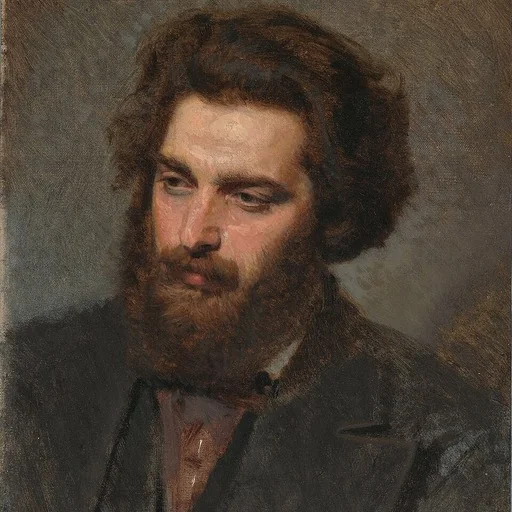
Russian, 1841–1910
Arkhip Kuindzhi was a Russian Impressionism painter. 12 works are cataloged here, principally at Tretyakov Gallery, most of them oil paintings. Arkhip Kuindzhi was born in Mariupol uyezd.
Arkhip Ivanovich Kuindzhi (27 January 1841 – 24 July 1910) was a Russian landscape painter of Urum (Crimean Greek) origin.
Overview
Arkhip Ivanovich Kuindzhi (27 January [O.S. 15 January] 1841 – 24 July [O.S. 11 July] 1910) was a Russian landscape painter of Urum (Crimean Greek) origin.
Date of birth
Kuindzhi's exact date of birth is not known. Although it was believed that he was born in 1842, the latest discoveries in archives suggest that he was born in 1841. Kuindzhi himself, when asked by St. Petersburg Academy of Arts to clarify his date of birth, "clearly wrote 1841, then, with doubt, January, and then several times crossed out the month". The researchers believe he was born somewhere between January and March 1841. The commonly recognized date is 27 January, although Kuindzhi celebrated his name day on 19 February [4 March N.S.], on the feast of Archippus.
Biography
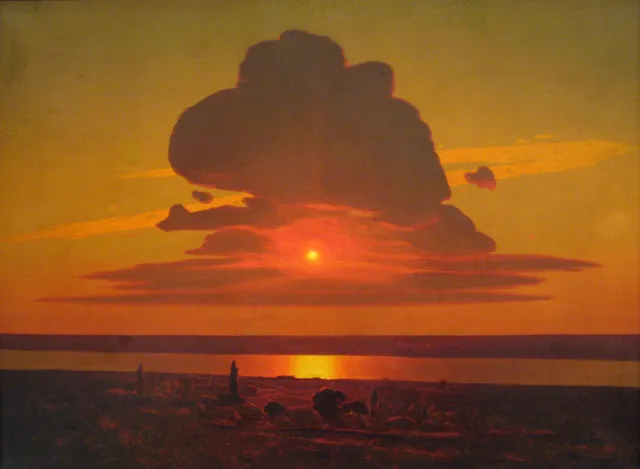
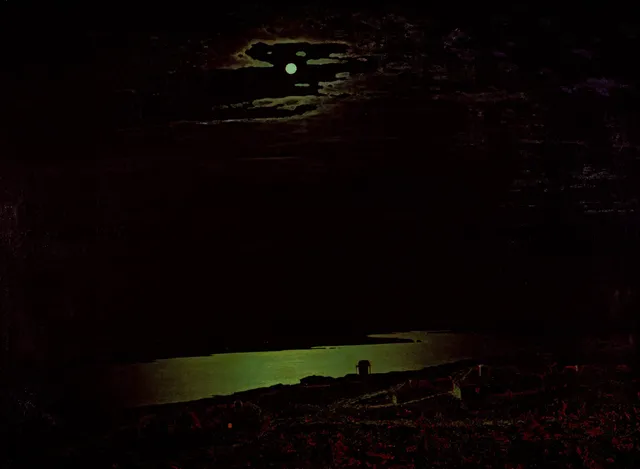
Arkhip Kuindzhi was born in Mariupol uezd, in Yekaterinoslav Governorate of the Russian Empire, but spent his youth in the city of Taganrog. His Christian name is a Russian rendering of the Greek Archippos, and his surname came from his grandfather's vocational nickname meaning 'goldsmith' in Crimean Tatar (Urum) (Crimean Tatar: quyumcı). He grew up in a poor family; his father was a Pontic Greek shoemaker, Ivan Khristoforovich Kuindzhi (elsewhere Emendzhi). Arkhip was six years old when he lost his parents, so he was forced to make a living working at a church building site, grazing domestic animals, and working at a corn merchant's shop. He received the rudiments of an education from a Greek friend of the family, who was a teacher, and then went to the local school. He became fluent in Crimean Tatar, Greek, Russian, and Ukrainian languages. In 1855, at age 13–14, Kuindzhi visited Feodosia to study art under Ivan Aivazovsky; however, he was engaged merely with mixing paints, and instead studied with Adolf Fessler, Aivazovsky's student. According to the Russian Biographical Dictionary: "Although Kuindzhi cannot be called a student of Aivazovsky, the latter had without doubt some influence on him in the first period of his activity; he borrowed much from him in his manner of painting". English art historian John E. Bowlt wrote that "the elemental sense of light and form associated with Aivazovsky's sunsets, storms, and surging oceans permanently influenced the young Kuindzhi." From 1860 to 1865, Kuindzhi worked as a retoucher in the photography studio of Simeon Isakovich in Taganrog. He tried to open his own photography studio, but was unsuccessful. After that, Kuindzhi left Taganrog for Saint Petersburg. He studied painting mainly independently and at the St. Petersburg Academy of Arts (from 1868; a full member since 1893). He was co-partner of travelling art exhibitions, known as the Peredvizhniki, a group of realist artists in Russia who, in protest to academic restrictions, formed an artists' cooperative which evolved into the Society for Traveling Art Exhibitions in 1870. In 1872, Kuindzhi left the academy and worked as a freelancer. His painting On the Valaam Island was the first artwork acquired by Pavel Tretyakov for his art gallery. In 1873, Kuindzhi exhibited his painting The Snow which received the bronze medal at the International Art Exhibition in London in 1874. In the middle of the 1870s, he created a number of paintings in which the landscape motif was designed for concrete social associations in the spirit of the Peredvizhniki (Forgotten Village, 1874; Chumaks Path in Mariupol, 1875; both in the Tretyakov Gallery). In his mature period, Kuindzhi aspired to capture the most expressive play of light in nature. He applied composite techniques, such as high horizons, to create panoramic views. By employing light effects and vivid tonal colors, he created the illusion of illumination (Evening in Ukraine, 1876; A Birch Grove, 1879; After a Thunderstorm, 1879; all three are in the Tretyakov Gallery; Moonlit Night on the Dnieper, 1880 in the Russian Museum, St. Petersburg). His later works are remarkable for their decorative effects and the building of color. Kuindzhi also developed a close friendship with the chemist Dmitri Mendeleev, who taught at Saint Petersburg University. Kuindzhi attended his classes as an auditor or student. Kuindzhi frequently visited Mendeleev and his wife's weekly gatherings, developing a life-long in
Theft of works
In January 2019, his work Ai-Petri. Crimea was stolen from Moscow's Tretyakov Gallery, but was found and safely recovered the next day. The man who stole the painting was sentenced to three years in prison. On 21 March 2022, during the Russian invasion of Ukraine, the Kuindzhi Art Museum was damaged in a Russian airstrike during the siege of Mariupol. Although three original paintings by Kuindzhi that had been held in the collection—a sketch for Red Sunset, and two preparatory works, Elbrus and Autumn—had been placen in the museum's basement prior to the bombing and were not damaged, they were then taken by Russia as part of its looting campaign.
Works by Arkhip Kuindzhi
Collections represented

Museum

Museum
Artists in a similar vein