Artist
Hervé Télémaque
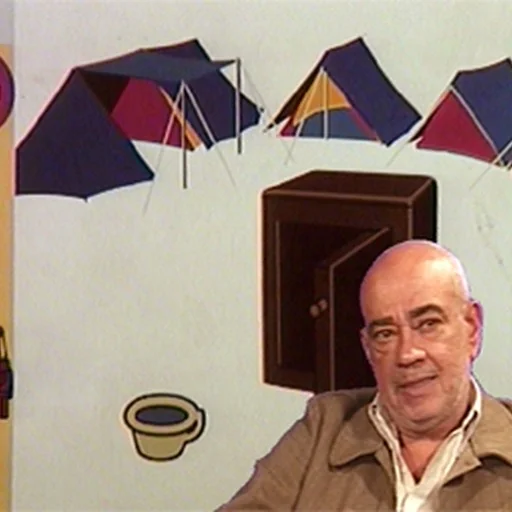
Haitian, 1937–2022
Hervé Télémaque was a Haitian Abstract Expressionism artist. 5 works are cataloged here, principally at Museum of Modern Art. Hervé Télémaque was born in Port-au-Prince.
Overview
Hervé Télémaque (5 November 1937 – 10 November 2022) was a French painter of Haitian origin, associated with the surrealism and the narrative figuration movements. He lived and worked in Paris from 1961 on.
Biography
Télémaque was born in Port-au-Prince, Haiti. Following a health problem, he had to give up his hopes of competing in sports. In 1957, when François Duvalier came to power, he left Haiti for New York City and joined the Art Student's League until 1960, when his teacher, the painter Julian Levi, encouraged his artistic vocation. During his stay in the United States, where he frequented museums, he was simultaneously intellectually nourished by abstract expressionism, then surrealism, as used and reinterpreted by American artists (De Kooning, Lam, etc.), and in particular by the influence of Arshile Gorky. As early as 1959, his painting entitled Sirène (Musée Sainte-Croix) marked his uniqueness. Télémaque wanted to be reality-based and escape abstraction: even the title refers to his daily life, evoking the boats sirens he heard from his room in Brooklyn Heights. With L'Annonce faite à Marie (Musée des beaux-arts de Dole, FNAC), which recalls his marriage the same year with Maël Pilié, the theme of sexuality, especially present at the beginning of his work, is announced (Histoire sexuelle, 1960 ; Ciel de lit n°3, 1962, Musée d'art moderne et d'art contemporain de Nice ; Femme merveille, 1963,Institut d'art contemporain de Villeurbanne). He was disappointed by the segregationist atmosphere in the United States¹. (Toussaint Louverture in New York, 1960, Dole Museum). In 1961, he came to France and settled in Paris. He frequented the surrealists there, without formally joining the group. But it was in the precepts of population art (comic strip, use of the episcope, then in 1966 use of acrylic) that he truly found his very particular way, while defending European creation, more critical of society. Since 1962, he took part in the adventure of Narrative Figuration, bringing together artists such as Bernard Rancillac, Eduardo Arroyo, Peter Klasen, Öyvind Fahlström, and Jacques Monory, which the critic Gérald Gassiot-Talabot gathered in 1964, at the request of Télémaque and Rancillac, in an exhibition entitled "Mythologies quotidiennes". From 1962 to 1964, he produced one of his most original series, in particular in the form of diptychs, where pieces of anatomy², accompanied by visual metaphors named "fictions"; (cross, arrow, weapon, underwear, urn, mask) and comments, sometimes simply written in chalk or pencil, flow on an initially white background (Le voyage, 1962 ; Portrait de famille, 1962, Fondation Gandur pour l'Art; Etude pour une carte du tendre, 1963;My Darling Clementine, 1963, MNAM, etc.).
"In the sixties, I settle down in the stripping, I become part of the Arte povera movement. This is a real break with the Baroque enumeration that is taking place there. The cane appears in my work in 1968. Especially with Le Désert, a cane broken into two pieces, cut from a sphere, a derisory stick for an improbable walking." A statement made to art critic Alexia Guggémos in a long interview published by Somogy Editions (Confidence, published in 2015). Télémaque intended to compose his own vocabulary, going beyond a narrative speech with a socio-political aim (One of 36,000 Marines, 1963, Gandur Foundation), from which he moves away from 1967, to the benefit of an inner poetic and jubilant universe, more hermetic, enriched by the experience of his own psychoanalysis started in 1958 with Georges Devereux, and this time inspired by the works of De Chirico, René Magritte or Marcel Duchamp. Thus, in his paintings are found evocative everyday object
Collective exhibitions (selection)
1962: Paris, Musée d'art moderne de la ville de Paris, Art latino-américain à Paris, with Jorge Camacho, Simona Ertan, Joaquin Ferrer, Eduardo Jonquieres, Wifredo Lam, Roberto Matta, Jesus Rafael Soto... 1964: He participates in the exposition Mythologies quotidiennes, organised at musée d'Art moderne de la Ville de Paris, associating him with the Narrative Figuration, 1968: Cassel (Hesse), Documenta IV et Venise, Biennale de Venise, 1972: Paris, Grand Palais, exposition Douze ans d'art contemporain, 1976: Paris, MAMVP, rétrospective à l'ARC, 1980: Recherche Art et Industrie de Renault, 1982: Paris, Grand Palais, Foire internationale d'art contemporain (FIAC), galerie Adrien Maeght, 1996: Foire internationale d'art contemporain, galerie Louis Carré & Cie et galerie Marwan Hoss, 2006: Paris, Grand Palais, La Force de l'art, 2006: Paris, galeries nationales du Grand Palais, Il était une fois Walt Disney. Aux sources de l'art des studios Disney, 2008: Paris, galeries nationales du Grand Palais, Figuration narrative. Paris, 1960–1972, 2009: Paris, La Maison rouge, fondation Antoine de Galbert, Vraoum ! trésors de la bande dessinée et art contemporain 2009: Paris, Musée d'art moderne de la Ville de Paris, Dans l'œil du critique. Bernard Lamarche-Vadel et les artistes 2011: Paris, musée du Louvre, salle de la Chapelle, Musée Monde (dans le cadre de l'exposition Le Louvre invite Jean-Marie G. Le Clézio) 2014: Paris, Grand Palais, Haïti, deux siècles de création artistique, 19 November 2014–15 February 2015 2016: Munich, Haus der Kunst, Ockwui Enwezor Post War 2022: Paris, Musée de l'Histoire de l'immigration, « Paris and nowhere else »
Solo exhibitions (selection)
1964: London, Hanover Gallery 1964: Paris, galerie Mathias Fels 1965: Rome, L'Attico 1967: Paris, galerie Mathias Fels 1971: Paris, galerie Mathias Fels "Passage" (Achat d'une œuvre par le Président Pompidou). 1979: Paris, Zurich, galerie Maeght "Selles" 1981: Paris, galerie Adrien Maeght 1986: Casa de las Americas, dans le cadre de la IIe biennale de La Havana. 1989: Paris, galerie Jacqueline Moussion, first personal exposure, New York 1960. 1991: Paris, galerie Jacqueline Moussion, retrospective from 1973 and series La Chambre noire. 1994: Paris, galerie Louis Carré, Fusain et marc de café – Deuil : le dessin, l'objet. 1995: Retrospective at Electra Fondation in Paris, Œuvres d'après nature. 1997: Johannesburg, retrospective at Electrical workshop. 1998: Valencia, retrospective at Institut Valencià d'Art Modern of Valencia. 1999: Centre d'art de Tanlay, Hervé Télémaque: des Modes & Travaux et creation of an original work for the stamp of France commemorating the abolition of slavery, issued in April. 2001: Paris, galerie Louis Carré & Cie, Trottoirs d'Afrique. 2005: Paris, musée de la Poste, Hervé Télémaque. Du coq à l'âne (rétrospective). 2009: Paris, galerie Louis Carré & Cie, Combine painting 1965–1969 2010: Baie-Mahault (Guadeloupe), Hervé Télémaque is the guest of honor of the 2nd edition of "Art Bemao", a modern and contemporary art event that presents a current look at the visual arts in Guadeloupe 2011: Paris, galerie Louis Carré & Cie, La Canopée, The Brown paper bag 2013: Paris, galerie Louis Carré & Cie, Passages et autres (1970–1980) 2015: Paris, Centre Pompidou, 25 February-18 May 2015: Musée de Louviers 2015: Marseille, Musée Cantini 2016: Le François, Martinique, Fondation Clément 2018: Paris, galerie Guttklein Fine Art, "Jalons" 1, 2 2019: Paris, galerie Rabouan Moussion, "L'inachevée conception" 2021: Londres, Serpentine Gallery, "A Hopscotch of the Mind" 2023: Etats-Unis, Musée d'art d'Aspen, "A Hopscotch of the Mind"
Acquisitions (selection)
The Centre Pompidou's National Museum of Modern Art owns 18 artworks by Télémaque. Among them, 8 paintings and one sculpture added in 2014 thanks to a donation from the artist. The MOMA possess three of Télémaque's artworks including No title (The Ugly American) 1962/64.
Publications (selection)
Hervé Télémaque – Monographie, by Anne Tronche, Groupe Flammarion (2003) Confidence d'Hervé Télémaque, interviewed by Alexia Guggémos, Somogy Éditions d'Art (maison d'édition) (2015) Télémaque, by Gérard Durozoi, David Lemaire, Alexia Guggémos, Flammarion (2015)
Archives
(in French) Archives, Hervé Télémaque, list of creations from 1958 to 1978, Galerie Louis Carré & Cie
Collections represented

Museum
Artists in a similar vein