Artist
El Lissitzky
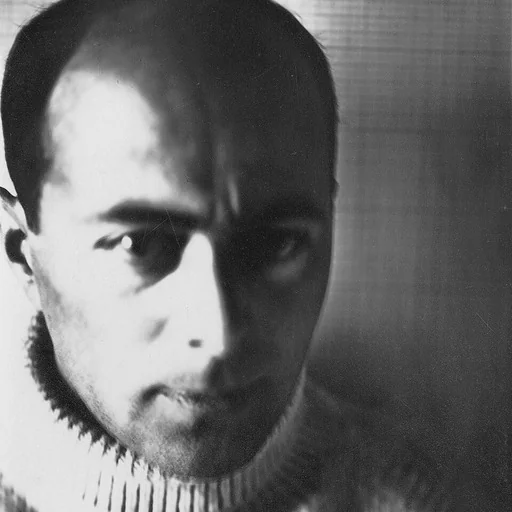
Russian, 1890–1941
El Lissitzky was a Russian Suprematism artist. 3 works are cataloged here, principally at Museum of Modern Art. El Lissitzky was born in Pochinok.
El Lissitzky (Russian: Эль Лиси́цкий, born Lazar Markovich Lissitzky Russian: Ла́зарь Ма́ркович Лиси́цкий, ; 23 November 1890 – 30 December 1941) was a Russian and Soviet artist, active as a painter, illustrator, designer, printmaker, photographer, and architect. He was an important figure of the avant-garde, helping develop suprematism with his mentor, Kazimir Malevich, and designing numerous exhibition displays and propaganda works for the Soviet Union. Lissitzky began his career illustrating Yiddish children's books in an effort to promote Jewish culture. He started teaching at the age of 15, maintaining his teaching career for most of his life. Over the years, he taught in a variety of positions, schools, and artistic media, spreading and exchanging ideas. He took this ethic with him when he worked with Malevich in heading the suprematist art group UNOVIS, when he developed a variant suprematist series of his own, Proun, and further still in 1921, when he moved to Weimar Republic. In his remaining years he brought significant innovation and change to typography, exhibition design, photomontage, and book design, producing critically respected works and winning international acclaim for his exhibition design. This continued until his deathbed, where in 1941 he produced one of his last works – a Soviet propaganda poster rallying the people to construct more tanks for the fight against Nazi Germany.
Overview
El Lissitzky (Russian: Эль Лиси́цкий, born Lazar Markovich Lissitzky Russian: Ла́зарь Ма́ркович Лиси́цкий, ; 23 November [O.S. 11 November] 1890 – 30 December 1941) was a Russian and Soviet artist, active as a painter, illustrator, designer, printmaker, photographer, and architect. He was an important figure of the avant-garde, helping develop suprematism with his mentor, Kazimir Malevich, and designing numerous exhibition displays and propaganda works for the Soviet Union. Lissitzky began his career illustrating Yiddish children's books in an effort to promote Jewish culture. He started teaching at the age of 15, maintaining his teaching career for most of his life. Over the years, he taught in a variety of positions, schools, and artistic media, spreading and exchanging ideas. He took this ethic with him when he worked with Malevich in heading the suprematist art group UNOVIS, when he developed a variant suprematist series of his own, Proun, and further still in 1921, when he moved to Weimar Republic. In his remaining years he brought significant innovation and change to typography, exhibition design, photomontage, and book design, producing critically respected works and winning international acclaim for his exhibition design. This continued until his deathbed, where in 1941 he produced one of his last works – a Soviet propaganda poster rallying the people to construct more tanks for the fight against Nazi Germany.
Early years
Lazar Markovich Lissitzky was born on 23 November 1890 in Pochinok, a small Jewish community 50 kilometres (31 mi) southeast of Smolensk, Russian Empire. His father Mordukh Zalmanovich (Mark Solomonovich) Lissitzky was well-educated travel agent who knew English and German languages, "in his spare time he translated Heine and Shakespeare". He emigrated to America, but returned to Russia as his wife's rabbi advised against emigration. Lissitzky's mother Sarah strictly observed Jewish religious traditions. From 1891 to 1898 Lissitzky's family lived in Vitebsk, where Lazar's brother and sister were born. In 1899 Lazar moved to Smolensk, where he lived with his grandfather and attended City School 1. In 1903, during a summer vacation he spent with his parents in Vitebsk, he started to receive instruction from Yury Pen, a famous Jewish artist and teacher. Marc Chagall and Ossip Zadkine were also Pen's students. By the time Lissitzky was 15 he was teaching students himself; he later recalled in his diary that "[a]t age fifteen I began to earn a living by tutoring and drawing." He applied to the St. Petersburg Academy of Arts in 1909, but was rejected, possibly because he failed the exams or due to the "Jewish quota" under the Tsarist regime that limited the number of Jewish students in Russian schools. Instead, in 1909 he moved to Germany to study architectural engineering at the Darmstadt Polytechnic Institute. His wife later wrote that while studying Lissitzky "earned extra money by doing examination projects for fellow-students who were either too lazy or too inept to do their test-pieces for themselves". He also worked as a bricklayer, and visited local Jewish historical sites on vacations, like the medieval Worms Synagogue, of which he made drawings of the interior and decorations. Lissitzky had travelled to Paris and Belgium during 1912, and spent several months in St. Petersburg. In 1913 he went to a tour of Italy; he wrote in his diary that "I covered more than 1,200 kilometers in Italy on foot – making sketches and studying." He graduated cum laude from Darmstadt Polytechnic in 1914 . When World War I began, Lissitzky returned to Russia via Switzerland and Balkans; and in 1915 started studies at Riga Polytechnic Institute, that was evacuated to Moscow, and started to participate in exhibitions. He also started to work for the architectural firms of Boris Velikovsky and Roman Klein. Klein was also a Egyptologyst, and he was responsible for creating the Egyptian Department of the Pushkin Museum. Lissitzky also took part in arranging this exhibition.
Jewish period
Much of Lissitzky's childhood was spent in Vitebsk, a large city with affluent Jewish life. The art historian Igor Dukhan noted that "there were Litvaks, Hasidim, and early Jewish bourgeoisie, as well as public organizations of diverse and even contradictory character – a Jewish literary–musical society, a Society for the Enlightenment of Jews in the Russian Empire, a Society for Jewish Language, as well as Bundist and Zionist-oriented groups". Lissitzky spent his childhood and youth near the Pale of Settlement; art historian Nancy Perloff noted that it influenced him because of "a powerful Jewish solidarity, the community-wide response to the knowledge that Jews would never be considered true Russians". While in Darmstadt, Lissitzky travelled to Worms to study its medieval synagogue, when he returned to Russia he became involved in a Jewish artistic circle. In 1917, he became secretary of the organizing committee of the Moscow Exhibition of Paintings and Sculpture by Jewish Artists. After the Revolution the Tsarist 1915 decree that prohibited usage of Hebrew lettering in print was abolished, and Jews acquired the rights as any other people of the former Russian Empire. Lissitzky moved to Kiev in 1917, and started to work with Yiddish book design. One of the goals of Lissitzky and his Jewish colleagues was an attempt to create new, secular Jewish culture; one of his main ideas and desires of that time was creation of "an all-inclusive art and culture in Russia".
Ethnographic expeditions
In 1916, Lissitzky and his artist-colleague Issachar Ber Ryback undertook an ethnographic expedition to Jewish shtetls, possibly funded by S. An-sky's Jewish Historical Ethnographic Society. They toured a number of cities and towns of the Belarusian Dnieper region and Lithuania in order to identify and document monuments of Jewish antiquity. Lissitzky was particularly impressed by the Cold Synagogue in Mogilev; he made several drawings of its decorations and interior, and in 1923 wrote an article for Berlin-based Jewish journal Rimon-Milgroim: "On the Mogilev Shul: Recollections". In the article, Lissitzky compared his visit to Mogilev synagogue with visits to "Roman basilicas, Gothic chapels, or baroque churches". He went on to praise Chaim Segal, the creator of the synagogue's interior murals:
The walls—wooden, oaken beams that resound when you hit them. Above the walls, a ceiling like a vault made out of boards. The seams all visible. ... the whole interior of the shul is so perfectly conceived by the painter with only a few uncomplicated colors that an entire grand world lives there and blooms and overflows this small space. The complete interior of the shul is decorated, starting with the backs of the benches, which cover the length of the walls, all the way to the very pinnacle of the vault. The shul, which is a square at the level of the floor, becomes an octagonal vaulted ceiling, resembling a yarmulke. ... These walls and ceiling are structured with an immense feel for composition. This is something completely contrary to the primitive. This is the fruit of a great culture. Where does it come from? The master of this work, Segal, says in his inscription, full of the most noble enthusiasm: "Long already have I wandered through the world of the living..."
Yiddish children's book design
Lissitzky's first book design was Moishe Broderzon's 1917 Sikhes khulin: Eyne fun di geshikhten (An Everyday Conversation: A Story, also called The Legend of Prague), created in a form of a Torah scroll. The book was printed in 110 copies. Lissitzky explained in the colophon that he "intended to couple the style of the story with the 'wonderful' style of the square Hebrew letters." In 1918 he illustrated Mani Leib's book Yingl Tsingl Khvat (The Mischievous Boy), incorporating typography into the illustrations. Lissitzky created ten illustrations for the book; for each page he arranged text and his drawings differently. Scholars trace Lissitzky's style of the book to be inspired by his earlier expedition to the shtetls and by Chagall. The first illustration features a Christian church and beys-medresh to show peaceful coexistence of Christians and Jews mentioned by Mani Leib; a goat and a pig in the bottom symbolizes Jews and Christians. Another illustration was described as "reminiscent of Ryback ... while the Jew sitting at the table, the clock on the wall and the window cut in cubist triangles bear a resemblance to some of Chagall's interiors." Scholars note that Lissitzky greatly expanded the meanings of Leib's book, his "brave Tsingl corresponds to the numerous mounted heroes of the Russian fairy tales and the traditional oral epic bylina which ... were a source of inspiration for leading Russian artists like Ivan Bilibin or Viktor Vasnecov. Lissitzky is too much aware of this double cultural heritage not to use its visual potential. ... Lissitzky's Tsingl grows out of a double Slavic-Jewish oral and visual tradition and ... responds to the requirements of modern Jewish art combining avant-garde techniques and Jewish folk art." In 1918, Lissitzky together with Joseph Chaikov, Issachar Ber Ryback, Mark Epstein and some others founded the art section of the Kultur-Lige movement in Kiev. In 1917 and 1919 Lissitzky created two variants of the book Had Gadya (The Only Kid), a ten-verse Aramaic song based on a German ballad, singed in a conclusion of a Passover seder. The song tells a story of a young goat purchased by a father, who was eaten by a cat; the song continues to talk about the succession of attackers until God destroys the final aggressor. The song is usually considered as an allegory for the oppression and execution of the Jews, with attackers being different peoples mistreating Jews throughout history. Lissitzky used Yiddish for the book verses, but introduced each verse in a traditional Aramaic, written in Hebrew alphabet. These two versions differ in style: art historians Igor Dukhan and Nancy Perloff called the 1917 version "an expressionist decorativism of color and narrative" and "a set of brightly colored, folklike watercolors", respectively, and 1919 version being "marked by a stylistic shift". Two versions also differ in narrative: in the earlier book the Angel of Death is "cast down but still alive", in the later one he is definitely dead, his victims are resurrected. Dukhan treats these differences as Lissitzky's sympathies towards the October Revolution, after which Jews of the Russian Empire were liberated from discrimination. Perloff also thinks that Lissitzky "viewed the song both as a message of Jewish liberation based on the Exodus story and as an allegorical expression of freedom for the Russian people." Several researched noted a similarity between Lissitzky's drawing and first stamp issued in Soviet Russia
The end of the Jewish period
Jewish period was rather short for Lissitzky; he illustrated the last Jewish book in 1923. According to the art historian Eva Forgács, in April 1919 a decree issued by the new Soviet state (by Joseph Stalin with support of Yevsektsiya leader Samuil Agurskii), "abolished the elected local communal units of Jewish life, the kehillas in the Ukraine". Forgács wrote that, the second decree issued in June designated all Jewish organizations as "enemies of the revolution", after that all synagogues, zionist, and Jewish cultural organizations were closed, while usage of Hebrew letters was called "anti-communist", and was "regarded as cultural separatism". As Forgács wrote, "that autumn, Eliezer (Lazar) Lissitzky abandoned his Judaic heritage and became El Lissitzky. It is unclear if the name change was legal or merely an appropriate pseudonym." For Shatskikh this name change signifies the "'abrupt and total' shift from the creation of explicitly Jewish works to the production of abstract, non-ethnic universalist art". Jewish themes and symbols sometimes appeared in his later works: scholars found connections between his photomontage called The Constructor and Kabbalah, his Figurinnenmappe (Traveler All Over the Time) was linked to Ahasver, "the everlasting Jew", Hebrew letters were used in a number of Prouns and book covers he made, such as an illustration for Ilya Ehrenburg's story Shifs-Karta (Yiddish: שיפֿס קאַרטע; Passenger Ticket). The illustration is a "photogram of the open hand with two Hebrew letters – 'pe' and 'nun' (traditional Jewish tombstone initials for "here lies"). In the foreground is the schedule of the New York–Hamburg and Hamburg–New York sea routes, a ship sailing to America, an American flag, and a framing Magen David". The illustration was interpreted as "the end of Jewish wandering as well as the persistence of traditional Jewish beliefs." Dukhan sees this work as an "intermediate play" between Lissitzky's "Jewish expressionism of the late 1910s" and the abstract language of the 1920s. Nisbet interprets the black hand to be the hand of "pogrom-instigators", both "the Whites and the Communists, both of whom wish to eradicate the culture of the shtetl". Art historian Victor Margolin doubts Lissitzky's embrace of Revolution. Though Lissitzky bragged that he designed the flag for the All-Union Central Executive Committee "which was carried across Red Square on the first of May 1918", there is no other evidence of that. Despite this fact, Margolin writes that because of his Jewish origins Lissitzky was conspicuous of communists, who had an anti-Jewish position and a tendency of assimilation; he also was in opposition to Yevsektsiya, "who believed that Jews should be Communists first and nationals second". Lissitzky's writings also do not show his support of Communism; in one of his essays he even wrote that Suprematism will surpass Communism. According to Forgács, "Suprematism ... as Lissitzky saw it, straddled loyalty to the communist Soviet state and the desire to not betray Jewish culture: its vision of the future was distant and universal, projected far ahead into the cosmos ..."
Suprematism and Vitebsk Art School
In May 1919 Lissitzky returned to Vitebsk when Marc Chagall invited him to teach graphic arts, printing, and architecture at the newly formed People's Art School – a school that Chagall created after being appointed Commissioner of Artistic Affairs for Vitebsk in 1918. Lissitzky was engaged in designing and printing propaganda posters and illustrations for a local Vitebsk newspaper; later, he never mentioned his works of this period, probably because he portrayed Leon Trotsky and other early revolutionaries, who later became enemies of the Soviet state. The quantity of these posters is sufficient to regard them as a separate genre in the artist's output. Chagall also invited other Russian artists, most notably the painter and art theoretician Kazimir Malevich and his and Lissitzky's former art teacher, Yehuda Pen. However, it was not until October 1919 when Lissitzky, then on an errand in Moscow, persuaded Malevich to relocate to Vitebsk. Malevich would bring with him a wealth of new ideas, most of which inspired Lissitzky but clashed with local public and professionals who favored figurative art and with Chagall himself. After going through impressionism, primitivism, and cubism, Malevich began developing and advocating his ideas on suprematism. In development since 1915, suprematism rejected the imitation of natural shapes and focused more on the creation of distinct, geometric forms. He replaced the classic teaching program with his own and disseminated his suprematist theories and techniques school-wide. Chagall advocated more classical ideals and Lissitzky, still loyal to Chagall, became torn between two opposing artistic paths. Lissitzky ultimately favoured Malevich's suprematism and broke away from traditional Jewish art. Chagall left the school shortly thereafter. Chagall later recalled it in his memoirs: "My most zealous disciple swore friendship and devotion to me. To hear him, I was the Messiah. But at the moment he was appointed professor, he went over to my opponents' camp and heaped insults and ridicule on me." At this point Lissitzky subscribed fully to Suprematism and, under the guidance of Malevich, helped further develop the movement. Lissitzky designed Malevich's book On the New System in Art, that was printed in 1,000 copies – enormous number for the art book. Malevich scribed a note on Lissitzky's copy of the book "With the appearance of this booklet, I greet you, Lazar Markovich. It will be the trace of my path and the beginning of our collective movement."
UNOVIS
On 17 January 1920, Malevich and Lissitzky co-founded the short-lived Molposnovis group (Russian: МОЛодые ПОСледователи НОВого Искусства, Young followers of a new art), a proto-suprematist association of artists. After a brief and stormy dispute and two rounds of renaming, the group reemerged as UNOVIS (Russian: Утвердители НОВого ИСкусства, Exponents of the New Art) in February. The group, disbanded in 1922, was pivotal in the dissemination of suprematist ideology in Russia and abroad and launch Lissitzky's status as one of the leading figures in the avant-garde. Incidentally, the earliest appearance of the signature 'El Lissitzky' (Russian: Эль Лисицкий) emerged in the handmade UNOVIS Miscellany, issued in two copies in March–April 1920. The origin of Lissitzky's new name is unclear. Art historian Alexandra Shatskikh noted that UNOVIS' motto, a nonsense line from Malevich's book On New Systems in Art, "U-el-el'-ul-el-te-ka", can be a source of the new name "El". Under the leadership of Malevich UNOVIS worked on a "suprematist ballet", choreographed by Nina Kogan and on the remake of a 1913 futurist opera Victory Over the Sun by Mikhail Matyushin and Aleksei Kruchenykh. All members of UNOVIS shared credit for the works produced within the group, signing most pieces with a black square. This was partly a homage to a similar piece by their leader, Malevich, and a symbolic embrace of the Communist ideal. This would become the de facto seal of UNOVIS that took place of individual names or initials. Black squares worn by members as chest badges and cufflinks also resembled the ritual tefillin and thus were no strange symbol in Vitebsk shtetl. Lissitzky himself used a red square as a seal, all other group members used black. Shatskikh compares UNOVIS with the Bauhaus school, whose founder, Walter Gropius, said that a "joyfully creating commune, for which the Masonic lodges of the Middle Ages are the ideal prototype". UNOVIS had a motto, rituals, program, and an emblem; its leader, Malevich, wore white clothes and a white hat as symbols of Suprematism. Malevich himself said that it was modelled after a research laboratory. In April 1920 UNOVIS was asked to produce decorations for the celebrations of the Workers Day, 1 May. They decorated the whole city with suprematistic decorations, made drawing on buildings and on trams, and wrote Communism mottos. Sergei Eisenstein, who was in the city with a brief visit, later described it:
A singular provincial town. Built, like so many of the towns in the west of the country, of red brick. Begrimed with soot and depressing. But there is something very odd about this town. In the main streets the red bricks are painted white. And over this white background there are green circles everywhere. Orange squares. Blue rectangles. This is Vitebsk in the year 1920. The brush of Kasimir Malevich has gone over the brick walls. ... You see orange circles before your eyes, red squares and green trapeziums. ... Suprematist confetti strewn about the streets of an astonished town. In 1920 Lissitzky left Vitebsk for Moscow and became member of INKhUK (the Institute of Artistic Culture); on 23 September 1921 he gave a lecture there about his Prouns. In 1921 he also started to teach at Vkhutemas, but soon left Moscow for Germany; he stayed in Berlin for several years.
Beat the Whites with the Red Wedge
Perhaps the most famous work by Lissitzky from that period was the 1919 propaganda poster "Beat the Whites with the Red Wedge". Russia was going through a civil war at the time, which was mainly fought between the "Reds" (communists, socialists and revolutionaries) and the "Whites" (monarchists, conservatives, and factions of socialists who opposed the Bolshevik Revolution). The title, allegedly recommended by Ilya Ehrenburg, is possibly a response to the pogrom slogan "Beat the Jews!" (Russian: Бей жидов!, romanized: Bej zhidov!). The full slogan was Beat the Jews - save Russia! (Russian: Бей жидов — спасай Россию!), and it was predominantly used by right wing monarchists and the Black Hundreds. According to Sophie Lissitzky-Küppers, in 1945 Pablo Picasso declared that the "painting was not invented for decorating houses, but as a weapon of attack and defence". Art historian Maria Elena Versari connected Lissitzky's poster with Italian Futurism manifesto Futurist Synthesis of War, published in 20,000 copies in 1914, and signed by Filippo Tommaso Marinetti, Umberto Boccioni, Carlo Carrà, Luigi Russolo, and Ugo Piatti. Lissitzky never mentioned the manifesto, but his friend and colleague Malevich met Marinetti in 1914, and even called him one of the "two pillars, the two 'prisms' of the new art of the twentieth century". Also in 1918, young architect Nikolai Kolli created The Red Wedge monument in Moscow, that "consisted of a red triangle vertically inserted as a wedge into a white rectangular block. A very visible crack snakes downward from the tip of the triangle, suggesting that the force of the red wedge has succeeded in breaking the solidity of the white structure. The abstract metaphor was intended to signify the victory of the Red Army over the White, counter-Revolutionary forces." The monument was initially erected as a symbol of victory over White general Pyotr Krasnov, an important early triumph of the Red Army. Versari argues that Lissitzky "adopted an almost identical language" for his Beat the Whites with the Red Wedge, though he never mentioned it. Lissitzky later used similar idea, a wedge in a circle, for a cover of Yiddish magazine Der Apikojres ('Atheist', Yiddish: דער אפיקוירעס). Artur Kamczycki writes, "Apikojres is a heretic – a Jew who does not believe in revelation and negates traditional religion and will therefore not have a share in the world to come and is bound for eternal damnation. In Yiddish, this word is often used to describe someone who has opinions that contradict the orthodox doctrine. Lissitzky suggests here that a revolution requires sacrifice and transformations in the name of the new, better world". Kamczycki also noted that Lissitzky believed in the forces of Revolution and combined it with a messianic elements of Judaism; Lissitzky wrote:
The intellectuals, the highly-educated, were expecting the 'new era' to arrive in the shape of a Messiah, with aureole and white robes, with manicured hands, mounted on a white horse. But in reality the new era came in the shape of the Russian Ivan, with tousled hair, tattered and dirty clothes, barefoot, and with hands that were bleeding and torn by work. These people did not recognize the new era in an apparition like this. They turned their backs on him, ran away and hid. Only the youngest stayed put. But this youngest generation was not born in October 1917; the October Revolution in art originated much earlier.
Return to Germany
In 1921, roughly concurrent with the demise of UNOVIS, suprematism was beginning to fracture into two ideologically adverse halves, one favoring Utopian, spiritual art and the other a more utilitarian art that served society. Lissitzky was fully aligned with neither and left Vitebsk in 1921. He took a job as a cultural representative, "cultural emissary", of Soviet Russia and moved to Weimar Berlin where he was to establish contacts between Russian and German artists. What he had done in this role is still unclear. Post-war Berlin was a cultural center, with an enormous number of Russian émigrés, estimated between 300,000 and 560,000 in 1920–1921, with Vladimir Nabokov, Boris Pasternak, Alexander Blok, Aleksey Tolstoy, Ilya Ehrenburg, Marina Tsvetaeva, Andrei Biely, Viktor Shklovsky, Roman Jakobson, Ivan Puni, Ksenia Boguslavskaya, Naum Gabo, Antoine Pevsner, Vasily Kandinsky, Vladimir Mayakovsky, Lily and Osip Brik, and Sergei Esenin among them. Lissitzky worked as a writer and designer for international magazines and journals while helping to promote the avant-garde through various gallery shows. He started the very short-lived magazine Veshch/Gegenstand/Objet with Russian-Jewish writer Ilya Ehrenburg, that intended to display contemporary Russian art to Western European audience. It was a wide-ranging publication, mainly focused on new suprematist and constructivist works, and was published in German, French, and Russian. Two issues of the magazine were published in 1922. The magazine is considered to be a continuation of UNOVIS ideas. In the first issue, Lissitzky wrote:
We hold that the fundamental feature of the present age is the triumph of the constructive method. We find it just as much in the new economics and the development of industry as in the psychology of our contemporaries in the world of art. Objet will take the part of constructive art, whose task is not to adorn life but to organize it.
The magazine, though short-lived, became influential. Besides Russians, articles by Blaise Cendrars, Le Corbusier, van Doesburg, Viking Eggeling, Carl Einstein, Fernand Léger, Lajos Kassák, and Ljubomir Micić were published in the first issue. In 1923 Lissitzky designed (or "constructed" in his words) the book Dlia Golosa ("For the Voice"), a collection of Vladimir Mayakovsky's poems. This book was called a "masterpieces of modernist typographic design" even during the time of its publication. Lissitzky acknowledged that his work on the book "won him election to membership" in the Gutenberg Society. In Berlin Lissitzky also met and befriended other artists, most notably Kurt Schwitters, László Moholy-Nagy, and Theo van Doesburg. Together with Schwitters and van Doesburg, Lissitzky presented the idea of an international artistic movement under the guidelines of constructivism while also working with Kurt Schwitters on the issue Nasci (Nature) of the periodical Merz. The year after the publication of his first Proun series in 1921, Schwitters introduced Lissitzky to the Hanover gallery Kestnergesellschaft, where he held his first solo exhibition. The second Proun series, printed in Hanover in 1923, was a success. Later on, he met Sophie Küppers—the widow of Paul Küppers, an art director of the Kestnergesellschaft—whom he would marry in 1927.
Prouns
In 1919–1920, Lissitzky proceeded to develop a suprematist style of his own, a series of abstract, geometric paintings which he called Proun (pronounced "pro-oon", "UNOVIS Project", Russian: ПРОект УНовиса). He rejected any specific orientation of Prouns, and "intended them to have neither top nor bottom"; commenting on it he wrote "We have made the canvas rotate. And as we rotated it, we saw that we were putting ourselves in space." Prouns were his own, architectural version of suprematism, he also took a lot from the Russian constructivist movement. Describing Prouns he used a lot of constructivism terms such as 'space', 'concrete', 'construct', and 'construction', and described them to be "like a geographical map, like a design". In 1923, Lissitzky published the so-called Kestnermappe (Kestner Portfolio or Proun Portfolio), that included six lithographs and was published in fifty copies. Art historian Alan C. Birnholz noted that "the Proun compositions gradually turned away from color, displayed a growing sense of clarity and economy, and/or tended to diffuse the areas of tension in the formal interrelationship over the entire picture surface." Proun compositions were described as "a problem in the definition of space." He also ties the series with Lissitzky's searches for a new order, "For Lissitzky, the "cosmic space" of the Prouns came to symbolize the utopia he envisioned in the new social order of the Revolution." Lissitzky himself described Prouns as:
Cubism moves along tracks laid on the ground; the construction of Suprematism follows the straight lines and curves of the aeroplane ... PROUN leads us to construct a new body ... A PROUN begins as a level surface, turns into a model of three-dimensional space [räumlichen Modellbau], and goes on to construct all the objects of everyday life. [It is] a stopping point on the path of constructing a new form. Lissitzky rejected any definition of what exactly is Proun, writing "I cannot give an absolute definition of what Proun is, because the work is not yet dead." He did not see the Prouns as mere drawings, comparing "the artist who creates Proun works to the scientist who combines chemical elements to make an acid, which is no mere laboratory experiment, but is strong enough to affect all aspects of life." At one point he asserted that Prouns are the "communist foundation of steel and concrete for all the people of the earth." Prouns were Lissitzky's attempt to depart from Malevich's suprematism, he did it by adding the illusory third dimension to previously plain works. As Forgács wrote,
He adopted Malevich's cosmic void, although he did not paint it white, but insisted on painting voluminous floating geometric objects, thereby rationalizing suprematism inasmuch as he tended to reveal the entire body of the geometric solids through foreshortening, even if he used several systems of perspective within the frame of a single painting. This feature detracts from the volition of the unlimited, free-floating weightlessness of Malevich's suprematist shapes, just as the three-dimensionality adds gravity, or at least body and volume, to Lissitzky's equally free-floating forms. Bois and Nisbet also emphasizes Lissitzky's mastery of materials; writing about Proun 2C, both notes the "very richly textured surface" "wooden support sometimes appears as wood, and sometimes is treated to look like daub; in which glued pieces of paper or metal adopt all the characteristics of construction materia
Of Two Squares
An experimental book titled Pro 2 ■ (Pro 2 kvadrata: suprematicheskii skaz v 6i postroikakh (Of Two Squares: A Suprematist Tale in Six Constructions)) was created in 1920 in Vitebsk and published in 1922 in Berlin and then in De Stijl. It consists of 6 plates, and tells a story about two squares, red and black, travelling through space to Earth. The book commands reader to participate, not just read it:
It tells the children to take part "in the construction of a better future augured by the red square's arrival". Lissitzky addresses the child (the reader) as "participant in the construction of the future". Forgács sees the "radical, suggestive, and futuristic contents" of the book as Lissitzky's manifestation as a "modernizer" versus Malevich, "whom, by contrast, he positioned—albeit with admiration and due respect—as archaic, a man of the past", and calls the book "an initiative to create the international visual language of the future." She also called the book "applied suprematism" and "a suprematist-communist cartoon", and gives interpretation of the plot:
The plot is simple. The Red Square, a superior power, arrives from the cosmos in the company of the Black Square and triumphs over the old, disorderly, black-colored system on earth by disrupting, reconstructing, and recoloring it red. The Black Square, having witnessed the transformation of the chaotic black world into a clearly organized and regulated new red one, recedes back into the distance while the Red Square proceeds forward and directs its motion toward the viewer, covering the now red world, as if "stamping" it. Art historian Yve-Alain Bois suggested that it tells the story of the Revolution of 1917 – the black square being an anarchist movement that helped the red square (the communists) but soon was "driven out in a bloody purge by the Red Army during the events of Kronstadt in March 1921". He sees the book as a reference for a real history through anstract figures, and writes that "precisely because the scenario of this "story" is known in advance – a characteristic of the epic genre, where the emphasis on the codes is enhanced by a previous knowledge of the depicted facts – that Lissitzky is able to graft his ideological work onto the fundamentally abstract level of his semiological investigation". Bois also wrote that the book can wrongly be seen as a comics, he instead writes that "another maneuver-a Trojan horse-suggests itself: the poster might become part of the book." Margolin compares the book with the Torah, because it "propagated an all-encompassing ideal ... the construction of a new world. The book's design combined the Jewish passion for moral improvement with Lissitzky's hope that art could play a prophetic role in bringing this about". Samuel Johnson notes, however, that Lissitzky substituted messiah with "the interplanetary imagery of futurists poets like Velimir Khlebnikov".
Photography
Lissitzky became first interested in photography in 1920s; in 1924 his future wife, Sophie Küppers, gave him her father's camera, "a monstrosity with wooden plate-holders measuring 13 x 18 cm. And a large Zeiss lens." He soon created numerous photomontages, and started to promote fotopis, or "photo-painting". His photomontages were described as done using "various darkroom techniques, often in unprecedented combinations, including double printing, sandwiched negatives, the use of photogram elements and the creation of multiple generations of prints." However, modern analysis showed that Lissitzky used cheap, simple, and even "old-fashioned" techniques; for majority of his early works darkroom was not needed, and only after 1926 a real darkroom and an enlarger became necessary. Klaus Pollmeier wrote that "He seems to have visualized many aspects of the final image before the exposure of the negative in the camera, compensating for the shortcomings of his limited technology with a sharp and almost boundless imagination." The first known photo work by Lissitzky was made together with the Dutch De Stijl artist Vilmos Huszar, published in Merz with a caption "El Huszar and Vilmos Lissitzky". Among Lissitzky's photography works are a series of portraits of his friends and himself. He made a portrait of Kurt Schwitters, where he is photographed in front of the title page of Nasci journal issue; Hans Arp is portrayed in front of the Parisian Dada magazine of late 1920. Lissitzky's famous self-portraits are called The Constructor and Self-Portrait with Wrapped Head and Compass.
The Constructor
The Constructor (Self-Portrait) is a photomontage created by Lissitzky in 1923–1924, when he was severely ill with tuberculosis and stayed in Swiss hospital (at this time he even considered a suicide). It is a superimposed self-portrait and a photo of hand with a compass, with a graph paper extended to the left and right edges, with inverted letters and additional letters XYZ placed between the arrow and backwards L. Similar image of the hand with a compass was used earlier by Lissitzky for the Pelican advertisement. Two lines intersect in the upper left corner and touch all four edges. The Constructor became one of the most famous works of Lissitzky and of the whole constructivism movement. Multiple versions of the collage exist. The work was called "the icon of constructivist movement"; in 1965 designer Jan Tschichold called The Constructor Lissitzky's "finest and most important work". Researchers proposed several interpretations of the work. Nisbet writes that the usage of "the traditional iconography of the eye, the circle, and the pair of compasses" shows the author to be "the equivalent of the divine creator of the world", and compares the iconography of the hand on the photo with the hand from the Had Gadya illustrations. Michel Frizot sees it as a "manifesto piece" that "glorifies human vision" compared with photocamera. Rosalind Krauss compares Lissitzky's work with that of Herbert Bayer's (1937), and Laszlo Moholy-Nagy's to "establish the hand as an indexical signifier of 'new vision' in early 20th century photographs". Alla Vronskaya sees in The Constructor "a celebration of engineering and technology"; she also notes that compass was often used as a symbol of architecture. The eye and a compass were first used by Lissitzky in 1922, in a Tatlin at Work on the Monument to the Third International collage; he also used them in the Pelican advertisement, in the Vkhutemas bulletin, and in Film and Foto exhibition. This usage was connected with a standard Russian perspective textbook by Pavel Markov, Rules of linear perspective. Lissitzky also created a second self-portrait, called Self-Portrait with Wrapped Head and Compass, where the author is not a measurer, but a measured object; Lissitzky is facing left, his head covered with a white cap. In 1928 article, "The film of El's Life", Lissitzky described his eyes as "Lenses and eye-pieces, precision instruments and reflex cameras, cinematographs which magnify or hold split seconds, Roentgen and X, Y, Z rays have all combined to place in my forehead 20, 2,000, 200,000 very sharp, polished searching eyes". In a letter to Sophie from 12 September 1924, Lissitzky wrote "Am now working on a self-light-portrait [Selbstlichtportrait]. A colossal piece of nonsense, if it all goes according to plan." In a later letter to Sophie he described it: "Enclosed is my self-portrait: my monkey-hand." Paul Galvez called it the "great counteroffensive against reason", created after the rationalist Nasci journal. Galvez compares The Constructor with earlier Pelican advertisement, he sees the former as an advertisement of artist's skill for sale:
As demonstrated by a comparison of the self-portrait with a particularly telling English-language Pelikan advertisement, the artist's skill is now an object up for sale. In this countertop ad, the artist's disembodied hand has now become the friendly handshake of your local salesman, complete with cuff links, white shirt, and plaid jacket. The central object i
Collections represented

Museum

Artists in a similar vein