Artist
Andy Warhol
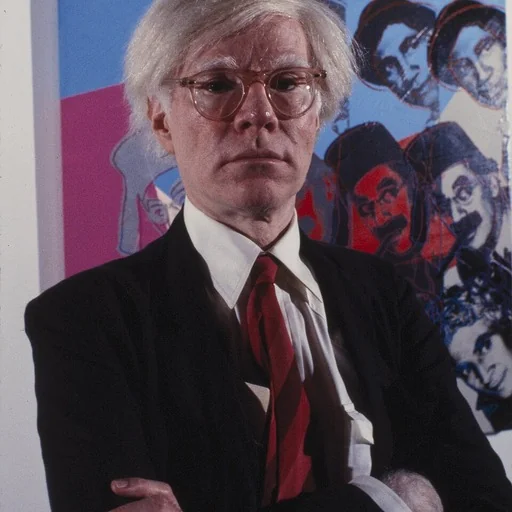
American, 1928–1987
Andy Warhol was an American Pop art artist. 31 works are cataloged here, principally at Museum of Modern Art. Andy Warhol was born in Pittsburgh.
Overview
Andy Warhol ( ; born Andrew Warhola Jr.; August 6, 1928 – February 22, 1987) was an American artist and filmmaker. Widely regarded as the most important artist of the second half of the 20th century, Warhol's practice spanned various media, including painting, filmmaking, photography, publishing, and performance art. A leading figure in the Pop art movement, his work explores the relationship between advertising, consumerism, mass media, and celebrity culture. His embrace of mechanical reproduction challenged traditional boundaries between high and low culture. He is also credited with popularizing the expression "15 minutes of fame." Born to working-class Rusyn immigrant parents in Pittsburgh, Warhol began his career as a commercial artist in New York before transitioning to fine art. Among his best-known early silkscreen paintings are Campbell's Soup Can (1962), Marilyn Diptych (1962), and Coca-Cola (3) (1962). In the mid-1960s, Warhol began devoting his attention to creating experimental films such as Blow Job (1964) and Empire (1965). He subsequently directed a number of underground films—including Chelsea Girls (1966), Four Stars (1967), and Blue Movie (1969)—featuring a shifting group of personalities known as Warhol superstars. His studio, the Factory, became a hub for avant-garde experimentation, bringing together drag queens, poets, bohemians, musicians, and wealthy patrons. Warhol also managed the influential rock band the Velvet Underground, who performed at his Exploding Plastic Inevitable (1966–67) multimedia events. After Warhol survived an assassination attempt in 1968, the Factory evolved into a business enterprise. He founded Interview magazine, produced the play Pork (1971), and published various books such as The Philosophy of Andy Warhol (1975) and Popism (1980). He executed several series of paintings—notably Mao (1972–73), Athletes (1977), and Last Supper (1985–86)—and commissioned portraiture, while expanding into television with Andy Warhol's TV (1980–83) and Andy Warhol's Fifteen Minutes (1985–87). He meticulously documented his social life through photography and daily recordings, published posthumously as The Andy Warhol Diaries (1989). Warhol died of cardiac arrhythmia at the age of 58 following gallbladder surgery in 1987. Warhol has been described as the "bellwether of the art market", with several of his works ranking among the most expensive paintings ever sold. In 2013, Silver Car Crash (Double Disaster) (1963) sold for $105 million. In 2022, Shot Sage Blue Marilyn (1964) sold for $195 million, the highest price ever paid at auction for a work by an American artist. Warhol has been the subject of numerous retrospective exhibitions, books, and documentary films. The Andy Warhol Museum in Pittsburgh, which holds an extensive permanent collection of his art and archives, is the largest in the United States dedicated to a single artist.
Childhood (1928–1936)
Warhol was born on August 6, 1928, in Pittsburgh, Pennsylvania. He was the fourth child of Andrej Varchola (Americanized as Andrew Warhola; c. 1886–1942 and Julia Warhola (née Zavacky, 1891–1972). His parents were working-class Rusyn emigrants from Mikó, Austria-Hungary (now Miková in northeast Slovakia).
In 1912, Warhol's father emigrated to the United States and found work in a coal mine. His wife joined him nine years later in 1921. The family lived at 55 Beelen Street and later at 3252 Dawson Street in the Oakland neighborhood of Pittsburgh. They were Ruthenian Catholic and attended St. John Chrysostom Byzantine Catholic Church. Warhol had two older brothers, Paul (1922–2014) and John (1925–2010), as well as an older sister, Maria (1912; died in infancy). Warhol's nephew James Warhola, became a successful children's book illustrator. At the age of eight, Warhol had a streptococcal infection that led to scarlet fever. Because there were no antibiotics to treat the illness, it progressed to rheumatic fever and ultimately the neurological condition Sydenham's chorea, sometimes referred to as St. Vitus' Dance. At times he was confined to bed and made to remain home from school. He would spend these days drawing, creating scrapbooks from Hollywood magazines, and cutting out images from comic books that his mother bought him. He also enjoyed using the family's Kodak Baby Brownie Special camera, and after noticing his passion for photography, his father and brothers built a darkroom in the basement for him.
Education (1937–1949)
When Warhol started art classes at Holmes School in 1937, his teacher recognized his talent and arranged for him to attend Saturday drawing classes at the Carnegie Institute in Pittsburgh. In May 1942, as Warhol was preparing to graduate from Holmes School, his father died of tubercular peritonitis, after having years earlier drunk contaminated water from a coal mine in West Virginia.
Warhol attended Schenley High School in Pittsburgh, where he excelled academically and artistically. His tenth-grade art teacher, Mary Adeline McKibbin encouraged him to enter a national Scholastic Corporation's art contest, which she also helped organize locally. The competition drew high school entries from across the United States, with tens of thousands of works submitted and regional selections exhibited at the Carnegie Museum of Art. McKibbin later claimed Warhol won a Scholastic award. However, biographer Blake Gopnik notes that contemporary coverage of the 1944 and 1945 contests suggests he did not receive a major prize, scholarship, or War Bond award. At most, Warhol appears to have earned an unpublicized "honorable mention," the gold pin for which he reportedly still wore in the 1980s. After graduating from Schenley High School in 1945, Warhol won a scholarship to the Carnegie Institute of Technology in Pittsburgh. While working as a produce huckster in 1946, Warhol created a series of pen-and-ink drawings satirizing his customers and documenting social contrasts encountered during his route, from affluent to working-class families. His illustrations depicted everyday interactions and behaviors, including demands from "new rich" customers and chaotic scenes involving families and children. The series won one of the annual Leisser Art Fund awards, valued at $40, which were given annually to Carnegie Tech students for the best visual representations of their summer activities. Warhol described this job as a "wonderful experience" and said that "people are funny," offering an early indication of his interest in observing everyday behavior and social interaction. As a student, Warhol worked part-time as a window dresser at Horne's department store and was reportedly threatened with expulsion on several occasions due to his attendance record. He also served as art director of the student art magazine, Cano, illustrating a cover in 1948 and a full-page interior illustration in 1949. These are believed to be his first two published artworks. Warhol earned a Bachelor of Fine Arts in pictorial design in 1949.
Commercial illustration and early exhibitions (1949–1954)
After graduating from the Carnegie Institute of Technology in June 1949, Warhol moved to New York City with his classmate Philip Pearlstein. They lived in a sixth-floor walk-up tenement building on St. Mark's Place near Tompkins Square Park in the East Village. On his second day in New York, Warhol visited Tina Fredericks, the art director of Glamour magazine, whom he had met during a brief visit to the city the previous year. He presented a portfolio of work completed at the Carnegie Institute of Technology, which Fredericks received favorably, purchasing a small $10 drawing of an orchestra for her personal collection. She subsequently commissioned Warhol to produce shoe illustrations; after more than one attempt, his drawings were accepted. Glamour published a page of Warhol's shoe illustrations along with several pages of people climbing the "ladder of success," accompanying the major feature "What Is Success?,"—a package of six articles by Katherine Sonntag, Hazel M. Wood, Margot Clarke, Patricia Curtain, Marya Mannes, and Elizabeth Weston. The publication marked the beginning of his career as a commercial artist.
Warhol was hired by prominent fashion magazines, including Glamour, Mademoiselle, Vogue, and Harper's Bazaar, and produced a prolific body of advertisements throughout the 1950s. During this period, gallerist Alexander Iolas is often credited with discovering Warhol and organizing his first solo exhibition, Andy Warhol: Fifteen Drawings Based on the Writings of Truman Capote, at the Hugo Gallery in New York in 1952. In May 1952, while working as a freelance artist, Warhol won the Art Directors Club Medal in its annual exhibition of advertising and editorial art for his drawing promoting CBS Radio's Nation's Nightmare documentary series. Warhol would be featured in the exhibition every year but one over the following decade. Between 1953 and 1954, he also designed several covers for Interiors magazine. In 1954, Warhol exhibited his work on multiple occasions at Vito Giallo's Loft Gallery in New York. ARTnews observed that Warhol had "developed an original style of line drawing," noting that his technique produced "the effect of the reverse side of a negative, although his lines are broken and the spaces not clouded." His "blotted line" technique combined aspects of printmaking and graphite drawing on paper. Within a year, Warhol—then working out of his railroad apartment on East 34th Street—invited Giallo to become his first paid studio assistant.
Rise to prominence and artistic development (1955–1956)
In 1955, Warhol began designing advertisements for the shoe manufacturer Israel Miller. Photographer John Coplans recalled that "nobody drew shoes the way Andy did. He somehow gave each shoe a temperament of its own, a sort of sly, Toulouse-Lautrec kind of sophistication, but the shape and the style came through accurately and the buckle was always in the right place." By 1956, Warhol's distinctive style had made him widely recognized as a fashion illustrator and he became so busy that he had to turn down assignments. His drawings for I. Miller attracted considerable attention and earned him the Art Directors Club Award for Distinctive Merit in 1956. In a 1956 interview with Mademoiselle, Warhol described his approach to combining commercial and fine art: "Every time I draw a shoe for a job, I do an illustration for myself." He acknowledged that "you almost have to specialize to get assignments," but noted that most New York art directors were eager to "give you a chance to do things." Warhol's personal illustrations were whimsical shoe designs embellished with gold leaf, and each represented a famous figure such as Truman Capote, Kate Smith, James Dean, Julie Andrews, Elvis Presley, and Zsa Zsa Gabor. They sold for $50 to $225 apiece when they were presented at the Bodley Gallery in New York in December 1956. In 1956, the Museum of Modern Art (MoMA) politely declined Warhol's gift of his drawing Shoe, citing limited storage space and asking him to retrieve it. Nevertheless, that same year one of his shoe drawings was included in MoMA's Recent Drawings U.S.A. group exhibition, marking Warhol's first museum showing. That year, he traveled around the world with his friend, production designer Charles Lisanby, studying art and culture in several countries. While in Kyoto, Japan, Warhol drew a stylized portrait of business tycoon Madame Helena Rubinstein.
Commercial expansion (1957–1961)
Warhol habitually used the expedient of tracing photographs projected with an epidiascope. Using prints by Edward Wallowitch, the photographs would undergo a subtle transformation during Warhol's often cursory tracing of contours and hatching of shadows. Warhol used Wallowitch's photograph Young Man Smoking a Cigarette (c. 1956) for a 1958 design for a book cover he submitted to Simon and Schuster for the Walter Ross pulp novel The Immortal, and later used others for his series of paintings. To promote himself as an artist, Warhol produced and distributed self-published books of his illustrations, including 25 Cats Name Sam and One Blue Pussy (1957) and A Gold Book (1957), which he gave to potential clients and contacts to generate work. He frequently incorporated calligraphy by his mother, Julia Warhol, to accompany his drawings.
With the rapid expansion of the record industry, RCA Records hired Warhol to design album covers and promotional materials. By the late 1950s, he was also working for high-end advertising clients, including Tiffany & Co. Warhol became widely recognized as one of "New York's more stylish window dressers and top shoe illustrators." His hand-drawn images appeared regularly in Vogue, the society pages of The New York Times, and in publications such as Amy Vanderbilt's Complete Cook Book (1961), which featured his illustrations at a moment when photography was beginning to replace drawn imagery in commercial media.. At a time when traditional artists rarely purchased the work of their peers, Warhol actively collected it. To survive, gallery artists typically did commercial work, such as window displays, and avoided using their real names because it was frowned upon. In contrast, Warhol gained recognition as a commercial artist, which caused tension with other artists. In 1960, Warhol purchased a Victorian townhouse at 1342 Lexington Avenue, now part of the Hardenbergh/Rhinelander Historic District, in the Carnegie Hill neighborhood of Manhattan. He used the house as both a residence and a studio, and his mother lived in the basement apartment.
Early Pop Art and silkscreen technique (1961–1962)
That April, his pop paintings were exhibited for the first time in the window display of the Bonwit Teller department store on Fifth Avenue at 57th Street. Five paintings based on comic strips and newspaper ads served as the backdrop for mannequins wearing spring dresses: Saturday's Popeye, Little King, Superman, Before and After, and Advertisement. In 1961, Warhol sold paintings directly to collector Robert Scull and soon attracted major buyers such as Emily Tremaine and Burton Tremaine, but dealer Ivan Karp's efforts failed to secure him gallery representation. When Karp introduced him to Leo Castelli, Castelli declined, feeling Warhol's work was too close to that of Roy Lichtenstein and concern over potential conflicts within his roster. Out of desperation, Warhol considered returning to the Bodley Gallery, but its director dismissed his new paintings as "ridiculous." Karp subsequently approached Sidney Janis, Richard Bellamy, Martha Jackson, and Robert Elkon, with only Jackson expressing interest in a future exhibition. After seeing Claes Oldenburg's storefront installation The Store in December 1961, Warhol returned home frustrated, telling friends Ted Carey and Muriel Flatow that his comic-strip paintings no longer felt original enough. Determined to create something more distinctive and impactful, he accepted Flatow's tongue-in-cheek suggestion—offered in exchange for $50—that he focus on what he liked most: money. Warhol began considering silkscreened images of dollar bills, drawn to the idea of mechanically reproducing currency like counterfeit cash. Seeking technical guidance, he turned to Floriano Vecchi of Tiber Press, who introduced him to the basics of silkscreen printing—transferring designs onto acetate, preparing screens, and pulling ink with a squeegee. These experiments marked a turning point in Warhol's practice and soon led to some of his earliest silkscreen works. Dealer Allan Stone took several works on consignment and offered Warhol a three-man exhibition alongside Robert Indiana and James Rosenquist, but all three artists declined, each holding out for a solo show. As Pop art gained momentum in New York in 1962, Warhol remained without major gallery representation, increasingly determined to secure his place within the emerging movement.
Campbell's Soup Cans and breakthrough success (1962–1964)
In May 1962, Warhol was featured in Time magazine's article "The Slice-of-Cake School," alongside Lichtenstein, Rosenquist, and Wayne Thiebaud. At the time, he was working on his Campbell's Soup Cans (1961–62) paintings and had completed sixteen of them. When Los Angeles dealer Irving Blum visited, he was surprised to learn that Warhol lacked gallery representation. With an opening available in July, Blum offered him a solo exhibition at the Ferus Gallery. Warhol sent 32 canvases to Los Angeles, each depicting a different variety of Campbell's Soup. The exhibition opened on July 9, 1962, marking his West Coast debut. During the run of the exhibition, a forthcoming December show at the Martha Jackson Gallery was canceled due to concerns about negative repercussions. Despite the cancellation, Jackson's assistant John Weber sold ten Warhol paintings that had been taken on consignment. In July 1962, Warhol's Big Campbell's Soup Can with Can Opener (Vegetable) (1962) became the first of his soup-can paintings to enter a museum exhibition when it was shown at the Wadsworth Atheneum in Hartford, Connecticut. The following month, his painting S&H Green Stamps (1962) was included in the exhibition New Painting of Common Objects at the Pasadena Art Museum in Pasadena, California. The show featured works drawn from commercial labels, consumer goods, and advertising imagery, contributing to the movement's early critical recognition. Warhol was invited by art dealer Sidney Janis to participate in the October 1962 exhibition, The New Realists: An Exhibition of Factual Painting & Sculpture at her New York gallery. Warhol exhibited his 1962 paintings 200 Soup Cans, Big Campbell's Soup Can 19c (Beef Noodle), and Do It Yourself (Flowers). The exhibition was widely seen as a turning point in the acceptance of Pop art; The New Yorker likened its impact on the New York art world to an "earthquake," while The Kansas City Star newspaper ran the headline, "Which Way Is Modern Art Going? Hold Your Breath and Watch the Soup Cans." Filmmaker Emile de Antonio introduced Warhol to dealer Eleanor Ward of the Stable Gallery, who agreed to give him a solo exhibition in exchange for a painting of a two-dollar bill. Warhol's first solo New York Pop show opened there on November 6, 1962. The exhibition contained eighteen new works, including Marilyn Monroe Twenty Times, Flavor Marilyns, Gold Marilyn Monroe, 129 Die in Jet!, Red Elvis, Troy Donahue, 100 Soup Cans, 100 Coke Bottles, and 100 Dollar Bills. The show received rave reviews from Michael Fried who wrote in Art International, "Of all the painters working today in the service—or thrall—of a popular iconography Andy Warhol is probably the most single-minded and the most spectacular." In December 1962, the MoMA hosted a symposium on Pop art, during which artists such as Warhol were attacked for "capitulating" to consumerism. Critics were appalled by Warhol's open acceptance of market culture, which set the tone for his reception. The next year, Warhol formed The Druds, a short-lived avant-garde noise band that included figures from the New York minimal art and proto-conceptual art scenes, including Larry Poons, La Monte Young, Walter De Maria, Jasper Johns, Claes Oldenburg, and Lucas Samaras. In January 1963, Warhol rented his first studio, an old firehouse at 159 East 87th Street, where he produced his Elvis series, including Eight Elvises (1963) and Triple Elvis (1963). These works, along with a series of portrait
The Factory scene, expansion into sculpture and film (1964–1966)
By 1964, Warhol had relocated his studio to 231 East 47th Street, which became known as the Factory. Warhol used assistants to increase his productivity, and these collaborations would remain a defining aspect of his working methods throughout his career. During this period, poet Gerard Malanga assisted him with the production of silkscreens and films at the Factory, which was covered in aluminium foil and silver paint by Billy Name in 1964. Warhol was among the artists commissioned to create an artwork for the New York State Pavilion at the 1964 World's Fair in Queens, New York. He created the mural Thirteen Most Wanted Men (1964), which was painted over after government officials objected to the images before the fair opened in April 1964. That spring, Warhol had his second exhibition at the Stable Gallery in the spring of 1964, which featured sculptures of commercial boxes stacked and scattered throughout the space to resemble a warehouse. For the exhibition, Warhol custom ordered wooden boxes and silkscreened graphics onto them. The sculptures of commercial cartons—Brillo Soap Pads, Del Monte Peach Halves, Heinz Tomato Ketchup, Kellogg's Corn Flakes, Campbell's Tomato Juice, and Mott's Apple Juice—sold for $200 to $400 depending on the size of the box.
A pivotal event in Warhol's career was The American Supermarket exhibition at Paul Bianchini's Upper East Side gallery in October 1964. The show was presented as a typical small supermarket environment, except that everything in it—from the produce, canned goods, meat, and paintings on the wall—was created by prominent Pop artists of the time. Warhol designed a paper shopping bag and contributed his box sculptures along with a Campbell's Soup Can painting, and genuine signed Campbell's soup cans. The exhibit was one of the first mass events that directly confronted the general public with both Pop art and the perennial question of what art is. In November 1964, Warhol's first Flowers series was exhibited at the Leo Castelli Gallery in New York. In May 1965, his second Flowers series, which had more sizes and color variation that the previous, was shown at Galerie Ileana Sonnabend in Paris. During this trip Warhol announced that he was retiring from painting to focus on film. Warhol made a conscious decision to oppose conventional painting, stating that he no longer believed in painting. Later that year, Warhol's first solo museum exhibition was held at the Institute of Contemporary Art, Philadelphia in October 1965. In response to art dealer Ivan Karp's suggestion to paint cows, Warhol produced Cow, screenprints on wallpaper for his April 1966 exhibition at the Leo Castelli Gallery.
Exploding Plastic Inevitable, Chelsea Girls, and Lecture tours (1966–1968)
In November 1966, Warhol was hired by the Abraham & Straus department store in Brooklyn to promote the "Paint-your-own-dress" collection by the Mars Manufacturing Company, which included a white paper dress that came with a paintbrush and a box of watercolors. In a live demonstration, Warhol decorated two dresses at the store that were given to the Brooklyn Museum using Nico as his model. In his capacity as the manager of the experimental rock group the Velvet Underground, he included them as a key component of his Exploding Plastic Inevitable multimedia happenings in 1966 and 1967, and he funded their debut album, The Velvet Underground & Nico (1967). Warhol intended to present the film Chelsea Girls (1966) at the 1967 Cannes Film Festival, but it wasn't shown because "the festival authorities explained that the film was too long, there were technical problems." Warhol's Factory became a hub for a group of "superstars," including Baby Jane Holzer, Edie Sedgwick, International Velvet, Ultra Violet, Viva, and Candy Darling, who appeared in his films and embodied his concept of fleeting celebrity. His remark that "everyone will be famous for 15 minutes" first appeared in a 1967 Time magazine article and became closely associated with the Factory scene.
To finance his film productions, Warhol began going on college lecture tours, where he screened some of his underground films and answered audience questions. Warhol sent actor Allen Midgette to impersonate him during a West Coast college tour in October 1967. Warhol reimbursed the four institutions where he did not appear and returned to the campuses in 1968. Around this time, Warhol met Fred Hughes, then working for the Menil Foundation, who soon became closely involved in his activities. At the time, Warhol had largely paused painting, but he resumed work shortly thereafter, producing the Big Electric Chair paintings for his retrospective at the Moderna Museet in Stockholm in 1968. Hughes quickly took on a central role in both Warhol's artistic and film projects, arranging a commission from the de Menils for Warhol to film a sunset as part of a project for the restoration of a bombed church in Texas. The remaining funds from that commission were used to finance Lonesome Cowboys (1968), which was filmed in Arizona.
Assassination attempt and recovery (1968)
On June 3, 1968, radical feminist writer Valerie Solanas shot Warhol and Mario Amaya, art critic and curator, at the Factory. Solanas had been a marginal figure in the Factory scene before the shooting. She authored the SCUM Manifesto, a separatist feminist tract that advocated the elimination of men; and appeared in the Warhol film I, a Man (1967). Amaya received only minor injuries and was released from the hospital later the same day. Warhol was seriously wounded by the attack and barely survived: he remained in hospital for nearly two months. Solanas turned herself in to the police a few hours after the attack and said that Warhol "had too much control over my life." She was subsequently diagnosed with paranoid schizophrenia and eventually sentenced to three years in prison. Jed Johnson, an assistant who was present at the Factory during the shooting, visited Warhol daily at the hospital, and the two developed an intimate relationship. Shortly after Warhol was discharged, Johnson moved in with him to aid in his recovery and to help care for his ailing mother. During Warhol's hospitalization that summer, Paul Morrissey assumed primary filmmaking responsibilities and directed his first film, Flesh (1968), starring Joe Dallesandro.
The assassination attempt had a profound effect on Warhol's life and art. Complications from a second operation the following year left his abdominal muscles improperly repaired, requiring him to wear a surgical corset for the rest of his life to prevent his stomach from distending when he ate. The Factory became more regulated, and Warhol focused on making it a structured business enterprise. He credited Morrissey with transforming the Factory into a "regular office." In August 1968, Warhol made an appearance in court after Phillip "Fufu" Van Scoy Smith, an investor in a canceled film adaptation of the Charlotte Brontë novel Jane Eyre, sued him for $80,000. A legal battle ensued for two years, ending after the backer failed to show up in court. Warhol reemerged on the public social scene that fall. In September 1968, Warhol and Ultra Violet attended a party celebrating the completion of the film Midnight Cowboy. The film includes a party scene featuring members of the Factory that was shot during Warhol's hospitalization. That same month, Warhol hosted a party at the Factory for the release of Nico's album The Marble Index. Warhol, Viva, and Ultra Violet also appeared on the cover of The New York Times Magazine on November 10, 1968.
New ventures in film, photography, publishing, theater, and commercial work (1969–1971)
In February 1969, Warhol and his entourage traveled to Los Angeles to discuss a prospective movie deal with Columbia Pictures. Warhol, who had always had an interest in photography, used a Polaroid camera to document his recuperation after the shooting. A few of his photographs were published in the May 1969 edition of Esquire magazine. He would become well known for always carrying his Polaroid camera to chronicle his encounters. Eventually, he used instant photography as the basis for his silkscreen portraits when he resumed painting in the 1970s.
After the release of the erotic film Blue Movie (1969), Warhol rented the Fortune Theater at 62 East 4th Street, where he screened male pornographic films from June 25 to August 5, 1969. The project was managed by Gerard Malanga under his business, Poetry on Film. The theater was called "Andy Warhol's Theater: Boys to Adore Galore." Morrissey came up with the idea to rent the theater and set the admission price at $5. Warhol and British journalist John Wilcock founded Interview magazine in the fall of 1969. The magazine was initially published as inter/VIEW: A Monthly Film Journal. It was revamped a few years later and came to represent Warhol's social life and fascination with celebrity. In 1969, Warhol received an invitation to curate an exhibition using items from the permanent collection of the Rhode Island School of Design Museum (RISD Museum) in Providence. In October 1969, the exhibition Raid the Icebox opened at Rice University's Institute for the Arts in Houston. In 1970, the show traveled to the Isaac Delgado Museum in New Orleans before arriving at the RISD Museum. Compared to the success and scandal of Warhol's work in the 1960s, the early 1970s were much quieter years, as he became more entrepreneurial. He was generally regarded as quiet, shy and a meticulous observer. Art critic Robert Hughes called him "the white mole of Union Square". His fashion evolved from what Warhol called his "leather look" to his "Brooks Brothers look," which included a Brooks Brothers shirt and tie, DeNoyer blazer, and Levi jeans.
As Warhol continued to forge into filmmaking, he had established himself as "one of the most celebrated and well-known Pop art figures to emerge from the sixties." The Pasadena Art Museum organized a retrospective of his work in 1970. The show traveled to the Museum of Contemporary Art, Chicago; Stedelijk Van Abbemuseum, Eindhoven; Musée d'Art Moderne de la Ville de Paris; Tate Gallery, London; and Whitney Museum of American Art, New York. The Whitney exhibition in 1971 distinctly featured Warhol's Cow (1966) wallpaper as the backdrop for his paintings. Meanwhile, Warhol produced the play Andy Warhol's Pork, which opened at New York's La MaMa Experimental Theatre in May 1971. A few months later, the controversial production was brought to the Roundhouse in London. Warhol also came up with the cover concept and did the photography for the Rolling Stones' album Sticky Fingers (1971), which features a close-up image of a man's crotch in jeans with a real zipper. He received a Grammy nomination for Best Album Cover at the 14th Annual Grammy Awards in 1972.
Montauk, social life, and domestic life (1971–1974)
In late 1971, Warhol and his business partner Paul Morrissey purchased Eothen, an oceanfront estate in Montauk, New York on Long Island. They began renting the main house on the property in 1972. Lee Radziwill, Jackie Kennedy, the Rolling Stones, Elizabeth Taylor, Truman Capote, and Halston were among the estate's guests.
In 1972, Warhol planned the Halston runway presentation at the Coty Awards. Although Warhol was considered to be apolitical, he participated in an exhibition with the poster Vote McGovern (1972) in an effort to raise funds for George McGovern's 1972 presidential campaign. In October 1972, Warhol's work was included in the inaugural show at the Art Museum of South Texas in Corpus Christi, Texas. The following month, Warhol's Mao screenprints debuted at the Leo Castelli Gallery in New York. In November 1972, Warhol and his live-in boyfriend Jed Johnson acquired a dachshund puppy they named Archie. Warhol doted on Archie and took him everywhere: to the studio, parties, restaurants, and on trips to Europe. He created portraits of Johnson, Archie, and Amos—a second dachshund that joined their family a few years later. In 1974, the couple moved into a Neo-Georgian townhouse at 57 East 66th Street in Manhattan's Lenox Hill neighborhood. By this time, Warhol's public presence had increased significantly due to his attendance at parties. In 1974, he said, "I try to go around so often so much and try to go to every party so that they'll be bored with me and stop writing about me." Warhol began traveling more frequently to Europe during this period and developed a particular fondness for Paris after filming L'Amour (1972) around the city. He maintained an apartment on the Left Bank, on Rue du Cherche-Midi, which he shared with his business manager Fred Hughes. While in Paris, Warhol and his circle socialized with members of the city's jet set, including Karl Lagerfeld, Yves Saint Laurent, Loulou de la Falaise, and Paloma Picasso. This lifestyle shift has been attributed in part to Hughes, who sought to cultivate a more polished public image for Warhol and to position the Factory as an international social and artistic presence.
The Philosophy of Andy Warhol, Studio 54, and Exposures (1975–1979)
Warhol designed the sets for the Broadway musical Man on the Moon by John Philips of the Mamas & the Papas, which opened in January 1975 at the Little Theatre in New York. In May 1975, Warhol attended President Gerald Ford's state dinner in honor of the Shah of Iran, Mohammad Reza Pahlavi, at the White House. In September 1975, he went on an eight-city U.S. book tour for his book The Philosophy of Andy Warhol (From A to B & Back Again), followed by stops in Italy, France, and England. In June 1975, the Baltimore Museum of Art mounted a major exhibition showcasing works from various periods of his career. In 1976, Warhol and painter Jamie Wyeth were commissioned to paint each other's portraits by the Coe Kerr Gallery in Manhattan. That year, Warhol traveled to Iran to do a portrait of Empress Farah Pahlavi. He returned to the Middle east in January 1977, when he traveled to Kuwait for the opening of his exhibition at the Dhaiat Abdulla Al Salem Gallery.
The opening of Studio 5 on April 1977 ushered in a new era in New York City nightlife. Warhol was a regular and was often seen partying with his friends Halston, Bianca Jagger, and Liza Minnelli. Around this time, Warhol was taking explicit photographs of men—referred to as "landscapes"—for what became known as the Torsos and Sex Parts series. Most of the men were street hustlers and male prostitutes brought to the Factory by Halston's lover Victor Hugo. This caused tension in Warhol's relationship with Johnson who did not approve of his friendship with Hugo. "When Studio 54 opened things changed with Andy. That was New York when it was at the height of its most decadent period, and I didn't take part. I never liked that scene, I was never comfortable. … Andy was just wasting his time, and it was really upsetting. … He just spent his time with the most ridiculous people," said Johnson.
In May 1977, Warhol and entrepreneur Geoffrey Leeds announced plans for the "Andy-Mat," a modern automat-style restaurant on Madison Avenue in New York City. Designed as a self-service dining space, the 115-seat restaurant was to feature pre-prepared frozen foods alongside luxury items such as champagne, served through pneumatic tubes, and a waitstaff would deliver orders. Warhol had total artistic control over the design, including the logo, flatware, and décor, with interiors incorporating whimsical, childlike motifs. Menu items, priced between $1 and $5.75, ranged from comfort foods like shepherd's pie to desserts and mini omelets. While the project aimed to blend everyday dining with artistic spectacle and potentially expand internationally, the restaurant was never realized. In June 1977, Warhol was invited to a special reception honoring the "Inaugural Artists" who had contributed prints to the Jimmy Carter presidential campaign. That year, Warhol was commissioned by art collector Richard Weisman to create Athletes, ten portraits consisting of the leading athletes of the day, for an exhibition that opened at New York's Coe Kerr Gallery in December 1977. In 1979, Warhol formed a publishing company, Andy Warhol Books, which was an imprint of Grosset & Dunlap. In October 1979, he released the photography book Exposures. The following month, he embarked on a three-week book tour before the Whitney Museum of American Art mounted the exhibition Andy Warhol: Portraits of the 70s. The exhibition showcased Warhol's portrait commissions of the decade—including Yves Saint Laurent, Gianni Agnelli, Marella Agnel
Collections represented

Museum
Artists in a similar vein