Artist
Carolina Carlesimo
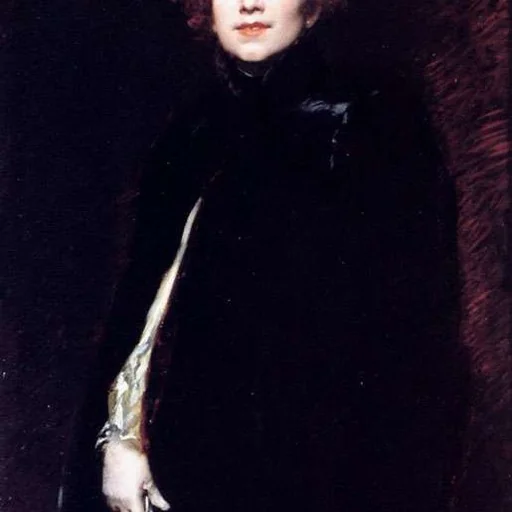
Italian, 1867–1923
Carolina Carlesimo was an Italian Impressionism artist. 1 work is cataloged here, principally at National Museum of Fine Arts, Argentina. Carolina Carlesimo was born in Casalvieri.
Overview
Juana Romani (born Carolina Giovanna Carlesimo; 30 April 1867 – 13 June 1923) was an Italian-born French portrait painter and artists' model.
Biography
She was born in Velletri (Latium, Italie) on April 30, 1867. At the age of ten, she moved to Paris with her mother and stepfather, Temistocle Romani, an engineer who was seeking employment there. They settled in the Latin Quarter and she was put to work as a model at several art schools. It was not long, however, before Filippo Colarossi, founder of the Académie Colarossi, took a special interest in her; inviting her to work and study at his school. In 1882, she posed for "Diana the Huntress", a well-known sculpture by Alexandre Falguière. She also posed for Carolus-Duran, Victor Prouvé, Ferdinand Roybet, who gave her lessons, and Jean-Jacques Henner, with whom she had a brief affair. At the age of nineteen "Il Romani", as she was called, decided to pursue her own career in art. That same year, she changed her first name to "Juana", the Spanish equivalent of her middle name, "Giovanna". She began to exhibit her works in 1888 at the Salon of the Société des Artistes Français and exhibited with them regularly until 1904. She was especially valued as a painter of female portraits, including many women from notable families, often depicting them as mythological or symbolic figures. One of her portraits was awarded a silver medal at the Exposition Universelle (1889). In 1901, she donated 5,000 lire to the art school in her home town. Four years later, it was officially renamed the "Scuola d'Arte Juana Romani". Her work was also well received by the critics. In 1896, Louis Gonse of Le Monde moderne declared that she was more skillful than her mentor, Roybet. She usually painted directly on the canvas, without preliminary sketching, and sold many works before they were finished. In her later years, she became mentally unsound and was confined to a psychiatric hospital in Paris. She died there, forgotten, around 1924. Her remaining works were auctioned off at the Hôtel Drouot. Many of her paintings may be seen at the Musée d'Orsay.
Modeling career
From 1882, she made her first steps in the artistic society as a model, first with the sculptor Alexandre Falguière and then with various famous painters such as Jean-Jacques Henner, Victor Prouvé, Raphaël Collin, Carolus-Duran, and Ferdinand Roybet, who admired her youthful yet well-shaped body, her mischievous face with a dimple on her chin, and her hair with reddish highlights. She posed for the sculpture Diana the Huntress, presented by Alexandre Falguière at the Salon of 1884. A version of this sculpture, carved in marble, is in the Musée des Augustins de Toulouse.
As a painter
In 1887, Juana stopped posing and decided to focus exclusively on her artwork. Initially, she painted under her name, Carolina Carlesimo di Casalvieri, but occasionally signed her works as Veliterna Romains Juana. In 1888, she definitively adopted the pseudonym Juana Romani. In 1888, at the age of twenty-one, Romani participated in her first Salon, showing the public a watercolor painting titled La Gitane. Carolus-Duran, who oversaw the studio she attended, explicitly supported her by asking his colleague Jean-Jacques Henner to influence the jury members in her favor. She regularly exhibited at the Société des artistes français from 1888 to 1904. According to the Catalogue Illustré du Salon des Artistes Français, the paintings exhibited by Juana include:
Her painting, heir to a pictorial tradition linked to the antiquity and marked by the influence of her masters (from Henner to Roybet), stages strong and sensual female figures drawn from biblical history, theater, opera, history and art history. Romani painted Biblical heroines in her signature romantic style. With their long billowing hair, enigmatic poses, Romani's figures exude a mysticism and power that feels both in line with the height of 1900s Paris and fashion today.
Collections represented

Artists in a similar vein
Artist