Artist
Felipe Ehrenberg
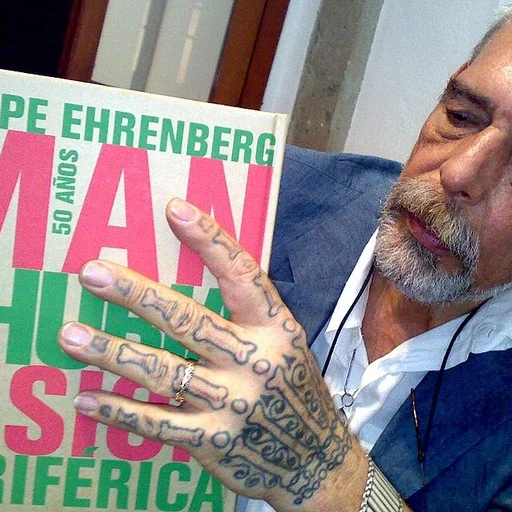
Mexican, 1943–2017
Felipe Ehrenberg was a Mexican artist. 2 works are cataloged here, principally at Museum of Modern Art. Felipe Ehrenberg was born in Mexico City.
Overview
Felipe Ehrenberg (27 June 1943, Tlacopac, Mexico City, 1943 – 15 May 2017) was a Mexican artist who worked in painting, drawing, printmaking and performance, among other mediums. He also published books and magazines.
Biography
Ehrenberg was born in Tlacopac, Mexico City, in 1943. He started his education as editor, continuing later as visual and graphic artist with different mentors, amongst which muralist José Chávez Morado, painter and sculptor Feliciano Béjar, and the artist Mathias Goeritz stand out. He presented his first exposition in 1960, in a collective exhibition organized at Galería de la Paz, Mexico City, and exhibited his work at other galleries in that city and in Acapulco between 1963 and 1964. His first individual exhibitions "La Montaña" and "Dibujos y Epoxis" were set up in 1965 at Galería del Centro de Arte y Artesanía and at Galería 1577 respectively. Between 1964 and 1967 he was editor of the arts section of the México City Times, an English publication, where he also wrote under the pseudonym "Montenegro." In the last years of the decade his work was shown frequently in individual as well as in collective exhibitions and started gaining international attention. In 1968 he represented Mexico in Salón Codex de Pintura Latinoamericana de Buenos Aires, where he won the prize "Premio Femirama de pintura." 1968, a crucial year in global politics, is also fundamental in Mexican history: a week before the inauguration of the Olympic Games in Mexico City, the military suppressed a student demonstration; hundreds of participants died. Impressed by the situation and in danger of being imprisoned, Ehrenberg went into exile to England with his family. It was there, with David Mayor and Martha Hellion, that the Beau Geste Press was founded, a collective of artists dedicated to publishing the work of visual poets, conceptual artists, neo-dadaists and experimental artists, many of whom were connected to the Fluxus movement. During these years Ehrenberg formed part of the foundation of the group "Polygonal Workshop," where he won the Perpetua Prize for the design and illustration of Opal Nation's "The Man Who Entered Pictures, 1974," edited by Southwestern Arts Association/British Arts Council. Ehrenberg returned to Mexico in early 1974, moving to Xico, a small town in the state of Veracruz. Continuing with his collective vocation, he joined Victor Munoz, Carlos Finck, and Jose Antonio Hernandez Amezcua, to found "Grupo Process Pentagono," a seminal movement which was later known as Movimiento Grupal. While developing his artistic career, Ehrenberg also started his teaching, giving courses in installations, cultural activism, and administration for the artists at Universidad Veracruzana. In 1975 he received a Guggenheim Fellowship for his investigation of the duality of Latin American culture, concentrating on "schizophrenic attitudes and schismatic in visual arts as a result of bilingualism." In 1979 he founded H2O (Haltos 2 Ornos) Talleres de Comunicación, a collective exhibition of 25 art instructors who redefined the models of independent editing and held muralist workshops. For 10 years, H2O directed the creation of more than 500 small communities and communication groups, and the creation of approximately 1,100 collective murals across Mexico. Ehrenberg's interest in the sociocultural aspects of art and his participation in the community converted him into a public figure in the 1980s. While he kept exhibiting his work at individual and collective exhibitions, he also ran unsuccessfully as candidate for the municipal and federal elections in 1982 for PSUM (Partido Socialista Unificado de México). Three years later, due to the earthquake of 1985, Eh
Collections represented

Museum