Artist
Tetsuya Noda
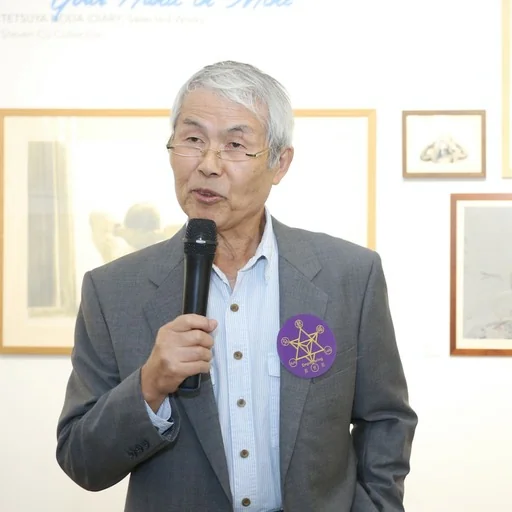
Japanese, b. 1940
Tetsuya Noda is a Japanese artist. 2 works are cataloged here, principally at Museum of Modern Art. Tetsuya Noda was born in Kumamoto Prefecture.
Overview
Tetsuya Noda (野田 哲也, Noda Tetsuya; born 5 March 1940) is a contemporary artist, printmaker and educator. He is widely considered to be Japan’s most important living print-artist, and one of the most successful contemporary print artists in the world. He is a professor emeritus of the Tokyo University of the Arts. Noda is most well-known for his visual autobiographical works done as a series of woodblock, print, and silkscreened diary entries that capture moments in daily life. His innovative method of printmaking involves photographs scanned through a mimeograph machine and then printed the images over the area previously printed by traditional woodblock print techniques onto the Japanese paper. Although this mixed-media technique is quite prosaic today, Noda was the first artist to initiate this breakthrough. Noda is the nephew of Hideo Noda an oil painter and muralist.
Early life, family and education
Noda was born in the Shiranui Township of Uki, Kumamoto Prefecture, on 5 March 1940. In 1959, he entered the Department of Oil Painting, Faculty of Fine Arts, Tokyo National University of Fine Arts and Music (presently Tokyo National University of Fine Arts and Music), and graduated in 1963. In 1965, Noda completed graduate course at the Tokyo National University of Fine Arts and Music. Noda was a student of Tadashige Ono in the art of woodblock printmaking. In June 1971, Noda married Dorit Bartur, the daughter of Moshe Bartur, then the Israeli ambassador to Japan. In 1972, their first son Izaya was born in October; and in 1974 their first daughter Rika was born in November.
Career
1968 At the age of 28, Noda won the International Grand Prize at the Tokyo International Print Biennale for diptych Diary: August 22, 1968 and Diary: September 11, 1968. 1977 Appointed lecturer in the Faculty of Art, Tokyo National University of Fine Arts and Music. 1981 Promoted associate professor in the Faculty of Art, Tokyo National University of Fine Arts and Music, Japan. 1991 Became professor in the Faculty of Art, Tokyo National University of Fine Arts and Music, Japan. 1993 Gave lectures and workshops as a visiting artist at Macau Academy of Visual Arts, China. 1996 Appointed international judge at the 10th Seoul International Biennial of Print, South Korea 1998 Gave lectures and workshops as a visiting artist at the Columbia University, New York, United States of America. 2007 Retired as Professor Emeritus at the Tokyo University of the Arts.
Awards
1968 International Grand Prize at the Tokyo International Print Biennale 1970 Warsaw National Museum Prize at the Krakow International Print Biennale 1972 2nd Prize at the Norwegian International Print Biennale 1974 Łódź Museum Prize at the Krakow International Print Biennale 1974 2nd Prize at the Norwegian International Print Biennale 1976 Prize of the Museum of Modern Art, Hyogo at the Tokyo International Print Biennale 1977 Grand Prize at the Ljubliana International Print Biennale 1978 Grand Prize at the Norwegian International Print Biennale 1980 Łódź Museum Prize at the Krakow International Print Biennale 1981 Belgrade Contemporary Museum Prize at the Ljubliana International Print Biennale 1981 Exhibition Prize at the Graphica Criativa, Finland 1984 Gold Medal at the Norwegian International Print Biennale 1986 Friends of Bradford Art Galleries and Museums Prize at the British International Print Biennale 1987 Grand Prize of Honor at the Ljubliana International Print Biennale 1993 Gen Yamaguchi Memorial Grand Prize, Numazu City 2003 Awarded with the Medal with Purple Ribbon by the Government of Japan 2015 Awarded The Order of the Sacred Treasure, Gold Rays with Neck Ribbon by the Emperor of Japan
Major exhibitions
Source:
1969 (G) Ljubljana International Print Biennale, Yugoslavia 1970 (G) British International Print Biennale, United Kingdom 1971 (G) Sao Paulo Biennale, Brazil 1972 (G) Venice Biennale: Graphic International, Italy 1973 (S) Soker-Kaseman Gallery, San Francisco, United States of America 1976 (G) Arakawa Shusaka, Ikeda Masuo, Noda Tetsuya (Cincinnati Art Museum), United States of America 1976 (G) Frechen International Print Biennale, Germany 1978 (S) Fuji Television Gallery, Tokyo, Japan 1978 (G) Norwegian International Print Biennale, Norway 1979 (S) Foire Internationale d'Art Contemporain, Grand Palais, Paris, France 1979 (S) The 13th International Biennial of Graphic Arts - TETSUYA NODA, International Centre of Graphic Arts (Ljubljana)(MGLC), Yugoslavia 1979 (G) Contemporary Japanese Art (Beijing & Shanghai), China 1979 (S) Soker-Kaseman Gallery, San Francisco, United States of America 1980 (S) Ikeda Museum of 20th Century Art, Shizuoka, Japan 1980 (S) Marina Dinkler Gallery, Berlin, Germany 1980 (G) Printed Art: A View of Two Decades (Museum of Modern Art, New York), United States of America 1981 (S) Gallery S. 65, Belgium 1981 (G) International Art Biennale, Valparaiso, Chile 1983 (S) Gallery 39, London, United Kingdom 1983 (G) Japanese Print Since 1900 (British Museum), United Kingdom 1984 (S) Tikotin Museum of Japanese Art, Haifa, Israel 1985 (G) Japanese Contemporary Art (National Gallery of Modern Art, New Delhi), India 1987 (S) Fuji Television Gallery, Japan 1988 (S) Old Jim Gallery, Vanderbilt University, United States of America 1989 (S) The 18th International Biennial of Graphic Arts - TETSUYA NODA, International Centre of Graphic Arts (Ljubljana)(MGLC), Yugoslavia 1990 (S) Australian National University Drill Hall Gallery, Canberra, Australia 1990 (G) "Japanese Prints of 20th Century, Reformist and Tradition" (Cincinnati Art Museum) 1995 (G) La Serigraphie Au Rendez-Vous (Galerie Dimmers, Bruxelles), Belgium 1996 (S) Patrick Cramer, Geneve, Switzerland 1996 (S) Don Soker Contemporary Art, San Francisco, United States of America 1997 (S) Shiyoda Gallery, Shizuoka, Japan 1998 (S) Gallery Goto, Tokyo, Japan 1998 (G) Photo Image: Printmaking 60s to 90s (Museum of Fine Arts, Boston), United States of America 1999 (S) Gallery Seijo, Sendai, Japan 2000 (S) Sakanomachi Museum, Toyama, Japan 2001 (S) Museum of Small Dreams, Yonago, Tottori, Japan 2001 (S) Aizawa Museum, Niigata, Japan 2002 (S) Museum Chiran, Kagoshima, Japan 2003 (G) "MOT Annual 2003 - DAYS", Museum of Contemporary Art, Tokyo, Japan 2003 (S) "Tetsuya Noda", Central Academy of Fine Arts Museum, Beijing, China 2004 (S) "Days in a Life", The Art of Tetsuya Noda, Asian Art Museum, San Francisco, United States of America 2005 (S) "Print World of Tetsuya Noda", Uki Municipal Shiranuhi Museum of Art, Kumamoto, Japan 2006 (S) "Tetsuya Noda - Diary", Contemporary Center of Graphic Art, Japan 2006 (G) "Contemporary Prints, Transformation of Photographic Image"(National Museum of Modern Art, Tokyo), Japan 2006 (G) "Connoisseurship of Japanese Prints: Part I" (The Art Institute of Chicago), United States of America 2007 (S) "Tetsuya Noda - Diary", University Museum, Tokyo University of the Arts, Japan 2008 (S) Ardel Gallery, Bangkok, Thailand 2009 (S) Gallery Itsutsuji, Tokyo, Japan 2010 (G) Emerging Japanese Print Artists of the 1960s, 70s, and Beyond, The Art Institute of Chicago, United States of America 2010 (G) "Contemporary Japanese Printmaking Exhibition" (Zhejian
Works
In the British Museum Magazine, Timothy Clark, the keeper of Japanese section wrote "In nearly fifty years, Noda has created some 500 further works that continue his mesmerizing ‘Diary’ series, using the unique combination of color woodblock and photo-based silkscreen onto handmade Japanese paper that he has made his own. Personal snapshots are rigorously reworked to become subtle mementos of universal significance: ‘what’s in a life?’ we are constantly prompted to ask." In the video entitled "Making Beauty: Noda Tetsuya", published by The British Museum on 11 October 2018, Noda and Clark discuss the concept and technique used in achieving the look and feel of the Noda's works. Video on YouTube
Concept
Since 1968, Noda’s works have been inspired by themes of his own life. It is a visual autobiography and the motif is a comment on his daily life - his family, people he knows, his children’s growth and scenery along his way. He takes photographs of what he sees and likes, then develops and retouches them with pencil or brushes. His works are done using materials close at hand. On the concept of visual autobiography, Robert Flynn Johnson stated, "To think that one's life is important enough to make it the focus of one's art can be an act of pure folly and egotistical pride or it can involve a humbling and sincere self-examination that draw on observation of small universal truths. It is clear that in a career of nearly forty years of creating an artistic world made at paper and ink, Tetsuya Noda has followed the latter, quieter path." In the age of social media, some critics are quick to see the parallelism of Noda's visual autobiography and popular social media sites. In 2016, a newspaper pointed out "In this era of social networking, it isn’t unusual for our friends to frequently post photos of the mundane happenings of our lives—a laughing baby, a just-read book, our lunch, a selfie—on Facebook, Instagram, or Snapchat. But for renowned contemporary Japanese artist Tetsuya Noda, documenting the ordinary details of his daily life is something he has done for almost 50 years." When asked about how he found his theme; "Diary as an opportunity", he replied, "at the university I was not at all satisfied with the assignment of painting nudes, it did not seem the right way to express myself." His independent thinking and determination were highly rewarded. "I started to use a mimeograph cutting machine for the photo images in addition to the woodblock printmaking techniques." In 1968, four years after he graduated from the university, he received the International Grand Prize at the 6th Tokyo International Print Biennale; "for the audacious combination of photography with traditional woodblock print."
Development
Chieko Tsuzuki of The National Museum of Modern Art, Tokyo described Noda's works as follows, "The diverse expressions of his works up until the mid-1970s, incorporating a myriad of elements and having a slight tendency to be overly explanatory, were gradually narrowed down. In the latter half of the 1970s, his works were centered around a combination of woodcuts and silkscreens. Through this combination, he increasingly produced works that expressed the expansion of space. Specifically, he minimized the use of subject matter; brought out the effect of light and subtle shading; and created a large, empty space on the surface plane, via capturing the subject from a low perspective. Regardless of their minimal images, his works during this period reveal a further deepening of his expression that enriched the viewers' impression and their lingering memory. In the 1980s and the 1990s, such expressions were further developed to depict works with a stronger sense of serenity and lyricism. These works differed from any type of independent painting that became complete via what had been depicted on the plane, or from any talkative kind of painting. Rather, the works of Noda from that era are pictures that utilized printing, with the aim of reaching into the minds and consciousness of the viewers, through their going back and forth between sets of ideas: the usual and the unusual, the individual and the universal, and reality and fiction. The viewer might also perceive a sense of consciousness to interact with the work, an idea which is shared by much of contemporary art."
Techniques
Each print is created through a unique and multilayered method he himself developed. He begins by selecting a photograph, taken on the day of the title, that he manipulates in various ways. First he adds drawn elements—such as lines or shading—and whites out other aspects of the image. The altered photo is then scanned in an old-fashioned mimeograph machine, a process that creates a stencil of the image. Next Noda takes a sheet of handmade Japanese paper which he uses for all of his prints and applies subtle color through traditional woodblock technique. Finally he silkscreens his manipulated photo over the top and adds his signature, his name along with an inked thumbprint.
Photography
On the use of photographs, Noda concluded the difference between his approach to photography and that of the Pop artist, "Andy Warhol used photographs of Marilyn Monroe and Jacqueline Onassis (then Kennedy), but notice that the subjects are famous people, and the photographs themselves had already appeared dozens of times in the mass media. I never use photos taken by other people. My photos are all my own." Japanese art critic Yoshiaki Tono (one of the "three greats" of Japanese art criticism) pointed out that "Where the Pop artists are concerned with America, with the iconography of a particular age and culture, with anonymous colloquialisms, Noda deals with something much more personal. His main subject is ordinariness - the ordinariness of individual people. Warhol's "Jackie" is the face of a whole period in American life. Imposed on it is an image of Americana during the convulsive sixties. Noda's 1968 prints are of a different dimension."
Education
As an educator, April Vollmer, artist and author of "Japanese Woodblock Print Workshop: A Modern Guide to the Ancient Art of Mokuhanga" (2015) wrote, "Today most art training takes place in universities, and two prominent Japanese artists—Tetsuya Noda at Tokyo University of the Arts (Tokyo Geijutsu Daigaku) and Akira Kurosaki at Kyoto Seika University—are largely responsible for the new international wave of Mokuhanga (Woodblock printing in Japan) awareness. Noda headed the woodblock department at Tokyo Geidai from 1991 until his retirement in 2007. Cultural exchange and the promotion of Japanese art forms are both part of the university’s mission, and Noda spearheaded an innovative program in which traditional Ukiyo-e master printers came each year from the Adachi Institute to work with students, providing a link between the traditional workshop system and the modern university. He also nurtured contacts with the West, and his 2004 retrospective at the San Francisco Museum of Asian Art clearly showed the influence of his study of Western art, combining Mokuhanga backgrounds photo-screenprinted scenes of everyday life. In 1998 Noda came to Columbia University’s LeRoy Neiman Center for Print Studies to teach mokuhanga to New York area printmakers. Many of the artists now teaching mokuhanga internationally studied with Noda, including Seiichiro Miida (who has now taken Noda’s place at Tokyo Geidai), Raita Miyadera (also at Tokyo Geidai), Michael Schneider (Austria), Tyler Starr (US), Roslyn Kean (Australia), and others from Turkey to Korea to Pakistan."
Evaluation
Lawrence Smith, formerly Keeper of Japanese Antiquities at The British Museum wrote, "He is a master in at least four artistic genres, all of them closely related to painting. If considered as a printmaker, no Japanese can remotely equal his range of subject… Noda is unquestionably the greatest Japanese printmaker alive. But if considered as a creator of work very close to painting, one has also to ask what living Japanese could be considered his equal… but in my view not one of them can rival his remarkable range of subjects and emotions". Edward Lucie-Smith, English art critic, curator and broadcaster, on "Japanese artists who have built major international careers", and in the context of Yayoi Kusama’s "distinctively Japanese extension of the Pop sensibility", and Takashi Murakami’s "traditionally Japanese origins of their imagery", situated between them is, "Another well-known Japanese artist who stresses the international, cross-cultural aspect of his work is Tetsuya Noda. Noda’s visual diaries tell the story of his mixed marriage to an Israeli woman, using photo-based imagery. the most obviously Japanese thing about them is their immaculately skillful use of print-making techniques." Mário Pedrosa, preeminent critic of art, culture, and politics and one of Latin America's most frequently cited public intellectuals, in a letter to Noda, praised, "Since the Bienal (sic) of Prints, when I had the joy of taking contact with your creative work, I always thought of how original and strong was the expression of your art." Daniel Bell talking about the originality of Noda's prints says, "Noda's distinctiveness lies in three things: the remarkably consistent subject matter of his work, the structure and configurations of his compositions, and the novel techniques, consciously derived from Ukiyo-e, as the means of realizing his intentions." Robert Flynn Johnson, curator in charge of the Achenbach Foundation for Graphic Arts at the Fine Arts Museums of San Francisco wrote, "it is Tetsuya Noda who stands as the most original, innovative, and thought-provoking Japanese printmaker of his era". Steven Co, art collector wrote, "Tetsuya Noda’s Diary Series is a visual map of temporal, personal, experiential, and lyrical moments. Noda strives to preserve memory with the objectivity of his camera, but then disrupts the resulting photograph with the subjectivity of his pencils and brushes before committing the memory to a print. As if to ensure that a memory is engraved into his mind, he would repeatedly retreat to that memory with rigor and vigor by personally pulling each print by hand. The result and effect are quiet and understated accounts of memories revisited, reassessed, and repeatedly asserted through this labor-intensive process. Mr. Noda’s works are as much about the process of making them as the pleasingly introspective and sensitive result of a single work or his whole body of works". Yusuke Nakahara, art critic (one of the "three greats" of Japanese art criticism), wrote on Tetsuya Noda's use of photograph in his works, "Noda has succeeded in capturing the unique quality that had been captured in any other photographic art work before which could only be seen through a camera. This is the special quality that Noda possesses that others have difficulty to realize in their work. That is the recollective quality that a photograph evokes which one must say gives a photograph its unique quality. This recollected quality is none other than th
Public collections
Tetsuya Noda's works are widely collected around the world by both generalist museums (national museums, fine art museums, modern art museum and contemporary art museums) and specialist museums (photography, print and graphic art).
Art Gallery of New South Wales Centre de la Gravure et de l'Image imprimée (Belgium) Art Gallery of Greater Victoria University of Alberta Museums Museo de la Solidaridad Salvador Allende, Santiago (Chile) Tikotin Museum of Japanese Art, Haifa (Israel) National Museum of Modern Art, Tokyo National Museum of Modern Art, Kyoto National Museum of Art, Osaka Tokyo Metropolitan Museum of Photography Museum of Contemporary Art, Tokyo Museum of Modern Art, Wakayama Contemporary Art Museum, Kumamoto Ueno Royal Museum, Tokyo Gyeonggi Museum of Modern Art (South Korea) Muzeum Sztuki in Łódź (Poland) The British Museum Arts Council of Great Britain The Metropolitan Museum of Art, New York Museum of Modern Art, New York National Museum of Asian Art, Smithsonian Institution Museum of Fine Arts, Boston The Art Institute of Chicago Brooklyn Museum Jewish Museum (Manhattan), New York Fine Arts Museums of San Francisco Los Angeles County Museum of Art Asian Art Museum, San Francisco Library of Congress Cleveland Museum of Art, Ohio Des Moines Art Center, Iowa Fogg Art Museum, Harvard University Georgetown University Library Rhode Island School of Design Museum, Rhode Island Mead Art Museum at Amherst College Jordan Schnitzer Museum of Art, University of Oregon Medici Museum of Art Smart Museum of Art, University of Chicago University of Saint Joseph Art Museum, West Hartford, Connecticut Minneapolis Institute of Art, Minnesota Samek Art Museum, Pennsylvania
Books
JAPANESE PRINTS OF THE TWENTIETH CENTURY: IKEDA MASUO, ARAKAWA SHUSAKU, NODA TETSUYA - HOWARD AND CAROLINE PORTER COLLECTION, Kristin L Spangenberg, Cincinnati Museum Association, 1975 TETSUYA NODA THE WORKS 1964 - 1978, Yoshiaki Tono, Fuji Television Gallery Co., Ltd, 1978 TETSUYA NODA WORKS 1982 - 1983, Yoshiaki Tono, Fuji Television Gallery Co., Ltd, 1983 THE WORLD OF TETSUYA NODA: PRINTMAKER'S DIARY, SUMMER 1984 (ʻOlamo shel Ṭeṭsuyah Nodah : yomano shel madpis, ḳayits 1984), Tetsuya Noda, Nehemia Hartuv, Eli Lancman, Pnina Rosenberg, The Tikotin Museum of Japanese Art, 1984 TETSUYA NODA WORKS 1983 - 1987, Takahiko Okada, Fuji Television Gallery Co., Ltd, 1987 TETSUYA NODA THE WORKS II 1978 - 1992, Yusuke Nakahara, Fuji Television Gallery Co., Ltd, 1992 TETSUYA NODA THE WORKS III 1992 - 2000, Daniel Bell, Fuji Television Gallery Co., Ltd, 2001 DAYS IN A LIFE: THE ART OF TETSUYA NODA, Robert Flynn Johnson, Asian Art Museum – Chong-Moon Lee Center for Asian Art and Culture (San Francisco, United States), 2004 ISBN 978-0939117222 TETSUYA NODA THE WORKS IV 1999 - 2005, Robert Flynn Johnson, Fuji Television Gallery Co., Ltd, 2005 TETSUYA NODA: DIARY, Hideyuki Kido, Center for Contemporary Graphic Art, 2006 TETSUYA NODA COMPLETE WORKS V 2006 - 2013, Lawrence Smith, Andrew Bae Gallery, 2014 TETSUYA NODA THE WORKS 1964 - 2016, Tetsuya Noda, Yoshiaki Tono, Yusuke Nakahara, Daniel Bell, Robert Flynn Johnson, Lawrence Smith, Abe Publishing, 2016 ISBN 978-4872424300 THE DIARY OF TETSUYA NODA: STEVEN CO COLLECTION, Ditas R. Samson, Steven Co, Tadayoshi Nakabayashi (中林忠良), Ayala Foundation, 2016 ISBN 978-6218028036 PAINT BY NUMBER, David Adelson, Laura Kruger, Wendy Zierler, Adriane Leveen, Hebrew Union College - Jewish Institute of Religion, 2016 ISBN 1-884300-53-7 YOUR HAND IN MINE, TETSUYA NODA (DIARY) SELECTED WORKS - STEVEN CO COLLECTION, Joey Ho Chong I, Steven Co, Arts Empowering Lab, 2019 ISBN 978-99981-914-2-6 STONES FROM OTHER MOUNTAINS - 2020 INTERNATIONAL OUTSTANDING PRINTMAKING ARTISTS' WORKS COLLECTION, Li Kang, Alicia Candiani, Peter Bosteels, Davida Kidd, Michel Barzin, Orit Hofshi, Ovidiu Petca, Heilongjiang Fine Arts Publishing House, 2020 ISBN 978-7-5593-6445-6 LA IMAGEN HUMANA - ARTE, IDENTIDADES Y SIMBOLISMO, Fundación La Caixa, 2021 ISBN 978-84990-029-4-1 TETSUYA NODA: A VARIATION OF MIMEOGRAPH - Steven Co Collection, Yung Sau-mui, Steven Co, Hong Kong Open Printshop, 2022 ISBN 978-988-77335-6-0 NODA TETSUYA'S DIARY OF CONTEMPORARY JAPANESE PRINTS - Steven Co Collection, Florian Knothe, Kuldip Kaur Singh, Steven Co, University Museum and Art Gallery, The University of Hong Kong, 2023 ISBN 978-988-74707-93 TETSUYA NODA'S PRINT WORKS 1970 - 1981 FROM THE UENO ROYAL MUSEUM, Tetsuya Noda, Takashi Okazato, Chieko Tsuzuki, Akemi Sakamoto, Michiyasu Itsutsuji, Mamoru Watanabe, The Ueno Royal Museum / The Japan Art Association, 2023
Collections represented

Museum
Artists in a similar vein