Artist
Hilma af Klint
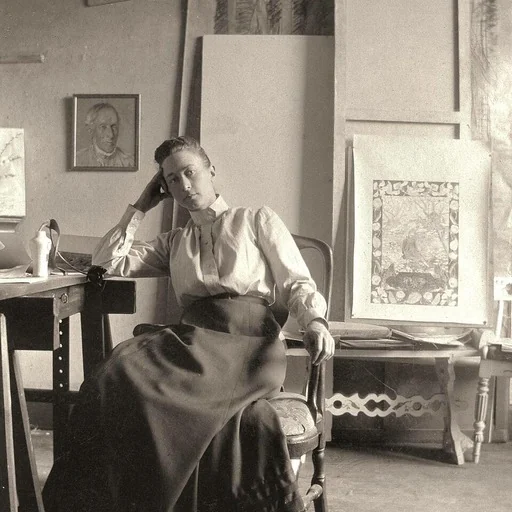
Swedish, 1862–1944
Hilma af Klint was a Swedish artist. 2 works are cataloged here, principally at Museum of Modern Art. Hilma af Klint was born in Solna.
Hilma af Klint (Swedish: ; 26 October 1862 – 21 October 1944) was a Swedish artist and mystic whose paintings are considered to be among the first major abstract works in Western art history. A considerable body of her work predates the first purely abstract compositions by Kandinsky, Malevich, and Mondrian. She belonged to a group called "The Five", a circle of women inspired by Theosophy who shared a belief in the importance of trying to contact the "High Masters", often through séances. Her paintings, which sometimes resemble diagrams, were a visual representation of complex spiritual ideas.
Overview
Hilma af Klint (Swedish: [ˈhɪ̂lːma ˈɑːv ˈklɪnːt]; 26 October 1862 – 21 October 1944) was a Swedish artist and mystic whose paintings are considered to be among the first major abstract works in Western art history. A considerable body of her work predates the first purely abstract compositions by Kandinsky, Malevich, and Mondrian. She belonged to a group called "The Five", a circle of women inspired by Theosophy who shared a belief in the importance of trying to contact the "High Masters", often through séances. Her paintings, which sometimes resemble diagrams, were a visual representation of complex spiritual ideas.
Early life
Hilma af Klint was the fourth child of Mathilda (née Sonntag) and Captain Victor af Klint, a Swedish naval commander. The family surname is 'af Klint', af being a Swedish nobiliary particle. She spent summers with her family at their manor, "Hanmora", on the island of Adelsö on Lake Mälaren. In these idyllic surroundings, she came into contact with nature at an early age. Her experience of natural forms became an inspiration in her work, and she later lived on Munsö, an island next to Adelsö. Af Klint showed a great interest in mathematics and botany and an ability in visual art. After the family moved to Stockholm, she studied at Tekniska skolan (Technical School, now Konstfack) in Stockholm, where she studied portraiture and landscape painting. Af Klint was admitted to the Royal Academy of Fine Arts at the age of twenty. Between 1882 and 1887, she studied portrait painting, botanical drawing, and landscape painting. She graduated with honors and was granted a scholarship in the form of a studio in the "Atelier Building" (Ateljébyggnaden) owned by the Academy of Fine Arts between Hamngatan and Kungsträdgården in central Stockholm, which was the main cultural hub in the Swedish capital at that time. The same building also held Blanch's Café and Blanch's Art Gallery, where conflict arose between the conventional views of the Academy of Fine Arts and the opposition movement of the Art Society (Konstnärsförbundet), inspired by the French plein air painters. Af Klint began working in Stockholm, gaining recognition for her landscapes, botanical drawings, and portraits. Her conventional painting was a source of income, but her abstract remained a separate practice.
Spiritual and philosophical ideas
In 1880, af Klint's younger sister Hermina died. Around this time, the spiritual dimension of her life had begun to develop. Af Klint's interest in abstraction and symbolism grew from her involvement in spiritism, which was very much in vogue at the end of the nineteenth and beginning of the twentieth century. Her experiments in spiritual investigation started in 1879. She became interested in the Theosophy of Madame Blavatsky and the philosophy of Christian Rosencreutz. In 1908, she met Rudolf Steiner, the founder of the Anthroposophical Society, who was visiting Stockholm. Steiner introduced her to his theories regarding the arts, and appears to have influenced her paintings later in life. Several years later, in 1920, she met Steiner again at the Goetheanum in Dornach, Switzerland, the headquarters of the Anthroposophical Society. Between 1921 and 1930, she spent long periods at the Goetheanum. Af Klint's work can be understood in the wider context of the modernist search for new forms in artistic, spiritual, political, and scientific systems at the beginning of the twentieth century. Other artists during this same period, including Wassily Kandinsky, Piet Mondrian, Kazimir Malevich, Fidus, and the French Les Nabis, were inspired by the Theosophical Society. The works of af Klint are mainly spiritual, and her artistic work is a consequence of this. She felt the abstract work and the meaning within were so groundbreaking that the world was not ready to see it, so she directed that the work remain unseen until twenty years after her death.
Work
At the Academy of Fine Arts she met Anna Cassel, the first of the four women with whom she later worked in "The Five" (De Fem), a group of artists who shared her ideas. The other members were Cornelia Cederberg, Sigrid Hedman, and Mathilda Nilsson. The Five began their association as members of the Edelweiss Society, which embraced a combination of the Theosophical teachings of Helena Blavatsky and spiritualism. All of The Five were interested in the paranormal and regularly organized spiritistic séances. They opened each meeting with a prayer, followed by a meditation, a Christian sermon, and a review and analysis of a text from the New Testament, followed by a séance. They recorded in a book a completely new system of mystical thought, in the form of messages from higher spirits called The High Masters ("Höga Mästare"). One Master, Gregor, announced, "All the knowledge that is not of the senses, not of the intellect, not of the heart but is the property that exclusively belongs to the deepest aspect of your being ... the knowledge of your spirit". Through her work with The Five, Hilma af Klint created experimental automatic drawing as early as 1896, leading her toward an inventive geometric visual language capable of conceptualizing invisible forces of the inner and outer worlds. She explored world religions, atoms, and the plant world, and wrote extensively about her discoveries. Af Klint created metaphors to express the messages she was receiving from the High Masters, the spirits who the artist believed used her as a conduit. As she became more familiar with this form of expression, af Klint was "assigned" by the High Masters to create the paintings for the "Temple", although she said that never understood what the "Temple" referred to. Af Klint said that she felt she was being directed by a force that would literally guide her hand. She wrote in her notebook:
The pictures were painted directly through me, without any preliminary drawings, and with great force. I had no idea what the paintings were supposed to depict; nevertheless I worked swiftly and surely, without changing a single brush stroke. In 1906, at the age of 44, af Klint painted her first series of abstract paintings.
The works for the Temple were created between 1906 and 1915, carried out in two phases, with an interruption between 1908 and 1912. Art critic Daniel Birnbaum argues that Anna Cassel likely contributed to af Klint's Temple paintings. As af Klint discovered her new form of visual expression, she developed a new artistic language. Her painting became more autonomous and more intentional. The spiritual would continue to be the main source of creativity throughout the rest of her life. The collection for the Temple comprises 196 paintings grouped within several sub-series. The major paintings, dated 1907, are large: each painting measures approximately 240 × 320 cm. This series, called The Ten Largest, describes the stages of life, from early childhood to old age. Quite apart from their diagrammatic purpose, the paintings have a freshness and a modern aesthetic of tentative line and hastily captured image, such as a segmented circle, a helix bisected and divided into a spectrum of lightly painted colors. The artistic world of af Klint is infused with symbols, letters, and words. The paintings often depict symmetrical dualities or reciprocities: up and down, in and out, earthly and esoteric, male and female, good and evil. The color choice throughout is meta
Signature style
Af Klint's later period abstract art (1906–1920) delved into symbolism employing a combination of geometry, figuration, scientific research, and religious practices. Her studies of organic growth, including shells and flowers, infused her portrayals life through a spiritual lens. Af Klint's individual or signature style was also marked with impressions from late 19th and early 20th century scientific discoveries as influenced by contemporary spiritual movements such as theosophy and anthroposophy. The notion of transcending the physical world and the constraints of representational art is visible in her abstract paintings. Britt Lundgren theorized that af Klint was influenced by the work of the scientist Thomas Young, whose writings were known to the Theosophists. Af Klint's symbolic visual language has an ordered progression that reflects her understanding of grids, circles, spirals and petal-like forms—sometimes diagrammatic, sometimes biomorphic. Her paintings also explore the dichotomies she saw in the world. Spiral forms appear often in her art, as they do in the automatic drawings by De Fem. While every geometric form suggests growth, progress, and evolution, her color choices were also intended to be metaphorical in nature. As one of the Proto-Feminist Artists, her style represents the sublime in art.
Personal life
Hilma af Klint never married, lived only with women, and prioritized deep friendships with them. She left no diary entries or letters that suggest romantic relationships. Modern speculation is that she was queer or lesbian, and that her paintings and views on androgyny and gender fluidity show queer sensibility. Af Klint's decision to keep her work secret for twenty years after her death has prompted comparisons with Emily Dickinson.
Legacy
In her will, Hilma af Klint left all her abstract paintings to her nephew, Vice Admiral Erik af Klint of the Royal Swedish Navy. She specified that her work should be kept secret for at least twenty years after her death. When the boxes were opened at the end of the 1960s, very few persons had knowledge of what would be revealed. In 1970, her paintings were offered as a gift to Moderna Museet i Stockholm, but the donation was declined. Erik af Klint then donated thousands of drawings and paintings to a foundation bearing the artist's name. Thanks to the art historian Åke Fant, her art was introduced to an international audience in the 1980s, when he presented her at a Nordik conference in Helsinki in 1984. The collection of abstract paintings of Hilma af Klint includes more than 1200 pieces, owned and managed by the Hilma af Klint Foundation in Stockholm, Sweden. In 2017, Norwegian architectural firm Snøhetta presented plans for an exhibition space dedicated to af Klint in Järna, south of Stockholm, with estimated building costs of €6 to 7.5 million. In February 2018, the Foundation signed a longterm agreement of cooperation with the Moderna Museet, where her works had been refused less than forty years earlier, thereby confirming the permanence of the Hilma af Klint Room as a space at the museum where a dozen works of the artist are shown on a continuous basis. Af Klint's work was included in the 2021 exhibition Women in Abstraction at the Centre Pompidou.
Cultural references
Hilma af Klint and her work are presented in the 2016 film Personal Shopper, in which the main character, played by Kristen Stewart, researches art inspired by spirits. The work of Hilma af Klint is cited by Jane Weaver as inspiration for Modern Kosmology (2017). Af Klint was the subject of a 2019 feature-length documentary by German director Halina Dyrschka, titled Beyond the Visible – Hilma af Klint . Hilma – an Opera about Hidden Art (2019) is a chamber opera composed by Swedish composer Benjamin Staern with libretto and direction by Mira Bartov that was performed at Moderna Museet, Stockholm and Solomon R. Guggenheim Museum in New York, where the opera deals with the complex relationship between Hilma and Rudolf Steiner. Af Klint's work is presented in the 2020 short film Point and Line to Plane, written and directed by Sofia Bohdanowicz. The short features the Solomon R. Guggenheim Museum's 2018 exhibition Hilma Af Klint: Paintings for the Future, which is seen in mid-installation. Af Klint's work can be seen in Episode 4, Season 1 (2021) of The Madame Blanc Mysteries. Hilma (2022) is an English-language Swedish biographical film directed by Lasse Hallström, and starring his wife Lena Olin and their daughter Tora Hallström as Hilma. Af Klint's work is presented in the 2024 Amazon Prime movie Upgraded, directed by Carlson Young. The main character, played by Camila Mendes, is an ignored but ambitious intern in the New York art world whose life and career take a turn when, by happenstance, she is upgraded to first class on a flight to London. Hilma, a 2024 opera by librettist Kate Scelsa and composer Robert M. Johanson and directed by Morgan Green that premiered in Philadelphia.
Exhibitions (posthumous)
"Hilma Af Klint: Paintings for the Future", the Solomon R. Guggenheim Museum's 2019 exhibition, had over 600,000 visitors, the most-visited exhibition in the museum's 60-year history. "Hilma af Klint: The Secret Paintings", City Gallery Wellington 2021 exhibition. "Hilma af Klint & Piet Mondrian: Forms of Life", Tate Modern, London. 2023. "Hilma af Klint and Wassily Kandinsky. Dreams of the Future." K20 Kunstsammlung Nordrhein-Westfalen, Düsseldorf, Germany. 2024. "Hilma af Klint: What Stands Behind the Flowers", Museum of Modern Art, New York City, 2025. "Hilma af Klint", Grand Palais, Paris, 2026.
Selected exhibitions
De geheime schilderijen van Hilma af Klint, Museum voor Moderne Kunst, Arnhem, Netherlands. 7 March 2010 – 30 May 2010 Hilma af Klint – a Pioneer of Abstraction was produced by and showed at Moderna Museet i Stockholm, Sweden, from 16 February until 26 May 2013, before touring to Hamburger Bahnhof – Museum für Gegenwart in Berlin, Germany, from 15 June to 6 October; Museo Picasso Málaga, Spain, from 21 October 2013 to 9 February 2014; Louisiana Museum of Modern Art, Humblebaek, Copenhaguen, Denmark 2014; Henie Onstad Kunstsenter, Oslo, Norway 2015; Kumu, Tallinn, Estonia 2015 Works by af Klint were exhibited at the Central Pavilion of the 55th Venice Biennale, Italy. 1 June – 24 November 2013.
Collections represented

Museum
Artists in a similar vein