Artist
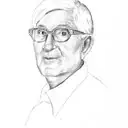
Victor Vasarely
French, 1906–1997
Victor Vasarely was a French artist. 10 works are cataloged here, principally at Museum of Modern Art. Victor Vasarely was born in Pécs.
Victor Vasarely (French: ; born Vásárhelyi Győző, Hungarian: ; 9 April 1906 – 15 March 1997) was a Hungarian-French artist, who is widely accepted as a "grandfather" and leader of the Op art movement. His work titled Zebra, created in 1937, is considered by some to be one of the earliest examples of Op art.
Overview
Victor Vasarely (French: [viktɔʁ vazaʁeli]; born Vásárhelyi Győző, Hungarian: [ˈvaːʃaːrhɛji ˈɟøːzøː]; 9 April 1906 – 15 March 1997) was a Hungarian-French artist, who is widely accepted as a "grandfather" and leader of the Op art movement. His work titled Zebra, created in 1937, is considered by some to be one of the earliest examples of Op art.
Life and work
Vasarely was born in Pécs and grew up in Piešťany (then Pöstény) and Budapest, where, in 1925, he took up medical studies at Eötvös Loránd University. In 1927, he abandoned medicine to learn traditional academic painting at the private Podolini-Volkmann Academy. In 1928/1929, he enrolled at Sándor Bortnyik's private art school called Műller (lit. "Workshop", in existence until 1938), then widely recognized as Budapest's center of Bauhaus studies. Cash-strapped, the műhely could not offer all that the Bauhaus offered. Instead, it concentrated on applied graphic art and typographical design. In 1929, he painted his Blue Study and Green Study. In 1930, he married his fellow student Claire Spinner (1908–1990). Together they had two sons, Andre and Jean-Pierre. Jean-Pierre was also an artist and used the professional name 'Yvaral'. He worked for a ball-bearing company in accounting and designing advertising posters in Budapest. Vasarely became a graphic designer and a poster artist during the 1930s combining patterns and organic images.
Vasarely left Hungary and settled in Paris in 1930. He worked as a graphic artist and as a creative consultant at the advertising agencies Havas, Draeger, and Devambez (1930–1935). His interactions with other artists during this time were limited. He thought of opening an institution modeled after Sándor Bortnyik's műhely and developed some teaching material for it. Having lived mostly in cheap hotels, he settled in 1942/1944 in Saint-Céré in the Lot département. After the Second World War, he opened an atelier in Arcueil, a suburb about 10 kilometers from the center of Paris (in the Val-de-Marne département of the Île-de-France). In 1961, he finally settled in Annet-sur-Marne (in the Seine-et-Marne département). Vasarely eventually went on to produce art and sculpture using optical illusion. Over the next three decades, Vasarely developed his style of geometric abstract art, working in various materials but using a minimal number of forms and colours:
1929–1944: Early graphics: Vasarely experimented with textural effects, perspective, shadow, and light. His early graphic period resulted in works such as Zebras (1937), Chess Board (1935), and Girl-power (1934). 1944–1947: Les Fausses Routes – On the wrong track: During this period, Vasarely experimented with cubistic, futuristic, expressionistic, symbolistic and surrealistic paintings without developing a unique style. Afterwards, he said he was on the wrong track. He exhibited his works in the gallery of Denise René (1946) and the gallery René Breteau (1947). Writing the introduction to the catalogue, Jacques Prévert placed Vasarely among the surrealists. Prévert creates the term imaginaries (images + noir, black) to describe the paintings. Self Portrait (1941) and The Blind Man (1946) are associated with this period. 1947–1951: Developing geometric abstract art (optical art): Finally, Vasarely found his own style. The overlapping developments are named after their geographical heritage. Denfert refers to the works influenced by the white tiled walls of the Paris Denfert – Rochereau metro station. Ellipsoid pebbles and shells found during a vacation in 1947 at the Breton coast at Belle Île inspired him to the Belles-Isles works. Since 1948, Vasarely usually spent his summer months in Gordes in Provence-Alpes-Côte d'Azur. There, the cubic houses led him to the composition of the group of works labelled Gordes/Cristal. He worked on the problem of empty and f
Legacy
The original UK cover for David Bowie's second album 'David Bowie' (1969) features Vasarely's work in the background. From 14 January - 23 April 2000, the Fundación Juan March, Madrid exhibited Vasarely, the first exhibition of his work exhibited in Spain. The exhibit included 47 paintings and drawings made between 1929 and 1988. The exhibit was also shown at the Centro Atlántico de Arte Moderno, Las Palmas de Gran Canaria (31 May - 16 July 2000) and Colegio Oficial de Arquitectos de Canarias, Santa Cruz de Tenerife (24 July - 9 September 2000). A new Vasarely exhibit was mounted in Paris at Musée en Herbe in 2012. In 2019, a temporary exhibition of Vasarely's work titled Le Partage des Formes was displayed in the Centre Georges Pompidou in Paris. Inaugurated in July 2024, a permanent exhibition of Vasarely's work in the Arkas Collection is being displayed in the Arkas Art Center in Alaçatı.
Awards
1964: Guggenheim Prize 1970: French Chevalier de L'Ordre de la Légion d'honneur Art Critics Prize, Brussels Gold Medal at the Milan Triennial
Museums
1970–1996: Vasarely Museum in the Saint-Firmin Palace in Gordes, Vaucluse, France (closed in 1996) 1976: Fondation Vasarely, Aix-en-Provence, France 1976: Vasarely Museum, Pécs, Hungary 1987: Vasarely Museum, Zichy Palace, Óbuda, Budapest, Hungary
Collections represented

Museum
Artists in a similar vein