Artwork
Studie af hyben og stedmoderblomst
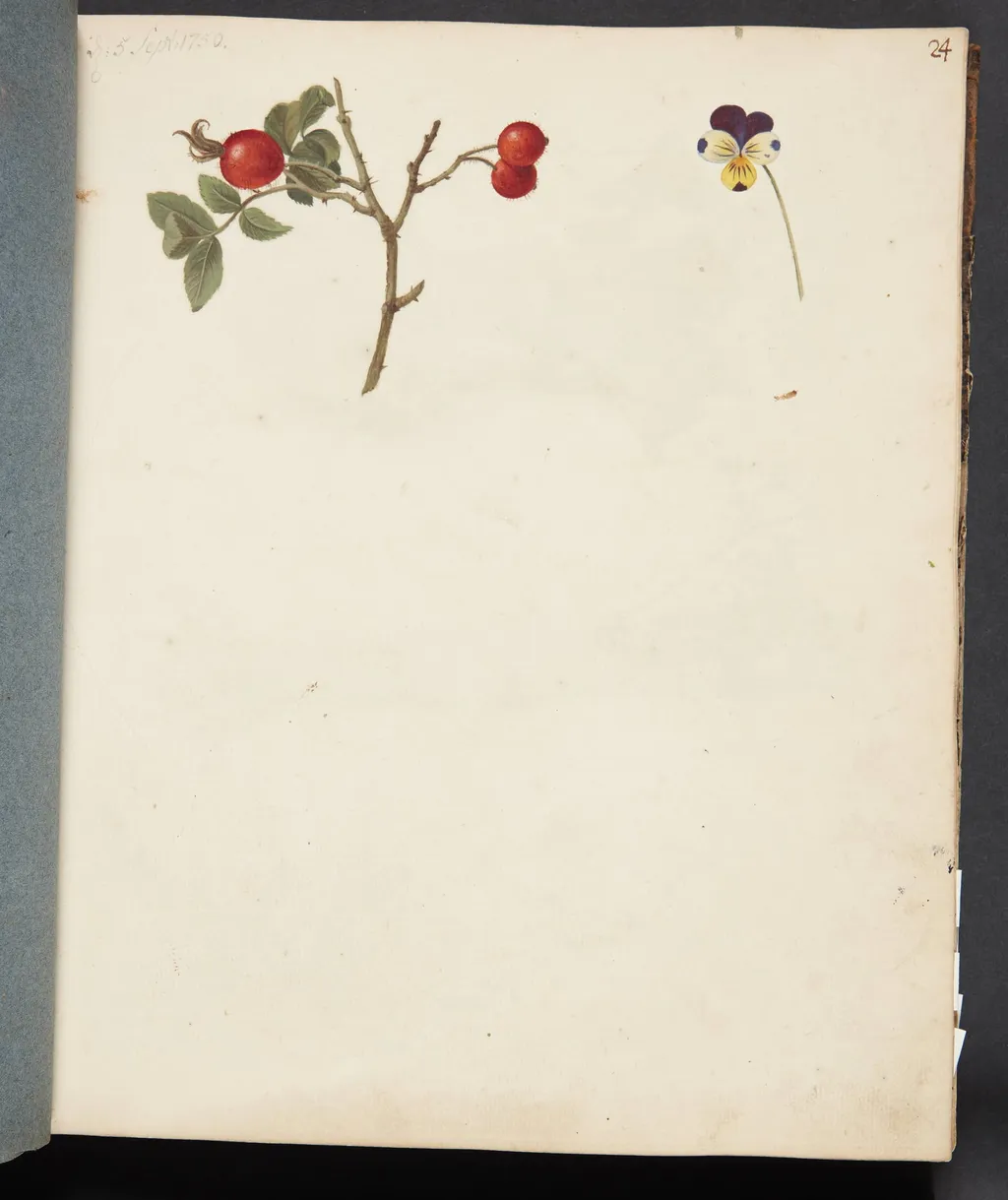
Studie af hyben og stedmoderblomst is an unspecified work on paper by the Rococo painting artist Unknown. It dates from 1750 and is held in the collection of the Statens Museum for Kunst.
About this work
Next, look up watercolor to see how artists use thin washes of paint to create soft, natural effects.
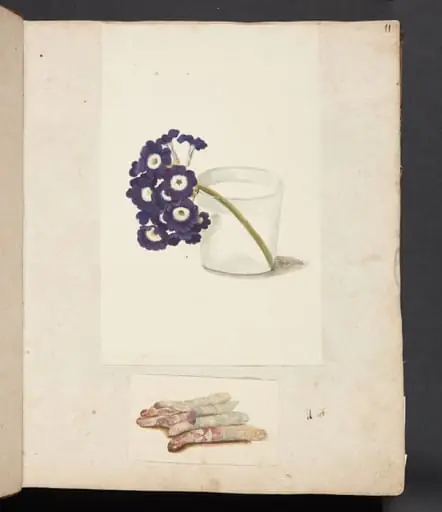
This page shows two simple watercolor drawings. On the left is a branch with green leaves and two bright red berries. To the right sits a single purple-and-yellow flower with dark spots.
The date "1750" is written in the corner, showing this was made over 270 years ago. The artist focused on small details like the tiny hairs on the leaves.
Next, look up watercolor to see how artists use thin washes of paint to create soft, natural effects.
Overview
‘Studie af hyben og stedmoderblomst’ is a pair of watercolor sketches executed in 1750 by the artist recorded as 1342_person. The drawings are part of the collection of the Museum of Ethnography and present a close observation of two plant specimens, rendered with a focus on fine botanical detail.
Subject & Meaning
The left image captures a branch of hyben, displaying green foliage and two vivid red berries, while the right image isolates a single flower of stedmoderblomst, characterized by its purple‑yellow petals marked with dark speckles. Both studies serve as visual records of the plants’ morphology, emphasizing the naturalist aim of documenting flora accurately.
Technique & Style
Executed in watercolor, the works employ thin, translucent washes that convey the delicate texture of leaves and petals. The artist’s attention to minute features—such as the fine hairs on the hyben leaves—demonstrates a meticulous approach typical of 18th‑century botanical illustration, where precision outweighs decorative flourish.
History & Provenance
Created in the mid‑18th century, the drawings have remained within institutional holdings, eventually entering the Museum of Ethnography’s collection. The date “1750” appears in the lower corner of each sheet, confirming their age of over 270 years and providing a clear chronological anchor for scholars.
Context
During the Enlightenment, European artists and scientists collaborated to produce detailed plant studies for classification and medicinal research. This pair aligns with that tradition, reflecting the period’s emphasis on empirical observation and the growing interest in cataloguing native species for both scientific and educational purposes.
Artist & collection

 Domestic Scene
 Giacomo and Cardinal Marco, investing Andrea, Abbot of San Zeno, with his Benefice
 The Nymph of Fontainebleau
 Portrait of a Woman
 Madonna and Child with Saints in the Enclosed Garden
 Venus and Minerva
 Family Group of Four on Sofa
 Wall painting from Room H of the Villa of P. Fannius Synistor at Boscoreale