Artwork
Studie af tulipan og andre blomster
Studie af tulipan og andre blomster is an unspecified work on paper by the Rococo painting artist Unknown. It dates from 1750 and is held in the collection of the Statens Museum for Kunst.
About this work
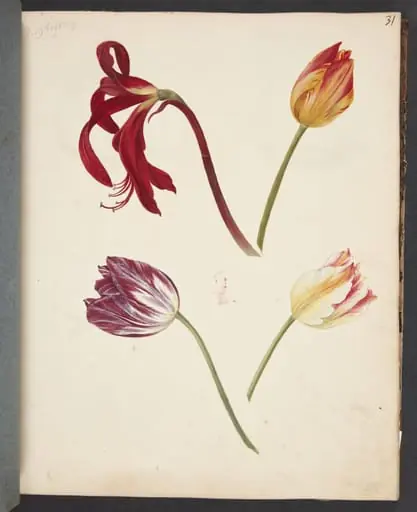
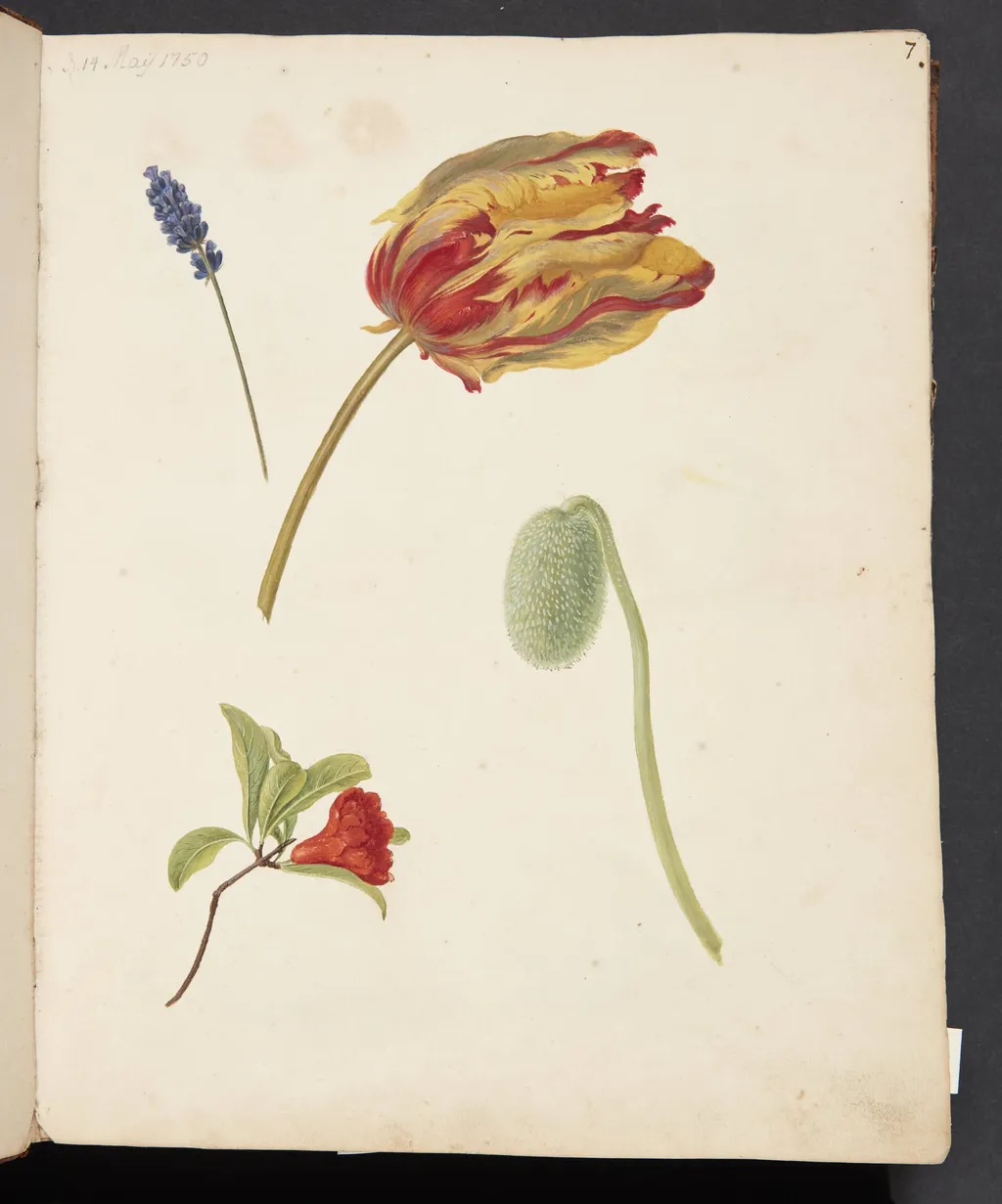
This page shows three painted flowers: a bright red tulip with yellow edges, a small purple bloom with a thin stem, and a green pod with spiky scales.
This page shows three painted flowers: a bright red tulip with yellow edges, a small purple bloom with a thin stem, and a green pod with spiky scales. Below them, a green leafy branch holds a single red bud. The colors are soft but clear, and the page looks old and slightly faded.
The tulip’s petals have a wavy, almost brushy texture, as if painted quickly. The date on the page—May 1750—suggests this was made a long time ago.
Next, check out how artists used watercolor to create delicate, natural-looking plants.
Overview
This watercolor study, dated May 1750, depicts four plant elements: a red tulip with yellow-tipped petals, a small purple flower, a spiky green pod, and a leafy branch bearing a single red bud. Executed on paper, the work is part of a botanical record kept by an anonymous artist. It resides in the Museum of Ethnography, where it is preserved as an example of 18th-century natural observation.
Subject & Meaning
The composition focuses on cultivated and wild plant forms, likely gathered for scientific or personal documentation. The tulip, prized in European horticulture, is rendered with attention to its distinctive shape and color gradation. The inclusion of a seed pod and unopened bud suggests an interest in plant life cycles, reflecting a broader Enlightenment-era curiosity in natural classification.
Technique & Style
The artist employed watercolor with loose, fluid brushwork, allowing pigments to blend subtly on the paper. Petals show soft edges and slight texture, indicating rapid, observational strokes rather than meticulous detail. Colors are muted by time but retain clarity, emphasizing tone over contrast. The lack of background or context directs focus entirely to the botanical specimens.
History & Provenance
The work bears a clear date—May 1750—indicating it was made during a period of growing interest in systematic botany. Its presence in the Museum of Ethnography suggests it was collected as part of a broader cultural or scientific archive, possibly linked to travel, trade, or colonial botanical exchange. Its origin remains undocumented beyond the date and medium.
Context
In mid-18th-century Europe, detailed plant studies were common among naturalists, collectors, and amateur scientists. Watercolor was favored for its portability and ability to capture subtle hues. This piece aligns with a tradition of private botanical journals, often compiled by individuals documenting flora encountered in gardens, markets, or expeditions.
Legacy
Though unsigned and unattributed, the study contributes to a larger body of pre-scientific botanical art that bridged aesthetic observation and empirical record. Its preservation in an ethnographic museum underscores its value as a material artifact of how people engaged with nature before modern taxonomy became standardized.
Artist & collection

 Domestic Scene
 Giacomo and Cardinal Marco, investing Andrea, Abbot of San Zeno, with his Benefice
 The Nymph of Fontainebleau
 Portrait of a Woman
 Madonna and Child with Saints in the Enclosed Garden
 Venus and Minerva
 Family Group of Four on Sofa
 Wall painting from Room H of the Villa of P. Fannius Synistor at Boscoreale