Artwork
Jerseykøer
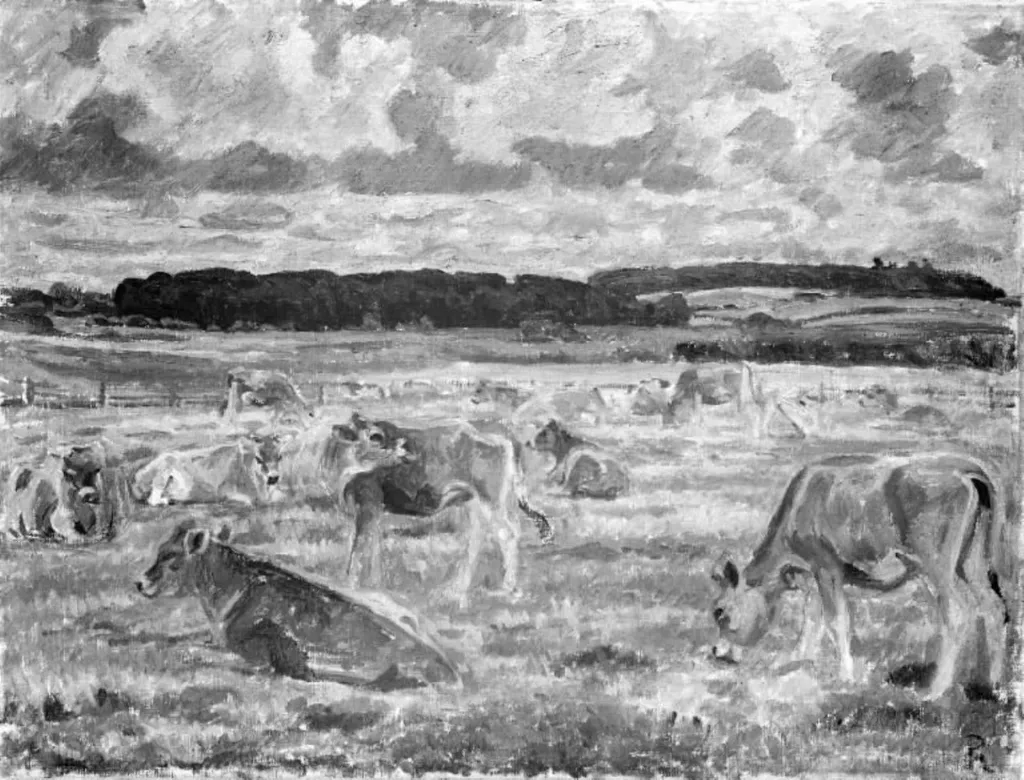
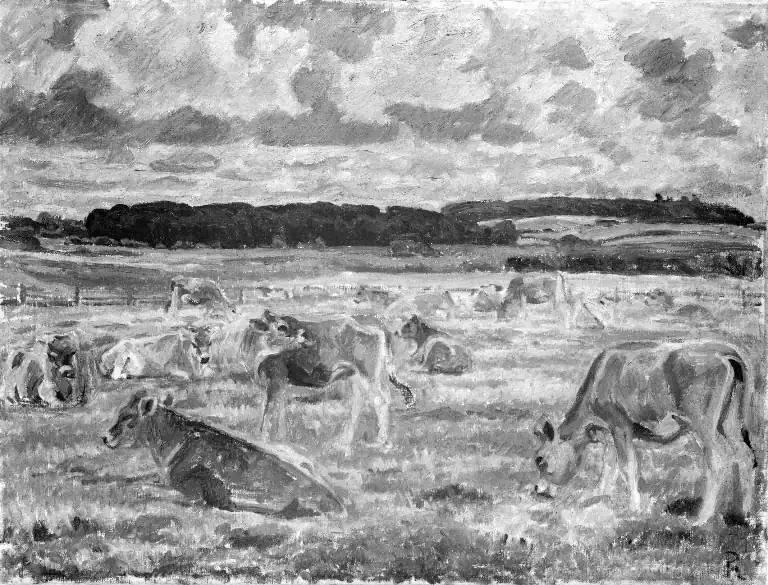
Jerseykøer is a photography by Unknown. It dates from 1917 and is held in the collection of the Statens Museum for Kunst.
About this work
Overview
The image is part of the collection at the Museum of Ethnography, where it serves as a document of rural life in early 20th-century Denmark.
Created in 1917 by an artist associated with the Danish photographic tradition, this black-and-white photograph captures a pastoral scene of Jersey cattle in an open field. The image is part of the collection at the Museum of Ethnography, where it serves as a document of rural life in early 20th-century Denmark. Its unidealized composition and textured grain reflect a documentary approach to the natural world.
Subject & Meaning
The photograph depicts a small herd of Jersey cows scattered across a quiet landscape, some standing, others resting. The absence of human figures emphasizes the animals’ autonomy within their environment. The overcast sky and muted tones suggest a moment of stillness, evoking the rhythms of agricultural life without sentimentality. The image conveys quiet endurance rather than pastoral idealism.
Technique & Style
The artist employed strong tonal contrasts to define the forms of the cattle and the rolling terrain, using chiaroscuro to model volume through light and shadow. The grainy texture of the photographic medium enhances the tactile quality of the scene, lending a sketchlike roughness to the animals’ hides and the earth. Compositionally, the cows are arranged organically, avoiding symmetry in favor of natural distribution.
History & Provenance
The photograph entered the collection of the Museum of Ethnography shortly after its creation, likely as part of a broader effort to record rural Danish life. Its preservation reflects early 20th-century interest in ethnographic documentation through visual media. No record of exhibition or private ownership prior to institutional acquisition is known, suggesting it was produced for documentary purposes rather than commercial display.
Context
Made during a period when photography was increasingly used to record everyday life, this image aligns with Scandinavian efforts to document regional agriculture before industrialization transformed rural landscapes. Unlike romanticized depictions of the countryside, it avoids embellishment, presenting the animals and terrain with observational neutrality, consistent with emerging documentary practices of the time.
Legacy
The photograph remains a quiet example of early ethnographic photography in Denmark, valued for its unembellished portrayal of rural animals and environment. It contributes to a visual archive of pre-industrial farming practices and demonstrates how photographic technique could convey realism without theatricality. Its continued presence in the Museum of Ethnography underscores its role as a historical record rather than an artistic statement.
Artist & collection

 Domestic Scene
 Giacomo and Cardinal Marco, investing Andrea, Abbot of San Zeno, with his Benefice
 The Nymph of Fontainebleau
 Portrait of a Woman
 Madonna and Child with Saints in the Enclosed Garden
 Venus and Minerva
 Family Group of Four on Sofa
 Wall painting from Room H of the Villa of P. Fannius Synistor at Boscoreale