Artwork
To unge piger i et lysthus
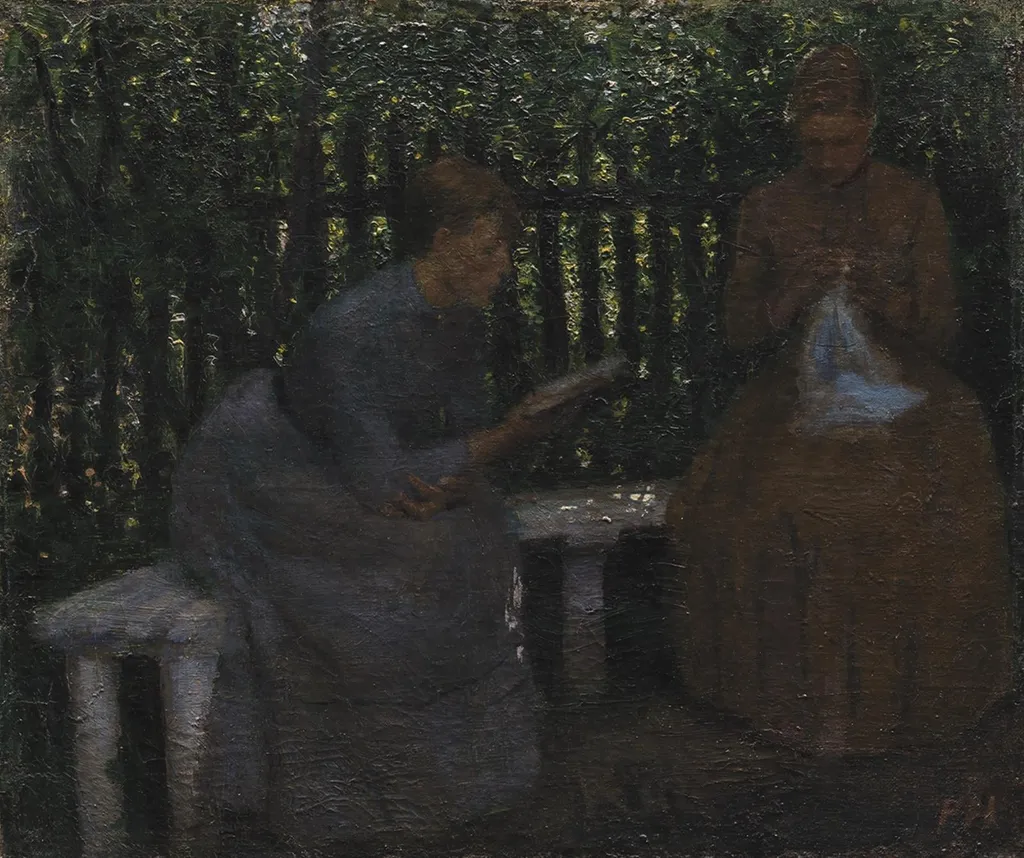
To unge piger i et lysthus is a photography by Unknown. It dates from 1884 and is held in the collection of the Statens Museum for Kunst.
About this work
Overview
Painted around 1884, To unge piger i et lysthus is a quiet interior scene by Danish artist P.S. Krøyer. It portrays two young girls in a garden pavilion, their stillness and proximity suggesting a moment of shared quiet. The work is part of the Museum of Ethnography’s collection, where it is contextualized within late 19th-century Nordic domestic imagery rather than ethnographic material.
Subject & Meaning
The painting captures two girls in a garden house, one seated, the other standing nearby, dressed in simple, long garments typical of the period. Their unposed posture and lack of overt interaction convey a sense of private, unremarkable intimacy. The scene resists narrative drama, instead emphasizing the calm rhythm of everyday childhood moments in a secluded outdoor space.
Technique & Style
Krøyer employs soft, diffused light to model the figures and foliage, creating a gentle luminosity that unifies the composition. Brushwork is loose yet deliberate, with muted greens and pale tones dominating the palette. The background dissolves into atmospheric foliage, focusing attention on the girls’ subtle presence and the quiet harmony between them.
History & Provenance
The painting was completed during Krøyer’s period of heightened focus on domestic and garden scenes, following his association with the Skagen artists’ colony. It entered the Museum of Ethnography’s holdings in the early 20th century, likely through donation or institutional acquisition, though its original commission or ownership remains undocumented.
Context
In late 19th-century Denmark, depictions of children in natural settings reflected broader cultural interests in innocence, domesticity, and the moral value of rural life. Krøyer’s approach aligns with Nordic realism, avoiding idealization in favor of observed quietude. The garden house, a common feature in bourgeois gardens, serves as a transitional space between interior and nature.
Legacy
While not among Krøyer’s most widely reproduced works, To unge piger i et lysthus exemplifies his sensitivity to light and quiet human presence. It contributes to a body of Nordic genre painting that values subtlety over spectacle, influencing later Scandinavian artists interested in everyday emotional textures rather than dramatic narratives.
Artist & collection

 Domestic Scene
 Giacomo and Cardinal Marco, investing Andrea, Abbot of San Zeno, with his Benefice
 The Nymph of Fontainebleau
 Portrait of a Woman
 Madonna and Child with Saints in the Enclosed Garden
 Venus and Minerva
 Family Group of Four on Sofa
 Wall painting from Room H of the Villa of P. Fannius Synistor at Boscoreale
 Seppeleitä sitovia tyttöjä, harjoitelma
 Evening in the Drawing Room. The Artist's Mother and Wife
 Evening in the Drawing Room. The Artist's Mother and Wife
 In the Woods at Giverny: Blanche Hoschedé at Her Easel with Suzanne Hoschedé Reading
 Out into the World
 Ranskalaisia silittäjiä
 Girl Reading
 Milliners
 Two Sisters in the Garden