Artwork
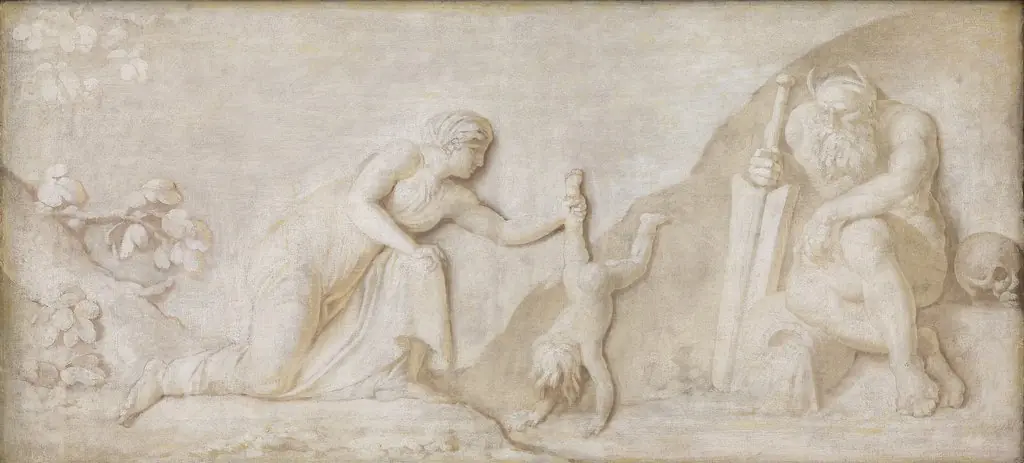
Thetis Immersing her Infant Son Achilles in the River Styx to Make him Invulnerable
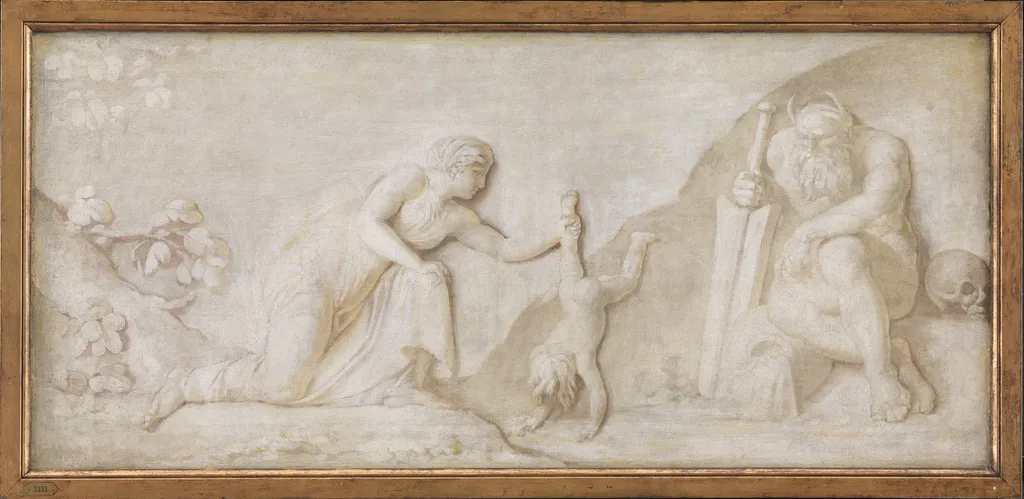
Thetis Immersing her Infant Son Achilles in the River Styx to Make him Invulnerable is a photography by Unknown. It dates from 1796 and is held in the collection of the Statens Museum for Kunst.
About this work
Overview
The scene is rendered with quiet solemnity, focusing on the physical intimacy of the act.
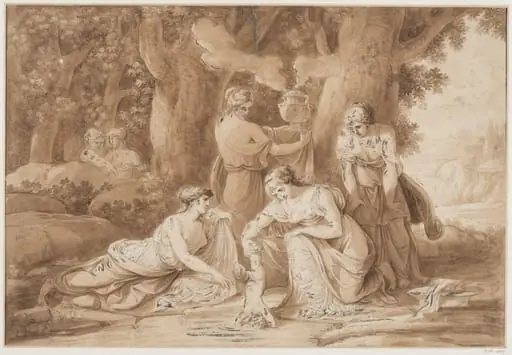
Painted around 1796, this work depicts a moment from Greek myth in which Thetis, a sea nymph, submerges her infant son Achilles in the River Styx to render him invulnerable. The scene is rendered with quiet solemnity, focusing on the physical intimacy of the act. The composition centers on the mother’s gesture, the child’s partial immersion, and the silent presence of an older male figure, likely Chiron, the centaur tutor. A dog and sparse vegetation ground the scene in a natural, unidealized setting.
Subject & Meaning
The image illustrates a pivotal mythological moment: Thetis’s attempt to secure Achilles’ immortality by dipping him in the sacred river. The legend holds that the heel she held remained untouched by the water, later becoming his fatal vulnerability. The painting captures not triumph but vulnerability—the tension between divine intervention and human fragility. The stillness of the figures and the muted environment underscore the gravity of the act, emphasizing fate over heroism.
Technique & Style
The artist employs soft chiaroscuro to model the figures against a dim, atmospheric background, enhancing the emotional weight of the scene. Light falls gently on Thetis’s arms and the child’s torso, drawing attention to the point of contact with the water. The older man’s form is partially shadowed, suggesting distance or detachment. Brushwork is restrained, avoiding dramatic flourish; the naturalism of the landscape and figures reflects a late 18th-century preference for quiet narrative over theatricality.
History & Provenance
The painting was created circa 1796 and entered the collection of the Museum of Ethnography, where it remains. Its attribution to the artist 241_person is documented in early 20th-century catalogues, though little is known of the artist’s broader oeuvre. The work’s presence in an ethnographic museum, rather than a fine arts institution, suggests its reception as a cultural artifact tied to mythic tradition rather than as a celebrated artistic achievement.
Context
Created during the waning years of Neoclassicism, the painting aligns with a broader European interest in classical mythology as a vehicle for moral and psychological exploration. Unlike grand historical paintings of the period, this work avoids spectacle, favoring intimacy and restraint. Its inclusion in an ethnographic collection may reflect contemporary efforts to frame myth as a universal human narrative, linking ancient stories to broader cultural practices.
Legacy
Though not widely exhibited or reproduced, the painting contributes to a quieter strand of mythological representation that prioritizes emotional nuance over heroic grandeur. Its preservation in an ethnographic context underscores a shift in how myth was understood—less as artistic inspiration, more as cultural expression. The work continues to invite reflection on the limits of protection, the inevitability of fate, and the quiet acts that shape destiny.
Artist & collection

 Domestic Scene
 Giacomo and Cardinal Marco, investing Andrea, Abbot of San Zeno, with his Benefice
 The Nymph of Fontainebleau
 Portrait of a Woman
 Madonna and Child with Saints in the Enclosed Garden
 Venus and Minerva
 Family Group of Four on Sofa
 Wall painting from Room H of the Villa of P. Fannius Synistor at Boscoreale